Antiviral Medications and CYP3A4/P-glycoprotein Interactions: What You Need to Know

When you're taking antiviral medications for HIV or hepatitis C, what you might not realize is that your body is running a silent chemical war inside your liver and intestines. Two key players in this battle are CYP3A4 and P-glycoprotein (P-gp). These aren't just abstract terms-they're biological gatekeepers that decide whether your meds work, overdose you, or do nothing at all. If you're on drugs like ritonavir, cobicistat, or any direct-acting antiviral (DAA), ignoring these interactions could mean the difference between staying healthy and ending up in the hospital.
How CYP3A4 and P-glycoprotein Control Your Meds
CYP3A4 is the most common enzyme in your liver and gut. It breaks down about half of all prescription drugs you take. P-glycoprotein, on the other hand, is like a bouncer at the door of your cells. It kicks out drugs before they can get absorbed or pushes them out after they've done their job. Together, they control how much of your medication actually reaches your bloodstream.
For example, if you take a drug that's metabolized by CYP3A4-like simvastatin for cholesterol-and you're also on a boosted antiviral like ritonavir, your body can't break down the statin fast enough. The result? Simvastatin levels can spike by more than 1,700%, leading to dangerous muscle damage. This isn't theoretical. The FDA has warnings built into the labels of these drugs for a reason.
P-gp works similarly. Most modern hepatitis C drugs like grazoprevir and paritaprevir are substrates of P-gp. That means they're designed to be moved around by this transporter. But if you add a P-gp inhibitor-like ritonavir or even grapefruit juice-you're essentially clogging the exit. The drug builds up in your system. A 2021 study showed that ritonavir can increase absorption of digoxin, a heart medication, by nearly threefold. That’s enough to cause serious heart rhythm problems.
Why Ritonavir Is the Poster Child for Drug Interactions
Ritonavir, first approved in 1996 as an HIV drug, became infamous not because it worked well against the virus-but because it wrecked havoc on other drugs. At 100 mg daily, it doesn’t just inhibit CYP3A4; it shuts it down. Studies show it can increase the concentration of other drugs by 300% to 500%. That’s why it’s used as a booster: you don’t take it to kill the virus. You take it to make other antivirals work better.
But here’s the twist: ritonavir doesn’t just inhibit. It also induces another enzyme, CYP1A2. That means while it makes some drugs stronger, it can make others weaker. Olanzapine, an antipsychotic, drops by 29% when taken with ritonavir. Alprazolam (Xanax), on the other hand, skyrockets by over 300%. This dual behavior makes predicting interactions incredibly tricky. A 2017 meta-analysis of 17 studies found that clinicians often misjudge these opposing effects, leading to under- or over-dosing.
And it gets worse. Ritonavir also inhibits P-gp at concentrations as low as 3.2 micromolar. That means it’s not just messing with liver enzymes-it’s sabotaging your gut’s ability to control drug absorption. This is why even over-the-counter supplements like St. John’s wort can be dangerous. St. John’s wort reduces ritonavir levels by 57%, which can lead to treatment failure. Grapefruit juice? It boosts ritonavir by 23%. One sip might not hurt-but daily consumption? That’s a recipe for toxicity.
Old vs. New: How Antiviral Regimens Have Changed
Early HIV treatments relied heavily on ritonavir boosting. Regimens like paritaprevir/ritonavir/ombitasvir/dasabuvir (used for hepatitis C) had interaction issues with over 40% of commonly used medications. Patients had to avoid statins, blood thinners, sedatives, and even some antibiotics.
Today, things are better-but not perfect. Newer regimens like glecaprevir/pibrentasvir have far fewer interactions. Only 17% of common drugs require dose changes, compared to 42% for the older ritonavir-based combos. Cobicistat, a newer booster, doesn’t induce CYP1A2, so it’s cleaner in that regard. But it has its own problems: it blocks the OCT2 transporter, which can raise creatinine levels and mimic kidney damage-even when kidneys are fine.
Then there’s sofosbuvir. It doesn’t rely on CYP3A4 at all. That’s a win. But it’s a substrate for P-gp. So if you’re taking a P-gp inhibitor like verapamil or quinidine, sofosbuvir levels can rise. The risk is lower than with ritonavir, but it’s still there.
Even newer drugs like lenacapavir, approved in 2022, are designed to bypass these systems entirely. They don’t touch CYP3A4 or P-gp. That’s the future: drugs that don’t play nice with your metabolism. But they’re expensive and not yet widely available. For now, most patients are still on regimens that interact.
Real-World Consequences: When Things Go Wrong
These aren’t just lab findings. Real people are getting hurt.
In 2021, a 68-year-old man on apixaban (a blood thinner) started darunavir/cobicistat for HIV. Within weeks, he had severe gastrointestinal bleeding. His anti-Xa level-used to measure blood thinning-was 384 ng/mL. The safe range? 50-250 ng/mL. He nearly died. The interaction wasn’t obvious because cobicistat doesn’t directly inhibit the enzyme that breaks down apixaban. But it blocks P-gp, which clears apixaban from the gut. Result? Toxic buildup.
Another case: a woman on warfarin, a blood thinner with a razor-thin safety margin, started a ritonavir-boosted regimen. Her INR (a measure of clotting time) shot up. She was hospitalized twice. Her doctors didn’t check for interactions until it was too late.
And it’s not just adults. A 2023 study in the Journal of Acquired Immune Deficiency Syndromes found that elderly patients on antivirals were 3.7 times more likely to have a dangerous interaction than younger ones-simply because they were taking more medications for heart disease, diabetes, and arthritis.

How to Stay Safe: The 30-Minute Rule
The good news? These interactions are predictable. And preventable.
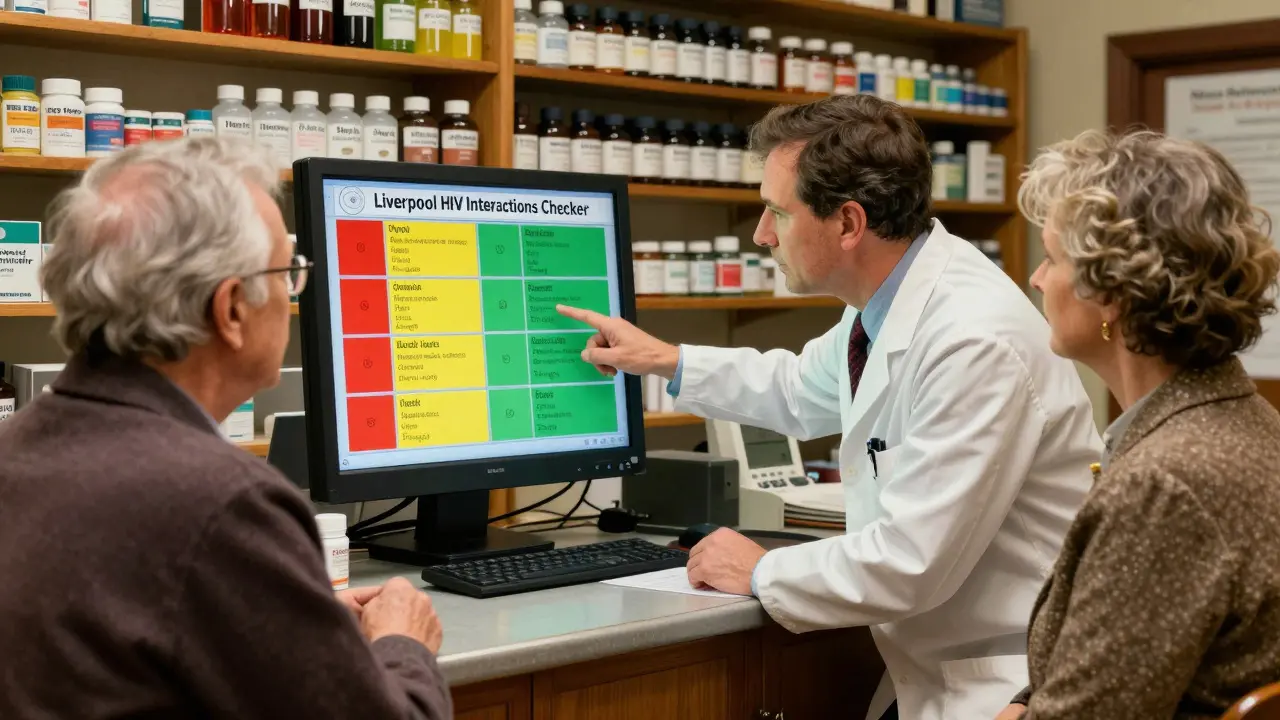
The University of Liverpool HIV Drug Interactions Group recommends a simple 30-minute screening process during your first visit. You need to list every medication you take-even vitamins, supplements, and herbal teas. Don’t forget the OTC stuff. A 2022 study found that 68% of patients didn’t mention St. John’s wort or grapefruit juice to their doctors.
Use the free Liverpool HIV Interactions Checker (downloaded over 1.2 million times). It gives color-coded warnings: red = dangerous, yellow = monitor, green = safe. In validation studies, it matched expert panel advice 98.7% of the time.
Pharmacists can help too. Ask them to run a drug interaction screen every time you get a new prescription. Many hospitals now integrate this into electronic records. Epic Systems added automated alerts for antivirals in 2021. One Mayo Clinic study showed a 31% drop in severe interactions after implementation.
If you’re on a boosted regimen, avoid these like the plague:
- Simvastatin, lovastatin (use pravastatin or rosuvastatin instead)
- Apixaban, rivaroxaban (use warfarin with close INR checks)
- Duloxetine (may not work if you’re on ritonavir)
- St. John’s wort (lowers antiviral levels)
- Grapefruit juice (raises antiviral levels)
- Cyclosporine, tacrolimus (can cause kidney or liver failure)
The Future: Personalized Antiviral Therapy
The next big shift isn’t just about better drugs-it’s about better matching. Pharmacogenomics is starting to play a role. For example, 85% of Caucasians carry a gene variant called CYP3A5*3/*3. That means their bodies break down tacrolimus slower. When you add ritonavir? Tacrolimus levels can spike 2.3-fold. That’s a recipe for kidney failure.
Future guidelines will likely include genetic testing before starting certain antivirals. Right now, it’s rare. But as more people live longer with HIV and hepatitis C, and as they pile on medications for aging-related conditions, this will become standard.
Dr. Melanie Thompson of the AIDS Research Consortium says it best: "As we approach universal treatment, the next frontier is managing the 4.7 average comorbidities per person with HIV. CYP and transporter interactions will determine treatment success more than viral factors."
Bottom line: You’re not just taking one drug. You’re taking a cocktail. And every pill you swallow has a conversation with every other pill in your body. Ignoring that conversation is dangerous. But understanding it? That’s how you stay alive.
Can I take grapefruit juice with my antiviral meds?
No. Grapefruit juice contains bergamottin, which inhibits CYP3A4 in your gut. This can cause antiviral drugs like ritonavir, cobicistat, or even some hepatitis C drugs to spike in your blood. Studies show it can increase ritonavir levels by 23%. That raises your risk of liver damage, dizziness, and heart rhythm problems. Stick to water or non-citrus juices.
Is St. John’s wort safe with HIV meds?
Absolutely not. St. John’s wort activates enzymes that break down antivirals. It can drop ritonavir levels by 57%, which means the virus can start replicating again. This has led to treatment failure and drug resistance in multiple cases. Even one dose can interfere. Avoid it completely if you’re on any boosted antiviral.
Do all antivirals have the same interaction risks?
No. Ritonavir-boosted regimens have the most interactions. Newer drugs like glecaprevir/pibrentasvir or sofosbuvir/velpatasvir have far fewer. Lenacapavir, a 2022 approval, doesn’t interact with CYP3A4 or P-gp at all. But even "low-risk" drugs can still affect P-gp or OATP transporters. Always check interactions-even if your doctor says it’s "safe."
What should I do if I’m on multiple medications?
List every medication, supplement, and herb you take. Bring that list to your pharmacist or HIV/hepatitis specialist. Ask them to run a drug interaction check using the Liverpool tool. If you’re on a boosted regimen, avoid statins, blood thinners, and sedatives unless specifically cleared. Never start or stop anything without checking first.
Can my doctor just switch me to a drug with fewer interactions?
Yes-if you’re having trouble managing interactions. Many patients on ritonavir-boosted regimens have successfully switched to cobicistat or non-boosted options like doravirine or lenacapavir. But switching isn’t always easy. Insurance, availability, and resistance history matter. Talk to your provider about alternatives. Don’t assume you’re stuck with the first regimen you were given.