Chronic Disease Self-Management: Practical Tools to Boost Daily Function

Living with a chronic condition often feels like carrying an invisible backpack full of rocks. You might wake up feeling stiff, worry about your blood sugar before lunch, or dread the phone call from your doctor because you forgot how many times you missed your inhaler last week. It is exhausting. But here is the truth: you do not have to just endure it. Chronic disease self-management is a set of evidence-based strategies and tools that empower individuals to take control of their physical, emotional, and social well-being despite long-term health conditions. It is not about curing the disease; it is about improving your daily function so you can actually live your life.
If you are reading this, you probably want to know what specific tools work, how to start without getting overwhelmed, and whether digital apps can replace human support. The short answer is that the best approach combines structured education, practical daily habits, and the right technology. Let’s look at exactly how these pieces fit together.
The Foundation: What Self-Management Actually Means
Many people think self-management means "do it yourself." That is a dangerous misconception. True self-management is about partnership. It was popularized in the 1990s by Dr. Kate Lorig at Stanford University through the Chronic Disease Self-Management Program (CDSMP), which remains the gold standard today. The core idea is simple: you are the expert on your own body, but you need skills to interpret those signals.
The program focuses on six key tasks:
- Problem solving: Figuring out why a flare-up happened and how to fix it.
- Decision making: Choosing treatments that fit your lifestyle, not just your diagnosis.
- Utilizing resources: Knowing when to call your doctor, when to see a specialist, and when to rest.
- Patient-provider partnerships: Communicating clearly during appointments.
- Action planning: Creating specific, small steps for change.
- Self-tailoring: Adjusting your routine based on how you feel each day.
These aren't abstract concepts. They are practical skills. For example, instead of just saying "I need to exercise," a self-management plan specifies "I will walk for 10 minutes after breakfast if my pain level is below 4." This specificity reduces anxiety and increases success rates.
Traditional Workshops vs. Digital Tools: Which Is Right for You?
You have two main paths to learn these skills: traditional in-person workshops or digital platforms. Both have pros and cons, and the best choice depends on your location, mobility, and learning style.
| Feature | In-Person CDSMP Workshop | Digital Platforms (e.g., Better Choices, ProACT) |
|---|---|---|
| Completion Rate | 72% | 58% |
| Social Support | High (peer-led groups) | Variable (discussion boards, AI chatbots) |
| Accessibility | Low (requires travel) | High (available anywhere with internet) |
| Personalization | Medium (group activities) | High (AI-driven insights, IoT integration) |
| Cost | Often free or low-cost via community centers | Varies (some free, some subscription-based) |
The in-person CDSMP workshop typically runs for six weeks, with 2.5-hour sessions led by trained peers who also have chronic conditions. This peer leadership is powerful. Hearing someone else say, "I struggled with this too," reduces isolation significantly. Studies show that rural participants value this social connection even more than urban dwellers, with 78% citing reduced feelings of loneliness as a key benefit.
However, if you live in a remote area or have limited mobility, traveling to a workshop every week is unrealistic. That is where digital tools shine. Programs like Better Choices, Better Health® allow you to log in 2-3 times a week for asynchronous lessons and discussion boards. While completion rates are slightly lower online, the reach is much broader. In rural areas, digital programs achieve 37% greater access than traditional models.
Essential Daily Tools for Improving Function
Knowledge is useless without application. Here are the concrete tools you should integrate into your daily routine to improve function immediately.
1. Action Planning Sheets
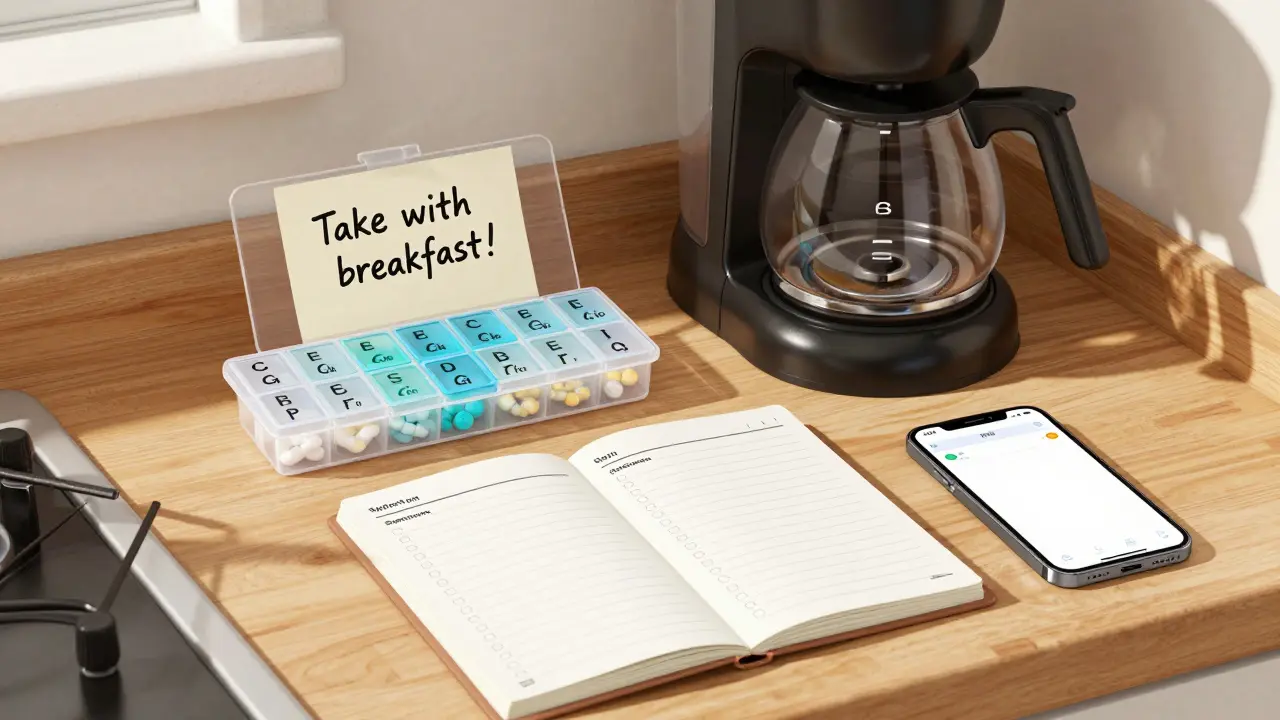
Forget vague goals. Use an action plan template. Write down one specific behavior you want to change, such as taking medication with dinner. Break it into tiny steps: "Place pill bottle next to coffee maker." Review this plan weekly. If you miss a day, don't quit-adjust the plan. Maybe the coffee maker is too far away. Move the bottle to the kitchen counter. Flexibility is key.
2. Symptom Tracking Logs
Memory is unreliable. Keep a simple log of your symptoms, energy levels, and triggers. You can use a notebook or an app. The goal is pattern recognition. Do you feel worse on days you skip lunch? Does stress spike your blood pressure? Data reveals truths that intuition misses. According to CDC guidelines, consistent tracking improves symptom management skills by an average of 23% compared to unstructured care.
3. Medication Management Systems
Medication errors are common and dangerous. Use a weekly pill organizer or a smartphone alarm. If you manage multiple conditions, consider a platform like ProACT, which integrates with clinician dashboards to alert providers if you miss doses. In one study, coaching sessions focused on medication management reduced errors by 31%. Simple consistency saves lives.
4. Energy Conservation Techniques
For conditions like arthritis or COPD, pacing is critical. Learn to prioritize tasks. Do the most important thing first when your energy is highest. Rest before you are exhausted, not after. This concept, often called "spoon theory" in patient communities, helps prevent crash-and-burn cycles that leave you bedridden for days.
Overcoming Common Barriers
Even the best tools fail if you cannot use them. Here are the biggest hurdles and how to clear them.
Health Literacy Gaps: About 41% of adults with chronic conditions struggle to understand basic health information. If medical jargon confuses you, ask your provider to explain it in plain language. Reputable programs like CDSMP provide materials written at a 6th-8th grade reading level. Never be afraid to say, "Can you show me how to do that?"
Time Commitment: Six-week programs sound daunting. Start small. Dedicate just 15 minutes a day to learning or planning. Consistency beats intensity. Many participants report initial overwhelm, especially when trying to track symptoms, adjust meds, and exercise simultaneously. The solution? Pick one area to focus on for the first two weeks. Master it, then add another layer.
Emotional Burnout: Chronic illness is lonely. Traditional programs address this through group support, but digital tools are catching up. Newer platforms like Mun Health offer AI-powered companions that provide emotional support and culturally specific advice. Early pilots showed 85% user satisfaction, filling a gap left by purely clinical approaches. Remember, mental health is part of physical health.

Getting Started: Your First Week Plan
Ready to take control? Follow this simple four-step launch plan.
- Assess Your Baseline: Write down your current daily routine. Note what works and what drains you. Identify one priority area (e.g., sleep, pain, diet).
- Choose One Tool: Download a symptom tracker or print an action plan sheet. Don't try everything at once.
- Set a Micro-Goal: Define a realistic target. Instead of "exercise more," try "walk to the mailbox and back twice a day."
- Find Support: Tell a friend or family member about your goal. Or join an online forum like r/ChronicIllness to share experiences. Accountability boosts adherence.
Expect a learning curve. The first few weeks may feel awkward. That is normal. Most users report inconsistent tracking in month one. Stick with it. By week four, these habits become automatic, freeing up mental energy for the things that truly matter to you.
Looking Ahead: The Future of Self-Management
The landscape is evolving rapidly. With 60% of U.S. adults living with at least one chronic condition, demand for effective tools is soaring. Medicare now covers services like Diabetes Self-Management Training (DSMT), serving over 1.2 million beneficiaries in 2022 alone. This insurance coverage removes financial barriers for millions.
Technology is also advancing. AI-assisted tools are predicted to grow at 24.7% annually through 2027. Imagine an app that analyzes your wearable data, predicts a flare-up before it happens, and suggests adjustments to your medication or activity level. We are moving toward personalized, proactive care rather than reactive treatment.
But remember: technology is a tool, not a replacement for human connection. The most successful patients combine digital efficiency with strong relationships with their care teams and support networks. Your health journey is unique. Use these tools to build a system that works for you, not against you.
What is the difference between self-care and self-management?
Self-care refers to basic daily activities like eating, sleeping, and hygiene. Self-management is a higher-level skill set involving problem-solving, decision-making, and adapting behaviors to handle the complex demands of a chronic condition. Self-management includes self-care but adds strategic planning and emotional regulation.
Is the CDSMP program covered by insurance?
Coverage varies by insurer and region. Many community health centers offer CDSMP workshops for free or at a low cost. Medicare covers specific self-management education services like DSMT, but general CDSMP workshops may not always be billed directly. Check with your local Area Agency on Aging or hospital system for subsidized options.
Can digital apps replace doctor visits?
No. Digital tools are supplements, not replacements. They help you monitor symptoms and adhere to plans between visits. However, only a licensed healthcare provider can diagnose new issues, adjust prescription medications, or perform necessary exams. Always consult your doctor before making significant changes to your treatment plan.
How long does it take to see results from self-management training?
Most participants notice improvements in confidence and symptom awareness within the first 4-6 weeks of starting a structured program. Long-term benefits, such as reduced hospitalizations and improved physical function, are typically sustained at 12-month follow-ups according to Stanford research. Consistency is key to lasting change.
What if I have multiple chronic conditions?
Multimorbidity is common and manageable. Programs like ProACT are specifically designed for older adults with multiple conditions. Focus on integrating tools rather than separating them. For example, a single symptom tracker can log both blood pressure and joint pain. Prioritize actions that benefit all conditions, such as balanced nutrition and gentle movement.
Mohit Patil
July 4, 2026 AT 00:24they dont want you to know the real cure because the pharma companies are watching every click you make on these so called health apps its all a surveillance state setup to control your data and sell it to the highest bidder while you sit there trusting their algorithms instead of listening to your own body which knows better than any machine ever could
Chandan Sharma
July 5, 2026 AT 01:37The dichotomy presented herein between the archaic methodologies of face-to-face communal learning and the nascent digital paradigms is rather pedestrian, yet one cannot deny the seductive allure of technological panaceas that promise omniscient oversight of one's corporeal functions; however, I must posit that the soul-crushing isolation inherent in modern existence is exacerbated by such reliance upon silicon-based intermediaries, thereby stripping the human experience of its essential vulnerability and shared burden, which is precisely what renders the traditional workshop model superior despite its logistical inconveniences.
Katie Dixon
July 5, 2026 AT 22:32Listen up folks because I am going to tell you something that nobody else wants to say out loud since they are too busy being politically correct about your little medical problems. You think you need an app? You think you need a doctor? No. You need to get off your ass and eat some real food like our ancestors did before the government started poisoning our water supply with fluoride and controlling our minds through 5G towers. I have been managing my own health for twenty years without stepping foot in a clinic and I feel stronger than any of you who are relying on these weakling digital crutches. Stop whining about your invisible backpacks and start lifting real weights. America was built on grit not on symptom trackers and therapy sessions. If you cant handle the pain then maybe you dont deserve to be here. But hey if you want to keep playing victim go ahead I just hope you enjoy your subscription fees while your immune system collapses from lack of real challenge.
Lorena Suarez
July 7, 2026 AT 10:46i mean honestly i just started using a simple notebook instead of an app and it feels way less stressful like why do we need ai to tell us how to breathe or whatever lol just take a deep breath and drink some water sometimes the simplest stuff works best and i love that this post mentions spoon theory because thats exactly how i feel every single day so thanks for getting it right mostly anyway
Isis Fleming
July 7, 2026 AT 15:39It is imperative to note that the efficacy of self-management protocols is contingent upon the individual's ability to maintain consistent adherence to the prescribed regimen, which often necessitates a structured approach to daily activities. Furthermore, the integration of digital tools should be viewed as a supplementary measure rather than a primary intervention, ensuring that the therapeutic alliance between patient and provider remains intact. One must consider the psychological impact of monitoring one's health metrics, as excessive focus on data can lead to anxiety and counterproductive behaviors. Therefore, a balanced perspective is required to optimize outcomes.
Fred Stone
July 8, 2026 AT 02:03hey man i tried that pill organizer thing and it actually helped me stop forgetting my meds at night which is crazy cause i used to lose them everywhere under the couch cushions and all that mess so yeah simple tricks work u dont need fancy tech just a box and some discipline probaly
Dawn Renee
July 8, 2026 AT 08:47I have noticed a disturbing trend in the way these so-called experts promote digital solutions without considering the underlying motives of the corporations behind them. It is highly probable that the data collected from these apps is being sold to third parties who use it to manipulate consumer behavior and influence political outcomes. We must remain vigilant against this encroachment on our privacy and autonomy. The idea that technology can replace human connection is not only false but dangerous. We are being conditioned to rely on machines for our emotional support which is a recipe for societal collapse. Wake up people before it is too late.
Anna Bartle
July 10, 2026 AT 05:00You absolutely CAN do this!!! Just pick ONE thing! Start small! Don't overwhelm yourself! Consistency is KEY! Keep going! You got this!!!
Chris Munton
July 10, 2026 AT 09:49The moral failing of society is evident in the way we treat those with chronic conditions as burdens rather than individuals deserving of dignity and respect. It is unacceptable that we allow systemic barriers to prevent access to basic healthcare resources. We must demand change and hold those in power accountable for their negligence. The statistics provided in this article are alarming and serve as a wake-up call for all of us to take action. We cannot stand idly by while our fellow citizens suffer due to lack of support and understanding. It is time to prioritize health equity and ensure that everyone has the opportunity to thrive regardless of their medical status.
Amrithaa Thayaparan
July 11, 2026 AT 10:35only the elite understand the true meaning of suffering and how it shapes character so if you think you can just track your symptoms and fix everything then you are deluding yourself because life is hard and you need to embrace the pain not run from it with your little apps and planners its weak mindedness to seek comfort in technology when you should be seeking strength in adversity
Ben Murphy
July 12, 2026 AT 08:02One must reflect upon the ethical implications of delegating personal health decisions to algorithmic systems that lack empathy and moral reasoning. The commodification of wellness through digital platforms raises serious concerns about the erosion of personal agency and the potential for exploitation by profit-driven entities. It is crucial to maintain a critical distance from such technologies and to prioritize authentic human connections in the pursuit of well-being. The path to healing is not found in data points but in the depths of our shared humanity.