Contact Allergy: Patch Testing for Metals and Fragrances
What Is Contact Allergy, and Why Does It Keep Coming Back?
You’ve tried every lotion, switched soaps, stopped wearing jewelry, and still, your skin breaks out in red, itchy patches. It’s not eczema. It’s not dryness. It’s not stress. For many people, the real culprit is something they touch every day-metals in their watchband, fragrance in their shampoo, or even the nickel in their jeans button. This isn’t just a rash. It’s allergic contact dermatitis, a delayed reaction triggered by your immune system reacting to specific chemicals in everyday products.
Unlike a food allergy that makes you swell up within minutes, this reaction takes time. It can show up two or three days after contact. That’s why most people never connect their rash to the perfume they’ve used for years or the earrings they’ve worn since high school. By the time the skin flares up, the trigger is long gone. That’s where patch testing comes in.
How Patch Testing Works-No Blood, No Needle
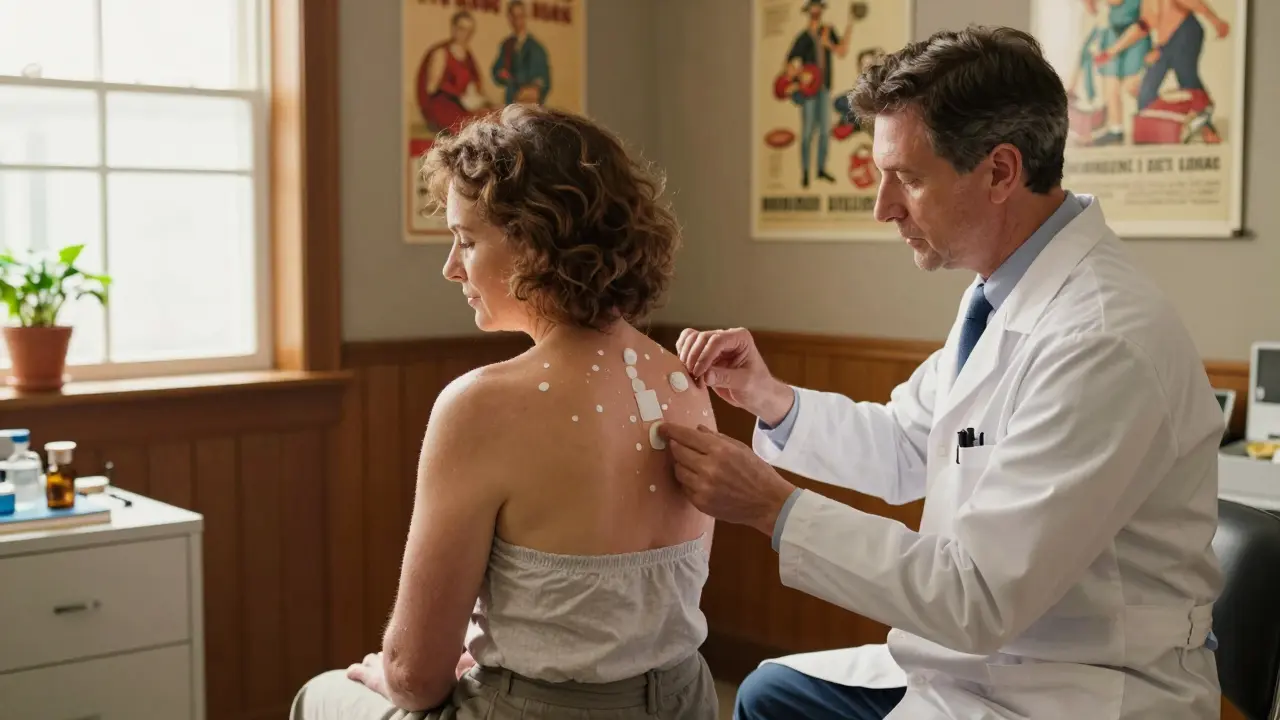
Patch testing is the only reliable way to find out what’s causing your skin to react. It’s not like a skin prick test or a blood test. There’s no poking or drawing blood. Instead, small amounts of common allergens are placed on patches and taped to your back. You wear them for 48 hours, then return to have them removed and your skin checked. A second check happens at 72 to 96 hours, because some reactions take longer to show up.
The patches contain tiny amounts of substances like nickel sulfate, cobalt chloride, and potassium dichromate-the metals most likely to cause reactions. Fragrance mixtures, including fragrance mix I and II, balsam of Peru, and cinnamic aldehyde, are also included. These aren’t random choices. They’re based on decades of data from thousands of patients across North America and Europe. The North American Contact Dermatitis Group updates their test panel every few years to include new allergens showing up in consumer products.
Why the back? Because it’s a large, flat surface that doesn’t move much. You’ll be told not to shower, sweat, or swim during the test. No scratching. No peeling off the patches. Even if your skin itches, you have to wait. Removing a patch early can ruin the whole test.
Why Fragrance Allergy Is Harder Than You Think
Fragrances are everywhere-soap, laundry detergent, shampoo, lotion, even "unscented" products. And they’re not one thing. There are over 3,000 different fragrance chemicals used in consumer goods. But patch testing doesn’t check them all. That’s why testing just the standard fragrance mixes isn’t enough.
Studies show that if you only test with fragrance mix I and II, you’ll miss 10 to 15% of people who are allergic. Why? Because some of the chemicals in those mixes are unstable and were removed years ago. New ones, like citral and farnesol, are now showing up more often in products. The 2023 update to the North American patch test series added eight new fragrance chemicals to catch these hidden triggers.
One patient, a nurse from Dunedin, kept getting rashes on her hands. She avoided scented products. She used "hypoallergenic" soaps. Nothing helped. After patch testing, she found out she was allergic to lyral-a fragrance chemical that had been removed from the standard mix in 2016 but was still in her hand cream. Once she stopped using it, her skin cleared up in two weeks.
Metals Are the Most Common Culprits
Nickel is the biggest offender. About 1 in 5 people tested for contact dermatitis turn out to be allergic to it. It’s in jewelry, belt buckles, zippers, keys, even some dental fillings and surgical tools. Cobalt and chromium are next. Chromium is often found in leather, cement, and some paints.
People often don’t realize they’re being exposed. A woman in her 40s thought her rash was from stress until she noticed it only appeared on her left wrist. She wore a cheap watch. The back of the watch contained nickel. She switched to a titanium watch, and the rash vanished. Another man had chronic foot eczema. He found out his work boots had nickel in the eyelets. He lined them with cloth, and the problem disappeared.
Testing for metals is straightforward. The concentrations used are standardized-5% nickel sulfate, 1% cobalt chloride, 0.5% potassium dichromate-based on decades of research to balance sensitivity and safety. Too high, and you get an irritant reaction. Too low, and you miss the allergy.
What Happens After the Test?
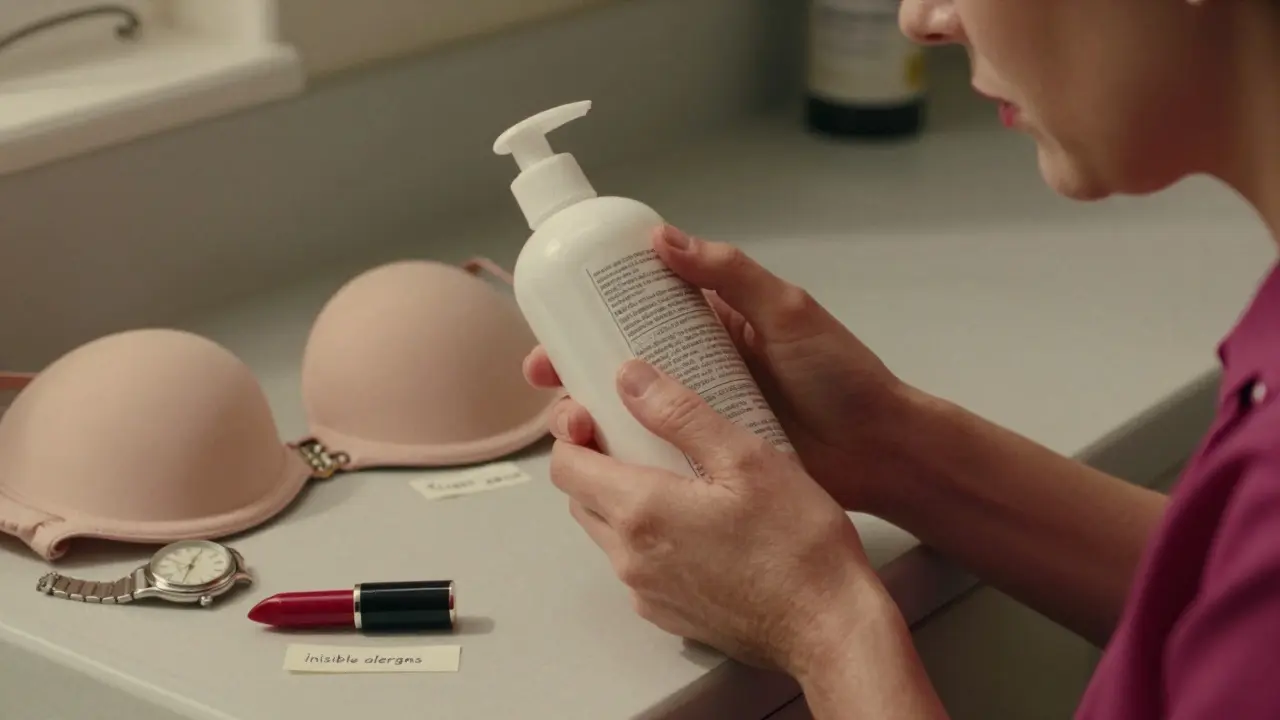
If your test comes back positive, you’ll get a list of the substances you’re allergic to-and what to avoid. It’s not just about buying "fragrance-free" products. You need to read ingredient labels. "Fragrance" on a label could mean any of 3,000 chemicals. Some products labeled "hypoallergenic" still contain hidden allergens.
For metals, you might need to switch to titanium or surgical-grade stainless steel jewelry. Avoid cheap jewelry altogether. Use plastic or coated zippers. If you work with cement or leather, wear gloves. For fragrances, avoid products that list any of the 26 allergens required to be labeled in the EU-even if they’re not required in your country. Look for products that list individual fragrance ingredients instead of just saying "fragrance."
Studies show that 60 to 80% of patients see their skin clear up completely once they avoid the allergens they’ve identified. But that only works if you know what to avoid. Without patch testing, most people guess wrong. One study found that patients who relied on memory or guesswork correctly identified their trigger only 30 to 40% of the time.
Why Other Tests Don’t Work
Some people ask if a blood test can detect contact allergies. The answer is no. Blood tests like lymphocyte transformation tests (LTT) are not standardized for fragrance allergies and have low sensitivity-only 60 to 70% accurate. Skin prick tests are for immediate allergies like pollen or peanuts. They don’t work for delayed reactions.
Photopatch testing is used only if you think your rash gets worse in the sun. That’s rare. Most people don’t need it. The only proven, reliable method for contact allergy is patch testing.
What to Expect During the Process
It’s not quick. It takes about a week. You’ll need three visits:
- Monday: Patches are applied. Takes 30 to 45 minutes.
- Wednesday: First reading. Patches are removed, skin is checked.
- Friday: Final reading. Skin is checked again for delayed reactions.
You’ll be given instructions: no showering for 48 hours, no sweating, no scratching. Wear loose cotton shirts. Avoid bending over too much. If a patch falls off, call your clinic immediately. Don’t try to reapply it yourself.
Side effects? Some people get mild irritation from the tape or the adhesive. That’s normal. A few get false positives-reactions that look allergic but aren’t. That’s why the test must be read by a dermatologist trained in patch testing. A nurse or general practitioner won’t have the experience to tell the difference.

Who Should Get Tested?
You should consider patch testing if:
- Your rash keeps coming back, even after using creams or steroids
- Your rash is on your hands, face, neck, or ears-common areas for contact exposure
- You’ve tried everything and nothing works
- You work with metals, leather, or chemicals
- You use a lot of skincare, perfume, or laundry products
It’s not for everyone. If you have active, weeping eczema, the test might not be safe. If you’re pregnant, talk to your doctor first. But if you’ve had a persistent rash for months or years, patch testing is worth it.
Real Stories, Real Results
On Reddit, someone wrote: "I had hand eczema for 7 years. I thought it was from washing dishes. I wore gloves. Nothing worked. Patch test showed I was allergic to balsam of Peru-in my lip balm. I stopped using it. My hands are clear. I wish I’d done this sooner."
A woman from Auckland wrote on a patient forum: "I was told I had chronic eczema. I spent $3,000 on treatments. Patch test showed nickel allergy. My bra clasp had nickel. I switched to a cotton bra with plastic hooks. Within 10 days, my back rash was gone."
These aren’t rare. They’re common. A 2023 survey found 87% of people who completed patch testing said it was "worth it," even with the inconvenience.
The Future of Patch Testing
Researchers are working on better ways to test. Some are developing peptide-based tests for metal allergies that might one day replace patches. Others are pushing for better labeling of fragrance chemicals on products. The EU already requires 26 fragrance allergens to be listed if they’re above a certain level. The U.S. is moving toward similar rules.
But for now, patch testing remains the gold standard. It’s not perfect. It’s not quick. But it’s the only way to know for sure what’s causing your skin to react. And if you’ve been suffering for years, that certainty is worth the wait.
What If the Test Is Negative?
If your patch test comes back negative, don’t assume it’s not an allergy. Sometimes, the allergen isn’t in the standard panel. That’s why some clinics offer extended testing with additional allergens-like those used in cosmetics, occupational exposures, or regional products.
Another possibility: you might have irritant contact dermatitis, not allergic. That’s caused by repeated exposure to harsh soaps, detergents, or solvents. It doesn’t involve the immune system, so patch testing won’t find it. But it still needs to be managed differently than allergic contact dermatitis.
Your dermatologist can help you figure out the next steps. Sometimes, a "use test"-applying the suspected product directly to your skin under supervision-can help confirm a trigger.
Mandy Vodak-Marotta
February 3, 2026 AT 05:53I used to think my hand rash was from dish soap-until I switched to a "hypoallergenic" brand and it got worse. Turns out, my "gentle" hand cream had lyral in it. I had no idea that was even a thing. Patch testing was the only thing that saved me. Now I read every ingredient like it’s a contract. And yeah, it’s annoying. But my skin hasn’t broken out in two years. Worth every minute.
Also, FYI-"unscented" doesn’t mean fragrance-free. It just means they masked the smell with another chemical. Mind blown.
Janice Williams
February 3, 2026 AT 07:52While I appreciate the clinical rigor of this piece, I must point out that the entire premise rests on a flawed assumption: that dermatological reactions are purely chemical in origin. The immune system is not a simple lock-and-key mechanism. Stress, microbiome dysbiosis, and even epigenetic factors play a far greater role than is acknowledged here. Patch testing, while useful, is a reductionist tool that ignores systemic context. One might argue it’s the medical equivalent of blaming a car’s engine for a flat tire.
Roshan Gudhe
February 3, 2026 AT 20:59There’s something deeply human in how we ignore the small things until they break us. Nickel in a watchband. Fragrance in a shampoo we’ve used since college. We don’t hate these things-we’ve lived with them. And then, one day, our skin screams. Maybe the real allergy isn’t to chemicals. Maybe it’s to the illusion that we’re in control.
Thank you for writing this. It’s not just about dermatology. It’s about listening-to our bodies, to science, to the quiet signals we’ve trained ourselves to mute.
Nathan King
February 5, 2026 AT 12:12The methodology described is indeed the gold standard, as corroborated by the North American Contact Dermatitis Group’s 2023 panel revisions. However, the article’s casual tone undermines its scientific credibility. The anecdotal narratives, while compelling, lack statistical context. For instance, the claim that 87% of patients found patch testing "worth it" is unsupported by citation. Furthermore, the conflation of irritant contact dermatitis with allergic contact dermatitis, though briefly mentioned, is insufficiently differentiated for a lay audience seeking definitive guidance.
Harriot Rockey
February 5, 2026 AT 23:26OMG I just realized my favorite lotion has balsam of Peru. 😱 I’ve had eczema on my neck for YEARS. I thought it was from my wool scarves. I’m going to throw it all out and get the patch test tomorrow. Thank you for this. I feel like I’ve been living in a fog and someone just turned on the lights. 🙌
Also, if anyone has a list of safe brands for fragrance-free stuff, DM me. I need help.
rahulkumar maurya
February 7, 2026 AT 03:52How quaint. A 2023 update? The real issue is that the entire diagnostic framework is antiquated. Patch testing was developed in the 1930s. We now have genomic profiling, metabolomic screening, AI-driven allergen prediction models. Yet we still tape paper squares to people’s backs like it’s 1952. This isn’t medicine-it’s ritual. And the medical establishment loves rituals because they’re profitable and unchallenging.
Samuel Bradway
February 8, 2026 AT 15:32I didn’t believe this would help me either. I tried everything-oatmeal baths, steroid creams, natural oils, even a 3-month elimination diet. Nothing. Then I got the patch test. Turns out, I was allergic to cobalt in my yoga mat. Yeah, my yoga mat. I didn’t even know it had metal in it. Now I use a cotton one. My skin’s been clear for 11 months. I just wanted to say… thank you. This post made me feel less alone.
Caleb Sutton
February 9, 2026 AT 07:07They’re lying. Patch testing is a scam. The patches contain trace amounts of the allergens they claim to test for-except they’re not real allergens. They’re placebo chemicals designed to make you think you’re getting answers. The real cause? 5G towers, glyphosate in your water, and the government’s secret agenda to make you buy expensive "hypoallergenic" products. Don’t fall for it.
pradnya paramita
February 9, 2026 AT 11:14It’s critical to note that the standard panel does not include newer sensitizers such as isoeugenol, hydroxycitronellal, or geraniol-common in modern perfumery. Extended panels (e.g., the TRUE Test with additional allergens) are necessary for patients with persistent, unexplained dermatitis despite negative standard results. Furthermore, the use of dimethylaminopropylamine (DMAPA) in cosmetics has shown rising prevalence in patch test-positive cases, particularly among women aged 25–40. Always request an extended panel if clinical suspicion remains high.
Jamillah Rodriguez
February 10, 2026 AT 00:43Ugh. I just read this whole thing and now I have to go throw out my entire bathroom? I’m not doing it. My skin’s fine. I’ll just keep using my lavender body wash. It smells nice. The rash? Whatever. I’m not a lab rat. 🤷♀️
Susheel Sharma
February 11, 2026 AT 06:16One must question the epistemological validity of relying on patch testing as the sole arbiter of allergic truth. The very act of taping chemicals to skin for 48 hours is an act of performative medicine-a theatrical spectacle designed to absolve the clinician of diagnostic uncertainty. The patient, meanwhile, becomes a passive vessel for institutional validation. The real tragedy? The system rewards compliance, not curiosity.
Rachel Kipps
February 11, 2026 AT 13:53i just got my patch test results last week. nickel and balsam of peru. i had no idea balsam was in lip balm. i’ve been using the same one for 10 years. i’m gonna buy new ones but… i think i forgot to write down the exact names of the chemicals. can someone tell me what to look for? thanks 😅
caroline hernandez
February 13, 2026 AT 09:17For anyone considering patch testing: if you have recurrent hand dermatitis, especially with involvement of the web spaces or fingertips, don’t skip the occupational allergen panel. Things like epoxy resins, acrylates, and formaldehyde-releasers are common in healthcare, beauty, and manufacturing jobs. I’ve seen patients with 5+ positive reactions-all missed by standard panels. Your dermatologist should offer an extended panel if your history suggests occupational exposure. Don’t settle for the basics.
Jhoantan Moreira
February 13, 2026 AT 22:11Thank you for this. I’ve been scared to get tested because I thought it’d be painful or invasive. Learning it’s just patches on the back made me feel way more comfortable. I’m booking my appointment this week. If anyone’s been through it and wants to share what the post-test care is like-hit me up. I’m nervous but hopeful. 🌱
Joseph Cooksey
February 15, 2026 AT 14:21Let’s be real-this isn’t about nickel or fragrance. It’s about capitalism’s ability to weaponize beauty and hygiene. We’ve been conditioned to believe that scent equals cleanliness, that jewelry equals status, that smooth skin equals worth. The allergens are just the byproduct. The real poison? The expectation that we must conform to these standards, even when our bodies scream in protest. Patch testing doesn’t solve the problem. It just lets you opt out quietly. And that’s the most subversive thing you can do.