Dofetilide and Cimetidine: Why This Drug Pair Can Trigger Deadly Heart Rhythms

Dofetilide Interaction Checker
Check Your Medication Safety
This tool checks if your medications are safe to take with dofetilide (Tikosyn) to prevent dangerous heart rhythms.
Please check your medications above to see if there's an interaction.
Imagine taking a medication to control your irregular heartbeat-something as simple as a pill for heartburn-and suddenly, your heart goes into a dangerous, potentially fatal rhythm. This isn’t a hypothetical. It’s a documented, preventable medical emergency that happens when dofetilide and cimetidine are taken together.
What Dofetilide Does-and Why It’s So Fragile
Dofetilide, sold under the brand name Tikosyn, is a powerful antiarrhythmic drug used to restore and maintain a normal heart rhythm in people with atrial fibrillation or atrial flutter. It works by blocking specific ion channels in heart cells, which helps reset the heart’s electrical timing. But here’s the catch: it has an extremely narrow safety window. Too little, and it doesn’t work. Too much, and it can trigger torsades de pointes-a chaotic, life-threatening heart rhythm that can lead to sudden cardiac arrest.
The drug is cleared almost entirely by the kidneys-about 80% of it leaves the body unchanged through renal excretion. That’s why doctors carefully adjust the dose based on kidney function. If your creatinine clearance drops below 20 mL/min, you shouldn’t take it at all. Even small changes in how much dofetilide stays in your bloodstream can push you over the edge into danger.
Cimetidine: The Quiet Killer in Your Medicine Cabinet
Cimetidine, sold as Tagamet, was once one of the most popular heartburn and ulcer medications. It blocks histamine receptors in the stomach to reduce acid. But unlike newer alternatives like famotidine (Pepcid) or proton pump inhibitors (omeprazole), cimetidine does something dangerous with dofetilide: it blocks the exact kidney transport system that removes dofetilide from your body.
This isn’t a mild interaction. Studies show cimetidine can increase dofetilide levels in your blood by 50% to 100% within just 24 hours. That’s not a small bump-it’s a doubling of exposure. And when dofetilide levels rise, so does the QT interval on your ECG. The QT interval measures how long your heart takes to recharge between beats. When it stretches too far, the risk of torsades de pointes skyrockets.
The Numbers Don’t Lie: How Deadly Is This Combo?
When you take dofetilide alone, about 3-5% of patients experience dangerous QT prolongation. Add cimetidine, and that number jumps to 12-18%. That’s more than a threefold increase in risk. According to the FDA-approved prescribing information, this interaction is so predictable and severe that it’s listed as a contraindication-meaning you should never take them together.
Real-world data confirms this. Between 2010 and 2022, the FDA’s adverse event database recorded 87 reports of QT prolongation and 23 cases of torsades de pointes directly tied to this combination. A 2020 case report described a 72-year-old man who developed torsades within 72 hours of starting cimetidine while on stable dofetilide. He needed emergency cardioversion and ICU care. Another patient, a 65-year-old woman, fainted after taking just one 300 mg dose of cimetidine for heartburn. She had polymorphic ventricular tachycardia-a precursor to sudden death.
Cardiologists at major hospitals report that 12-15% of unexpected torsades cases in dofetilide patients involve cimetidine use that was either missed or overlooked. That’s not rare. It’s a systemic failure.
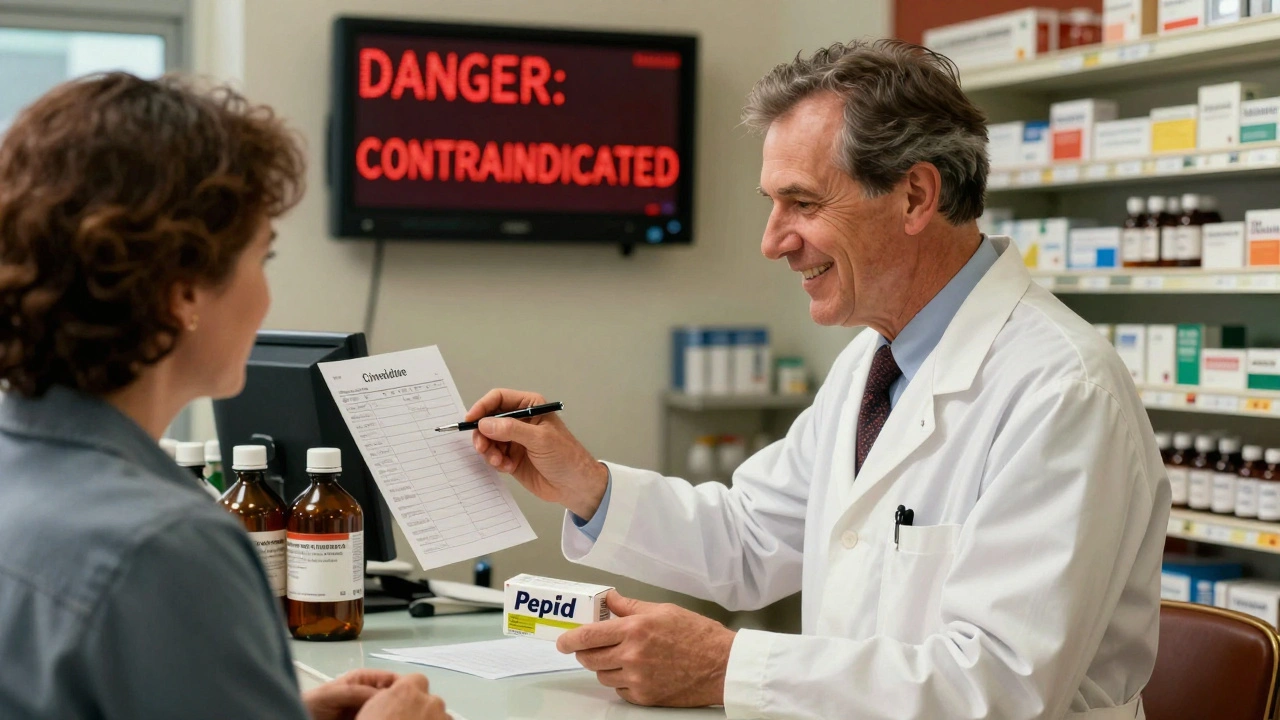
Why Famotidine Is Safe-And Cimetidine Isn’t
This is where things get critical. Not all acid-reducing drugs are the same. Famotidine (Pepcid), ranitidine (Zantac, now largely off the market), and proton pump inhibitors like omeprazole don’t interfere with the kidney’s cation transport system. They don’t raise dofetilide levels. So if you’re on dofetilide and need heartburn relief, famotidine is the clear, safe choice.
Studies show famotidine has no clinically meaningful interaction with dofetilide. In one FDA trial with 38 healthy volunteers, famotidine didn’t change dofetilide concentrations at all. In another trial with cimetidine, levels spiked by 40-50%. The difference isn’t subtle-it’s absolute.
What Happens If You’ve Already Taken Both?
If you’re on dofetilide and accidentally took cimetidine-even once-stop it immediately. Don’t wait. Call your doctor or go to the ER if you feel dizzy, faint, or notice your heart racing or skipping. A single dose can be enough to trigger arrhythmia.
Doctors are trained to check for this. Before starting dofetilide, they must confirm your QTc interval is under 440 ms (or 500 ms if you have bundle branch block). They also screen your entire medication list. If cimetidine is on it, they switch you to something else before even giving you the first dose of dofetilide.
And if you need cimetidine for a short-term emergency-say, acute GI bleeding-you must stop dofetilide for at least 10 days. That’s five half-lives of the drug. You can’t just wait a day or two. The risk doesn’t disappear quickly.
How Hospitals Are Stopping This Before It Happens
Thankfully, this interaction is now one of the most tightly controlled in cardiology. Most electronic health record systems-like Epic and Cerner-have built-in alerts that block doctors from prescribing cimetidine to patients already on dofetilide. If a clinician tries to override it, they’re forced to consult a cardiologist and document why.
Since 2015, the rate of accidental co-prescribing has dropped from 8.7% to just 1.2%. That’s thanks to automated alerts, pharmacist reviews, and mandatory education. Hospitals that achieve over 95% compliance with these safety protocols even get financial bonuses from quality improvement programs.
Even AI is stepping in. New algorithms can now predict potential dofetilide-cimetidine interactions with 94.7% accuracy-72 hours before they happen. That means your doctor might get a warning before you even pick up the cimetidine prescription.

Who’s Most at Risk?
Older adults are especially vulnerable. The American Geriatrics Society lists this combination as one of the most inappropriate drug pairs for seniors. Why? Because kidney function declines with age, making it harder to clear dofetilide even without cimetidine. Many older patients also take multiple medications-on average, 6.8 prescriptions-for conditions like high blood pressure, diabetes, or arthritis. The more drugs you take, the higher the chance of a hidden interaction.
And here’s another hidden danger: low potassium. If your potassium level drops below 3.6 mmol/L, your risk of torsades spikes even more. That’s why doctors monitor electrolytes closely in patients on dofetilide. Keeping potassium between 4.0 and 5.0 mmol/L isn’t optional-it’s essential.
The Bigger Picture: Why This Matters Beyond One Drug Pair
The dofetilide-cimetidine interaction isn’t just about two pills. It’s a textbook example of how drug metabolism works-and how easily it can go wrong. Many medications are cleared by the same kidney transporters. When one drug blocks that pathway, others pile up. Verapamil, trimethoprim, and ketoconazole do the same thing. That’s why doctors don’t just look at cimetidine-they check your full list.
It’s also a reminder that older drugs aren’t always safe just because they’ve been around for decades. Cimetidine was approved in 1977. Dofetilide in 1999. But the interaction wasn’t fully understood until after both were widely used. That’s why modern drug safety relies on real-world data, not just lab studies.
Even though cimetidine prescriptions have dropped from 28 million a year in the 1990s to about 1.2 million today, it’s still out there-in nursing homes, in over-the-counter packs, in patients who’ve been taking it for 20 years without realizing the danger.
What You Should Do Right Now
- If you’re taking dofetilide, check your medicine cabinet. Is there any Tagamet? Stop it. Call your doctor before switching to anything else.
- Ask your pharmacist to review all your medications-prescription and OTC-for interactions with dofetilide.
- Never take cimetidine for heartburn, ulcers, or acid reflux if you’re on dofetilide. Use famotidine or omeprazole instead.
- If you feel lightheaded, your heart races, or you faint, seek emergency help immediately. Don’t wait.
- Make sure your doctor checks your QTc interval before starting dofetilide-and again if you start any new medication.
This interaction is preventable. It’s not a mystery. It’s not rare. It’s a known, deadly trap-and it’s still being sprung because people don’t know about it. You can’t afford to be one of them.
Can I take cimetidine if I’m on dofetilide, even for just a few days?
No. Even a single dose of cimetidine can raise dofetilide levels enough to trigger torsades de pointes. This interaction happens quickly-within 24 hours. There is no safe short-term use. If you need acid suppression, switch to famotidine or a proton pump inhibitor like omeprazole.
Is famotidine safe to take with dofetilide?
Yes. Unlike cimetidine, famotidine does not inhibit the kidney transport system that clears dofetilide. Clinical studies show no significant change in dofetilide levels when taken with famotidine. It’s the preferred alternative for patients on dofetilide who need heartburn relief.
What should I do if I accidentally took cimetidine while on dofetilide?
Stop taking cimetidine immediately. Contact your doctor or go to the nearest emergency room. You may need an ECG to check your QT interval and possibly blood tests to monitor electrolytes. Do not wait for symptoms. Life-threatening arrhythmias can develop without warning.
Why don’t all doctors know about this interaction?
Most do-but not all. This interaction is well-documented in guidelines from the American Heart Association, the FDA, and the European Heart Rhythm Association. However, in busy clinics or with older patients on many medications, the risk can be missed. That’s why electronic alerts and pharmacist reviews are now standard in most hospitals. Always double-check your own meds.
Are there other drugs besides cimetidine that interact with dofetilide?
Yes. Verapamil, trimethoprim (in Bactrim), and ketoconazole also block the same kidney transport system and can raise dofetilide levels. Any new medication-prescription or over-the-counter-should be reviewed by your doctor before starting if you’re on dofetilide. Even some herbal supplements can interfere.
How can I make sure my pharmacist catches this interaction?
Always tell your pharmacist you’re on dofetilide when filling any new prescription-even for something as simple as an antacid or antibiotic. Ask them to run a drug interaction check. Most pharmacies have systems that flag this automatically, but human review is still essential. If they say it’s fine, ask them to double-check specifically for cimetidine, trimethoprim, or verapamil.
Kyle Flores
December 7, 2025 AT 14:05Man, I had no idea cimetidine could do this. My grandpa’s been taking Tagamet for years for his heartburn. I’m gonna call him right now and make him stop. This is scary stuff.
Helen Maples
December 9, 2025 AT 12:47This post is clinically accurate and urgently necessary. The FDA contraindication exists for a reason. Cimetidine is not a benign OTC drug in the context of dofetilide therapy. Pharmacies must implement mandatory counseling for patients on antiarrhythmics. No exceptions.
Ashley Farmer
December 9, 2025 AT 21:56I work in a nursing home and we’ve had two near-misses with this combo. One resident was on dofetilide and got Tagamet from her daughter’s medicine cabinet. We caught it before she took it, but it was too close. This needs to be on every discharge sheet, every med list, every pharmacy label. We’re saving lives here.
Jennifer Anderson
December 10, 2025 AT 12:35omg i just checked my meds and i have tagamet in my drawer… i’ve been on dofetilide for 3 years. i’m so glad i saw this. going to call my dr right now. thanks for posting!!
Sadie Nastor
December 12, 2025 AT 05:56Thank you for sharing this 💙 I used to take cimetidine for acid reflux and didn’t even know it could be dangerous. Now I use omeprazole and feel so much safer. Knowledge is power!
Nicholas Heer
December 13, 2025 AT 06:19Big Pharma doesn’t want you to know this. Cimetidine is cheap. Dofetilide? Expensive. They let this combo fly for decades so you’d keep buying the brand-name drug. Now they slap a warning on it and call it progress. Wake up. The system is rigged.
Sangram Lavte
December 13, 2025 AT 10:05Interesting. In India, we rarely see dofetilide prescribed anymore. Most patients get amiodarone or sotalol. But cimetidine is still common. This is a good reminder for doctors here too. Even if the drug isn't common, the interaction matters.
Oliver Damon
December 14, 2025 AT 00:56What’s fascinating is the pharmacokinetic precision here. Dofetilide is eliminated almost exclusively via renal cation transporters - specifically OCT2 and MATE1. Cimetidine inhibits both with high affinity, while famotidine has negligible binding. This isn’t just an interaction - it’s a molecular lock-and-key failure. The fact that AI can now predict this 72 hours out shows how far clinical pharmacology has come. Still, human vigilance remains irreplaceable.
Stacy here
December 15, 2025 AT 00:35They say it’s preventable - but how many people died before they figured it out? How many elderly patients were quietly dropped into the grave because someone didn’t check their meds? This isn’t a medical error. It’s a systemic massacre wrapped in white coats and EHR alerts. And now they’re giving hospitals bonuses for not killing people? That’s not progress - that’s guilt money.
Ryan Sullivan
December 16, 2025 AT 03:36Typical. Another post that reads like a medical textbook. No original thought. Just regurgitated FDA warnings. If you’re so concerned, why aren’t you lobbying for better drug labeling? Or writing a letter to Congress? Or are you just here to feel superior?
Wesley Phillips
December 17, 2025 AT 17:27So like… if I take one pill of Tagamet for a bad stomach ache and I’m on dofetilide, am I basically signing my death warrant? 😅 I mean… I get it’s bad but like… one time? Come on.
Jane Quitain
December 18, 2025 AT 11:03OMG I JUST TOOK TAGAMET YESTERDAY!! I’M PANICKING!! I’M ON DOFETILIDE!! HELP!!