Elderly Renal Impairment: How to Adjust Medication Dosing to Prevent Toxicity

Renal Dosing Calculator for Elderly Patients
Calculate Kidney Function
This calculator estimates creatinine clearance (CrCl) using the Cockcroft-Gault equation, which helps determine safe medication dosing for elderly patients with kidney impairment.
Results
Estimated Creatinine Clearance
-
mL/min
Dose Recommendation
When the kidneys slow down with age, even normal doses of common medications can become dangerous. This isn’t speculation-it’s a daily reality in hospitals and nursing homes. About 38% of adults over 65 have kidney function low enough to change how drugs are processed in their bodies. Yet, many prescribers still use the same dosing rules they’d use for a 30-year-old. The result? Higher rates of falls, confusion, hospital stays, and even death.
Why Kidney Function Matters More in Older Adults
The kidneys don’t just filter waste. They clear out most medications from the bloodstream. When kidney function drops, those drugs build up. For healthy adults, that’s rarely a problem. But in older adults, even small increases in drug levels can trigger serious side effects. A study in the Journal of General Internal Medicine found that nearly half of all adverse drug events in elderly patients are caused by improper dosing due to kidney problems.It’s not just about age. Many older adults have other conditions-diabetes, high blood pressure, heart failure-that damage the kidneys over time. The body also changes with age: muscle mass declines, which affects how creatinine (a marker used to measure kidney function) is produced. That means standard lab tests can be misleading.
How Doctors Measure Kidney Function
Doctors don’t measure kidney function directly. They estimate it using blood tests and formulas. Two main equations are used:- Cockcroft-Gault (CG): Calculates creatinine clearance (CrCl) using age, weight, sex, and serum creatinine. Formula: [(140 - age) × weight (kg)] / (72 × serum creatinine) × 0.85 (for women).
- MDRD: Estimates glomerular filtration rate (eGFR) using serum creatinine, age, sex, and race.
Here’s the catch: Cockcroft-Gault tends to underestimate kidney function in older adults by 15-20%. That means if the CG equation says CrCl is 40 mL/min, the real value might be closer to 50 mL/min. If doctors rely only on this number, they might reduce the dose too much-leaving the patient under-treated.
For patients with eGFR between 25 and 59 mL/min/1.73 m², experts recommend using Cockcroft-Gault as the starting point. MDRD can be used to double-check, especially if the result is near a dosing threshold like 30 mL/min. For people with better kidney function (above 60 mL/min), newer equations using cystatin C (a different blood marker) are more accurate and are now being adopted in updated guidelines.
Medications That Require Special Attention
Not all drugs are equal when kidney function drops. Some are safe. Others are risky. Here are key examples:- Metformin: Used for diabetes, it’s cleared almost entirely by the kidneys. The American Diabetes Association says to avoid it if serum creatinine is above 1.5 mg/dL in men or 1.4 mg/dL in women. But European guidelines are more flexible, allowing use with careful monitoring.
- Gabapentin: Used for nerve pain and seizures. Up to 90% is removed by the kidneys. Dose must be reduced as CrCl drops: 300 mg daily if CrCl is below 30 mL/min (vs. 900-1,800 mg daily in healthy adults). Yet, studies show over 60% of prescribers still give full doses.
- Allopurinol: For gout. In severe kidney impairment (CrCl <10 mL/min), start with 100 mg every other day instead of daily to avoid life-threatening skin reactions.
- Digoxin: Used for heart failure. Its therapeutic range is tiny: 0.8-2.0 ng/mL. Too much causes vomiting, confusion, and dangerous heart rhythms. Levels should be checked 15-20 days after starting in elderly patients with poor kidney function-not 5-7 days like in younger people.
- Lithium: For bipolar disorder. The safe range is 0.6-0.8 mmol/L. Even slight drops in kidney function can push levels into toxic territory. Regular blood tests are non-negotiable.
- Antibiotics: Cefepime, vancomycin, and piperacillin/tazobactam all need major adjustments. For example, cefepime goes from 1g every 6 hours to 1g every 24 hours when CrCl falls below 10 mL/min.

Common Mistakes in Dosing
Many errors happen because of oversimplification:- The 50% Rule: Some doctors say, “If CrCl is below 50, cut the dose in half.” Sounds simple. But 22% of high-risk drugs don’t follow this pattern. Vancomycin, for example, has nonlinear clearance-small changes in kidney function cause big spikes in blood levels.
- Ignoring Active Metabolites: Some drugs break down into toxic compounds cleared by the kidneys. Metformin itself is safe, but when combined with glyburide (a sulfonylurea), the metabolites can cause dangerous low blood sugar. This combination is now flagged in the Beers Criteria as unsafe for elderly patients with kidney impairment.
- Using Body Weight Incorrectly: For obese patients, using actual weight in Cockcroft-Gault can overestimate kidney function. Guidelines recommend using adjusted body weight (ideal weight + 40% of excess weight) in these cases.
What Works in Real-World Practice
The good news? We know how to fix this-and some places already have.A 2021 study at the Mayo Clinic showed that when clinical pharmacists took over dosing decisions for elderly patients on kidney-affected medications, adverse events dropped by 58%. Pharmacists don’t just read the chart-they check lab trends, review all medications (including over-the-counter ones), and adjust based on real-time data.
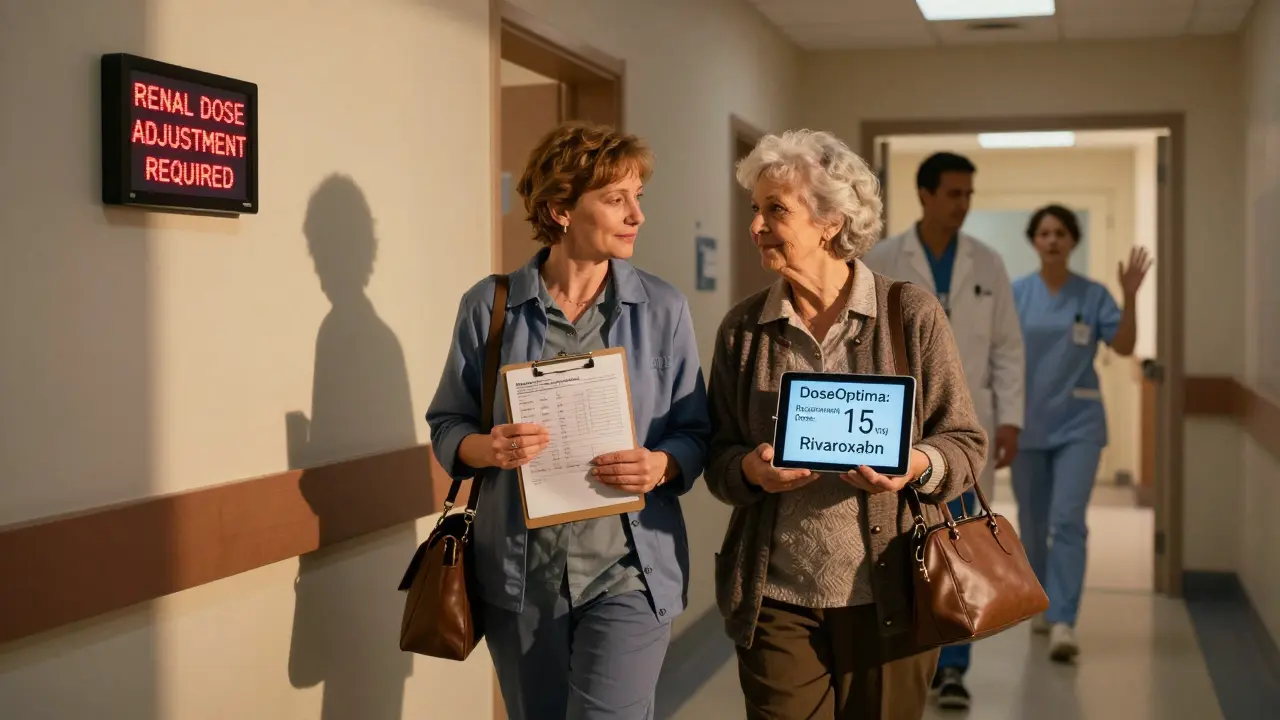
Hospitals that added electronic alerts in their EHR systems saw 37% fewer dosing errors. For example, if a doctor orders rivaroxaban (a blood thinner) for a patient with CrCl of 25 mL/min, the system pops up: “Dose should be reduced to 15 mg daily. Risk of bleeding increased.”
Mobile apps like Epocrates Renal Dosing (used over 1.2 million times) and AI tools like DoseOptima (FDA-approved in 2023) now give real-time, evidence-based recommendations. DoseOptima, tested across 15,000 patients, was 92.4% accurate in suggesting the right dose-far better than human judgment alone.
What’s Changing in Guidelines
The Kidney Disease: Improving Global Outcomes (KDIGO) group is updating its 2011 drug dosing report. The new version, expected late 2023, will:- Recommend cystatin C-based equations as the preferred method for elderly patients.
- Require all new drug labels to include specific dosing for CrCl ranges below 60 mL/min.
- Push for standardized protocols across 150 high-risk medications, as planned by ASHP by December 2023.
The FDA and EMA now require renal dosing data for all new drugs targeting patients over 65. This means future medications will come with clearer, more precise instructions.
What You Can Do
If you or a loved one is over 65 and taking multiple medications:- Ask your doctor: “What is my estimated CrCl or eGFR?”
- Ask: “Which of my medications are cleared by the kidneys?”
- Request a medication review with a pharmacist-especially if you’ve been hospitalized or started a new drug.
- Don’t assume “it’s just aging.” A fall, confusion, or nausea might be a drug reaction, not dementia.
Medication safety isn’t about taking less. It’s about taking the right amount. For older adults with kidney impairment, that balance is everything.
How do I know if my kidney function is low?
Your doctor can estimate kidney function using a blood test for creatinine and a formula like Cockcroft-Gault or MDRD. The result is given as eGFR (estimated glomerular filtration rate). If your eGFR is below 60 mL/min/1.73 m² for three months or more, it indicates chronic kidney disease. Many older adults have this without symptoms, so routine testing is key.
Can I still take my blood pressure medicine if my kidneys are weak?
Yes-but many blood pressure drugs need dose adjustments. ACE inhibitors and ARBs are often used in kidney disease because they protect kidney function. However, doses may need to be lowered if CrCl drops below 30 mL/min. Diuretics like furosemide may also need adjustment. Always check with your doctor or pharmacist before making changes.
Why do some medications need to be avoided completely?
Some drugs have no safe dose in severe kidney impairment because they or their metabolites build up to toxic levels. Examples include metformin (risk of lactic acidosis), NSAIDs like ibuprofen (can worsen kidney function), and certain antibiotics like ciprofloxacin (risk of seizures). The Beers Criteria lists 32 such medications for older adults with kidney disease.
Is it safe to use over-the-counter pain relievers?
Acetaminophen (Tylenol) is generally safe at low doses (up to 3,000 mg/day) in kidney impairment. NSAIDs like ibuprofen, naproxen, and aspirin should be avoided-they reduce blood flow to the kidneys and can cause sudden kidney failure, especially in older adults. Always check with your pharmacist before using OTC painkillers.
What’s the best way to prevent drug toxicity in elderly patients?
The most effective strategy is a pharmacist-led medication review. Pharmacists use up-to-date dosing guidelines, check for drug interactions, and monitor lab trends. Electronic alerts in EHRs also help. For families, keeping a current list of all medications-including supplements-and sharing it with every provider is critical. Never assume a new prescription overrides an old one.
Gabriella Adams
February 12, 2026 AT 22:21And yes, Cockcroft-Gault underestimates in older adults. That's why I always cross-check with cystatin C if the clinic has it. If not, I add 15% to the CrCl estimate. Better safe than sorry.
Jack Havard
February 14, 2026 AT 15:18Rachidi Toupé GAGNON
February 15, 2026 AT 15:36Sophia Nelson
February 16, 2026 AT 09:02Ojus Save
February 18, 2026 AT 07:34Rob Turner
February 20, 2026 AT 05:58Steve DESTIVELLE
February 21, 2026 AT 20:07Stephon Devereux
February 22, 2026 AT 22:13Also, stop calling it ‘elderly renal impairment.’ It’s not impairment. It’s adaptation. We just haven’t adapted our prescribing yet.