Generic Drug Concerns: Myths vs. Reality for Safety and Efficacy
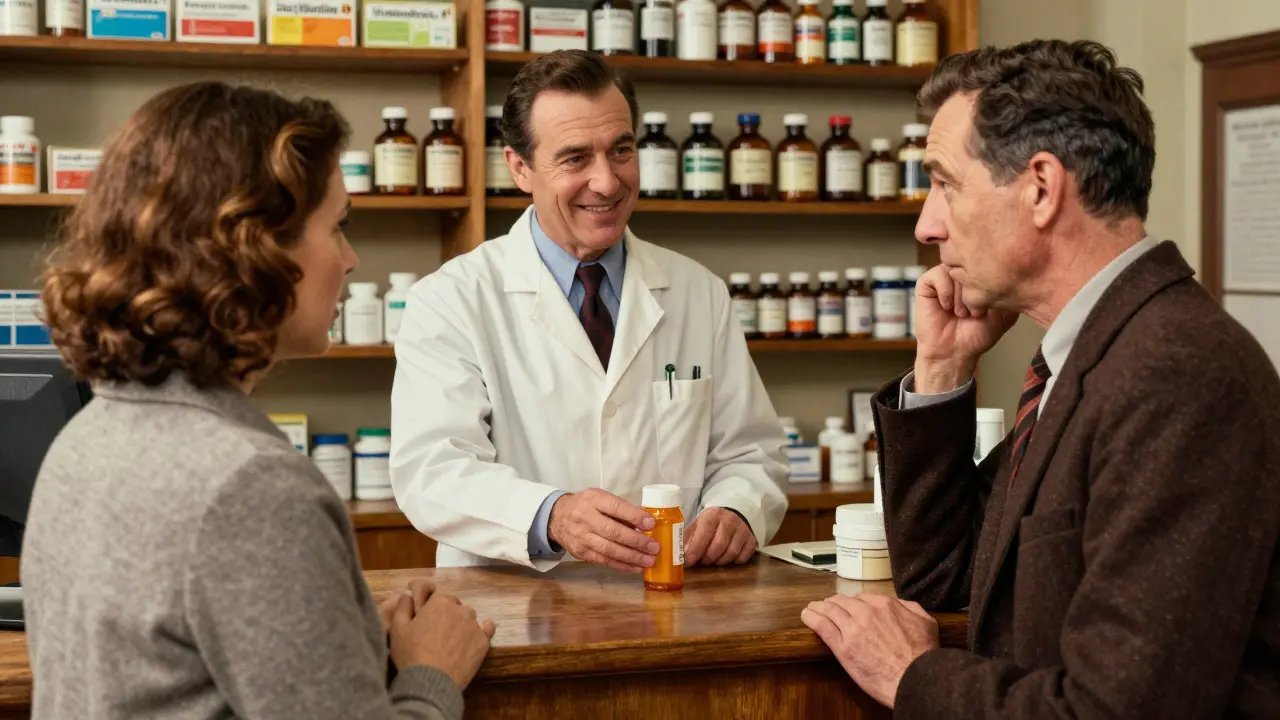
Imagine this: You’ve been taking a specific brand-name medication for years. It works perfectly. Then, your insurance changes or your doctor switches you to the generic version. Suddenly, you feel different. Maybe slightly worse. Or maybe exactly the same. This scenario plays out in pharmacies across New Zealand and globally every single day. The question isn't just about saving money-it’s about whether that savings comes at the cost of your health.
We often hear conflicting stories. Some say generics are identical twins to brand names. Others whisper that they’re cheap imitations that don’t work as well. So, what is the truth? Are we risking our health to save a few dollars? Let’s separate the science from the skepticism.
The Core Truth: What Makes a Generic “Generic”?
To understand if generics are safe, we first need to define what they actually are. A generic drug is a pharmaceutical product containing the same active ingredient, dosage form, strength, and route of administration as its brand-name counterpart. That’s the legal and scientific baseline.
In the United States, the Food and Drug Administration (FDA) requires these drugs to go through a rigorous approval process called the Abbreviated New Drug Application (ANDA). This pathway was established by the Hatch-Waxman Act of 1984 to encourage competition after patents expire. But here is the catch: while the *active* ingredient must be identical, the *inactive* ingredients-like fillers, dyes, and preservatives-can differ.
This distinction matters more than you might think. If you have an allergy to lactose or a specific dye, a generic could trigger a reaction even if the medicine itself is perfect. However, for the vast majority of people, these inactive components are harmless. The real test lies in how the body absorbs the drug, a concept known as bioequivalence.
Bioequivalence: The 80-125% Rule Explained
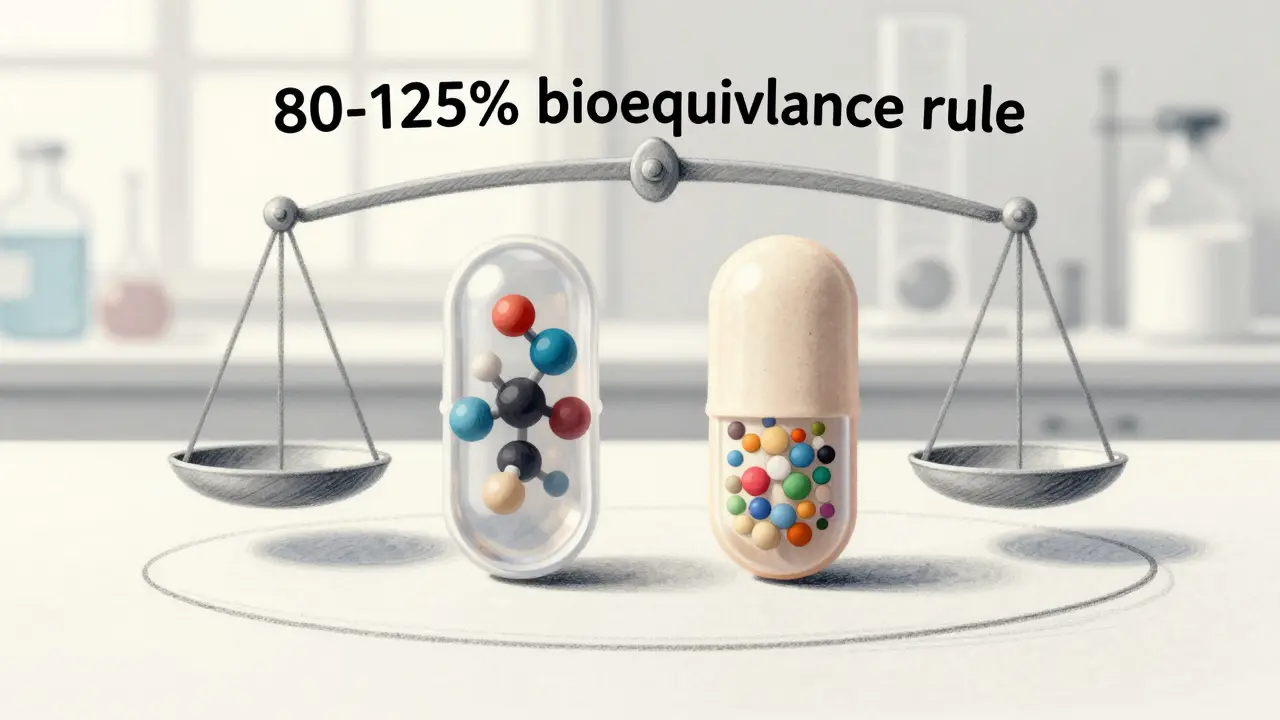
You’ll often hear the term "bioequivalence" thrown around in medical debates. It sounds technical, but it’s simple once you break it down. For a generic to be approved, it must demonstrate that it delivers the same amount of active ingredient into your bloodstream over the same period as the brand-name drug.
The FDA uses a statistical confidence interval of 80% to 125%. What does that mean? It means that in clinical trials involving healthy volunteers, the generic’s performance can vary within this range compared to the brand, and it is still considered equivalent. Why such a wide margin? Because human bodies vary wildly. One person might absorb 90% of a drug, another 110%, depending on their metabolism, diet, and genetics. The 80-125% rule accounts for this natural biological noise.
For most drugs, this variation is clinically irrelevant. If a painkiller works within that window, you won’t feel the difference. But for certain critical medications, that window is too wide. These are called Narrow Therapeutic Index Drugs (NTIDs).
Narrow Therapeutic Index Drugs: Where Caution Is Key
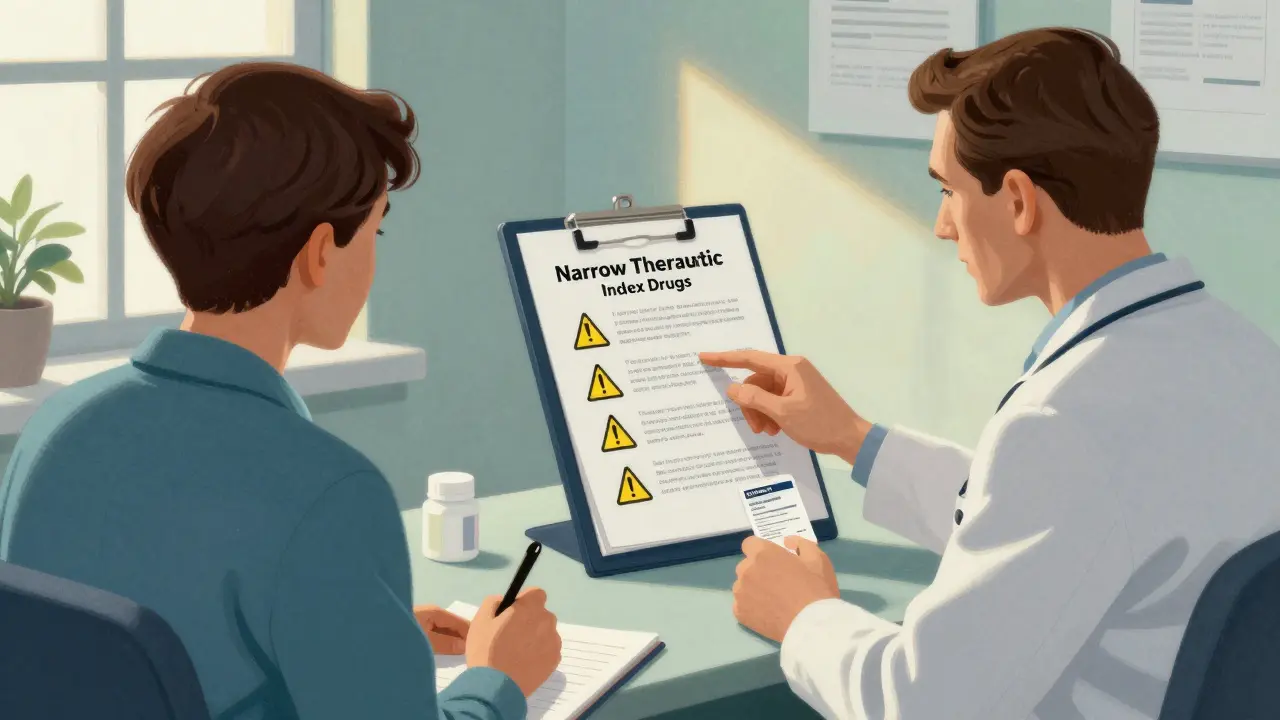
Not all drugs are created equal when it comes to substitution. NTIDs are medications where a small change in dose can lead to treatment failure or serious side effects. Think of drugs like warfarin (a blood thinner), levothyroxine (for thyroid issues), or phenytoin (for seizures).
For these high-stakes medications, the FDA applies tighter standards. Instead of the standard 80-125% range, NTIDs must fall within a narrower 90-112% bioequivalence limit. Even then, experts debate whether switching manufacturers is wise. Dr. Aaron Kesselheim of Harvard Medical School has pointed out that therapeutic inequivalence has been documented in specific cases, particularly for NTIDs or drugs with complex delivery systems.
If you are on one of these drugs, don’t assume all generics are interchangeable. Ask your pharmacist which manufacturer supplies your prescription. Consistency in the source can sometimes matter more than the label itself.
| Feature | Brand-Name Drug | Generic Drug |
|---|---|---|
| Active Ingredient | Original formulation | Identical chemical structure |
| Cost | High (covers R&D and marketing) | Low (typically 80-85% less) |
| Inactive Ingredients | Proprietary mix | May differ (dyes, fillers) |
| Bioequivalence Standard | N/A (Reference Listed Drug) | 80-125% (standard) / 90-112% (NTID) |
| Approval Pathway | New Drug Application (NDA) | Abbreviated New Drug Application (ANDA) |
The Cost Factor: Why Generics Dominate Prescriptions
Let’s talk money, because that’s why generics exist. In 2021, generic drugs accounted for approximately 90.2% of prescriptions filled in the United States, yet they represented only 19.3% of total drug spending. That is a massive efficiency gain. Between 2010 and 2020, generics saved the U.S. healthcare system $2.29 trillion.
Why the huge price drop? Brand-name companies spend billions on research, development, and clinical trials before a drug ever hits the market. They charge high prices to recoup those costs. Generic manufacturers skip that initial R&D phase because the safety and efficacy data already exist. They just prove their version is equivalent. This allows them to sell the drug at a fraction of the cost.
For patients managing chronic conditions like diabetes or hypertension, this difference can be life-changing. It means the difference between adhering to a treatment plan and skipping doses due to cost. Adherence is critical; missing doses leads to worse health outcomes, regardless of whether the pill is brand or generic.
What Does the Clinical Evidence Say?
If generics are so much cheaper and legally required to be equivalent, why do concerns persist? The answer lies in mixed clinical evidence. Large-scale studies show promising results, but smaller, specific case studies raise red flags.
A 2020 study published in *Nature* analyzed 17 cardiovascular drugs and found that generic medications were at least similar-and in some cases superior-to branded counterparts. Specifically, for drugs like metformin, patients on generics had significantly fewer major adverse cardiac events. This suggests that for many common conditions, generics are not just safe, but highly effective.
However, other research paints a nuanced picture. A Harvard Health study from 2017 looked at older adults switching to generic versions of blood pressure medications like losartan and valsartan. After the switch, emergency room visits and hospitalizations increased by 8% to 14% in the month following substitution. Another study found higher rates of psychiatric hospitalizations for patients switched to generic escitalopram or sertraline.
These contradictions highlight a key point: equivalence is population-based, not individual-based. Statistically, generics work for the majority. But for a small subset of sensitive individuals, the slight variations in absorption or inactive ingredients can make a noticeable difference.
Patient Experiences: Real Stories Behind the Stats
Data tells us what happens on average, but patient stories tell us what happens to *you*. Online forums and clinical reports reveal a spectrum of experiences.
On Reddit’s r/pharmacy, users frequently share frustrations. One user reported erratic TSH levels after switching from brand-name Synthroid to generic levothyroxine, requiring multiple dosage adjustments. Another described breakthrough seizures after a pharmacy substituted brand-name Keppra with a generic version of levetiracetam. These are serious, personal impacts that statistics can sometimes obscure.
Conversely, Consumer Reports’ 2022 survey of 1,200 generic drug users found that 82% reported identical effectiveness to brand-name versions. Only 7% noticed any difference at all. This aligns with a 2024 machine learning analysis of patient perceptions, which found that nearly 75% of participants held positive views on generic safety.
The takeaway? Most people do fine. But for those who don’t, the experience can be distressing. It’s not about fear-mongering; it’s about awareness. If you feel worse after a switch, speak up. Don’t assume it’s "just in your head."
Manufacturing Quality and Global Supply Chains
Where your pills come from matters. The FDA mandates that all generic manufacturing facilities comply with Current Good Manufacturing Practices (CGMP). In 2022, 98.7% of generic drug facilities passed FDA inspections, slightly higher than the 97.3% pass rate for brand-name facilities. This suggests that quality control is robust.
However, the global supply chain introduces complexity. According to the FDA’s 2023 Drug Shortage Report, 78% of active pharmaceutical ingredients (APIs) are sourced from China and India. While these countries produce high-quality APIs, geopolitical tensions or local regulatory lapses can pose risks. The concentration of production in a few regions means that disruptions there can ripple through global healthcare systems, leading to shortages or inconsistent batch quality.
Additionally, documentation varies. The FDA’s Transparency Initiative revealed that only 67% of generic drug labels include specific information about inactive ingredients, compared to 99% for brand-name drugs. This lack of transparency can make it harder for patients with allergies to make informed choices.
How to Navigate Generic Substitutions Safely
So, should you take generics? For most people, yes. They are safe, effective, and essential for affordable healthcare. But you can take proactive steps to ensure the best outcome.
- Know Your Medications: Identify if you are on a Narrow Therapeutic Index Drug (NTID). If so, discuss consistency with your doctor.
- Monitor Changes: When switching from brand to generic, pay attention to your body for the first few weeks. Note any new side effects or reduced efficacy.
- Ask About Manufacturers: Pharmacies can often specify which manufacturer supplies a generic. If you find one that works well, request that specific brand of generic.
- Check for Allergies: Review the inactive ingredients list if you have known sensitivities to dyes or fillers.
- Communicate Openly: If a generic doesn’t work, tell your doctor. They may write "Dispense As Written" on the prescription to force a brand-name fill, though this may impact your insurance coverage.
Remember, you are the expert on your own body. Doctors and pharmacists are guides, but your feedback is crucial data. Don’t suffer in silence if a switch feels wrong.
The Future of Generic Drugs
The landscape is evolving. The FDA launched a Complex Generic Drug Product Database in 2023 to address difficult-to-copy drugs like inhalers and topical creams. New guidelines are tightening standards for these complex formulations. Meanwhile, the global generic market is projected to reach $724.8 billion by 2028, driven by aging populations and cost pressures.
As biosimilars (generic versions of biologic drugs) enter the market, we will see even more scrutiny on equivalence. Biologics are larger, more complex molecules than traditional small-molecule drugs, making true "generics" impossible. Instead, we get biosimilars, which are highly similar but not identical. This adds another layer of complexity to the conversation.
Despite these challenges, the core promise remains: generics provide access. Without them, millions would go untreated. The goal isn’t to eliminate brands, but to ensure that generics meet the highest possible standard of care.
Are generic drugs always the same as brand-name drugs?
No, they are not identical in every way. They contain the same active ingredient and must meet strict bioequivalence standards, but they can differ in inactive ingredients like colors, flavors, and preservatives. For most people, this makes no difference, but for those with specific allergies or sensitivities, it can matter.
Is it safe to switch between different generic manufacturers?
For most drugs, yes. The FDA ensures that all approved generics meet the same quality standards. However, for Narrow Therapeutic Index Drugs (NTIDs) like warfarin or levothyroxine, switching manufacturers can sometimes cause fluctuations in blood levels. In these cases, consistency with one manufacturer is recommended.
Why do some people feel worse on generic drugs?
This can happen for a few reasons. First, slight variations in how the body absorbs the drug (bioavailability) may affect sensitive individuals. Second, reactions to inactive ingredients like dyes or fillers can occur. Finally, the "nocebo effect," where expecting a negative outcome causes actual symptoms, can play a role. Always report these feelings to your doctor.
Do generic drugs undergo the same testing as brand-name drugs?
They undergo different but rigorous testing. Brand-name drugs require full clinical trials to prove safety and efficacy from scratch. Generic drugs use the Abbreviated New Drug Application (ANDA) pathway, which relies on existing safety data but requires new bioequivalence studies to prove the generic performs similarly in the body.
Can I ask my doctor to prescribe only brand-name medication?
Yes, you can request "Dispense As Written" (DAW) on your prescription. However, this may result in higher out-of-pocket costs if your insurance plan favors generics. Discuss the financial implications with your provider and pharmacist before making this choice.
What are Narrow Therapeutic Index Drugs (NTIDs)?
NTIDs are medications where a small change in dose can lead to treatment failure or toxicity. Examples include warfarin, levothyroxine, and phenytoin. For these drugs, the FDA requires tighter bioequivalence limits (90-112%) compared to standard generics (80-125%). Patients on NTIDs should be cautious about switching manufacturers.
Are generic drugs manufactured under the same quality standards?
Yes. Both generic and brand-name manufacturers must comply with Current Good Manufacturing Practices (CGMP). In recent years, generic facilities have actually had slightly higher inspection pass rates than brand-name facilities, indicating strong regulatory oversight.
How much cheaper are generic drugs compared to brand names?
Generics typically cost 80-85% less than their brand-name equivalents. This significant price difference is due to the lack of initial research and development costs for generic manufacturers, allowing them to compete on price while maintaining quality.
What should I do if my generic medication doesn’t seem to work?
Contact your doctor immediately. Do not stop taking the medication abruptly. Your doctor may adjust the dosage, switch you to a different generic manufacturer, or revert to the brand-name drug if medically necessary. Keep a log of your symptoms to help guide the decision.
Is the rise of biosimilars changing the generic drug landscape?
Yes. Biosimilars are generic versions of biologic drugs, which are more complex than traditional small-molecule drugs. While not identical copies, they are highly similar. As biologics lose patent protection, biosimilars will become more common, bringing similar cost benefits but requiring careful monitoring for equivalence.