How Multiple Generic Drug Competitors Enter After the First Market Entrant
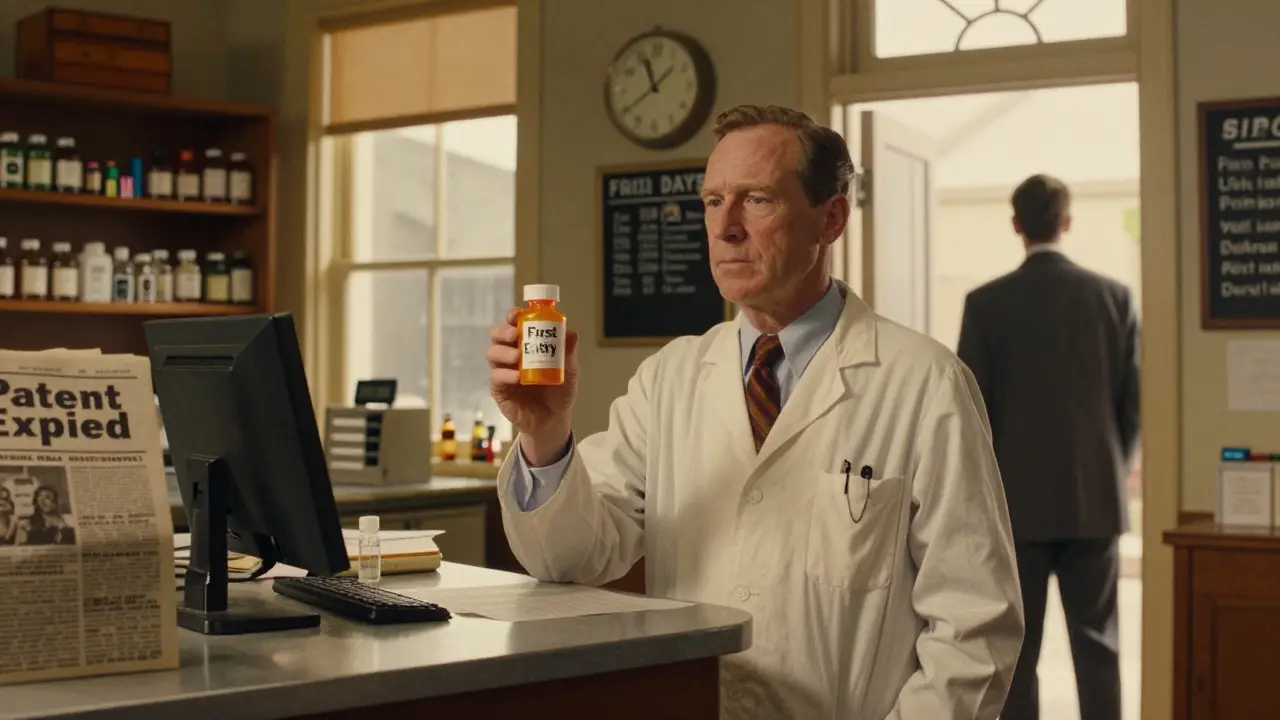
When a brand-name drug loses patent protection, the race to launch the first generic begins. But what happens after that first generic hits the market? It’s not a free-for-all. There’s a strict timeline, legal traps, pricing crashes, and strategic moves that determine who survives-and who gets crushed. The system isn’t broken. It’s designed this way. And understanding how competitors enter after the first generic is key to knowing why drug prices drop so fast-or sometimes, don’t drop at all.
The 180-Day Window That Changes Everything
The first generic company to successfully challenge a brand drug’s patent gets 180 days of exclusive rights to sell that generic. This isn’t just a reward. It’s a financial lifeline. During those six months, that first entrant captures 70 to 80% of the market. Prices stay high-often 70 to 90% of the original brand price. Why? Because no one else can legally sell it yet.This exclusivity period lets the first generic recoup the $5 million to $10 million it spent fighting the patent in court. Without it, no company would risk the legal battle. The clock starts ticking the moment the first generic is sold or when a court rules the patent is invalid. That’s when the floodgates open.
Why the Second Generic Changes Everything
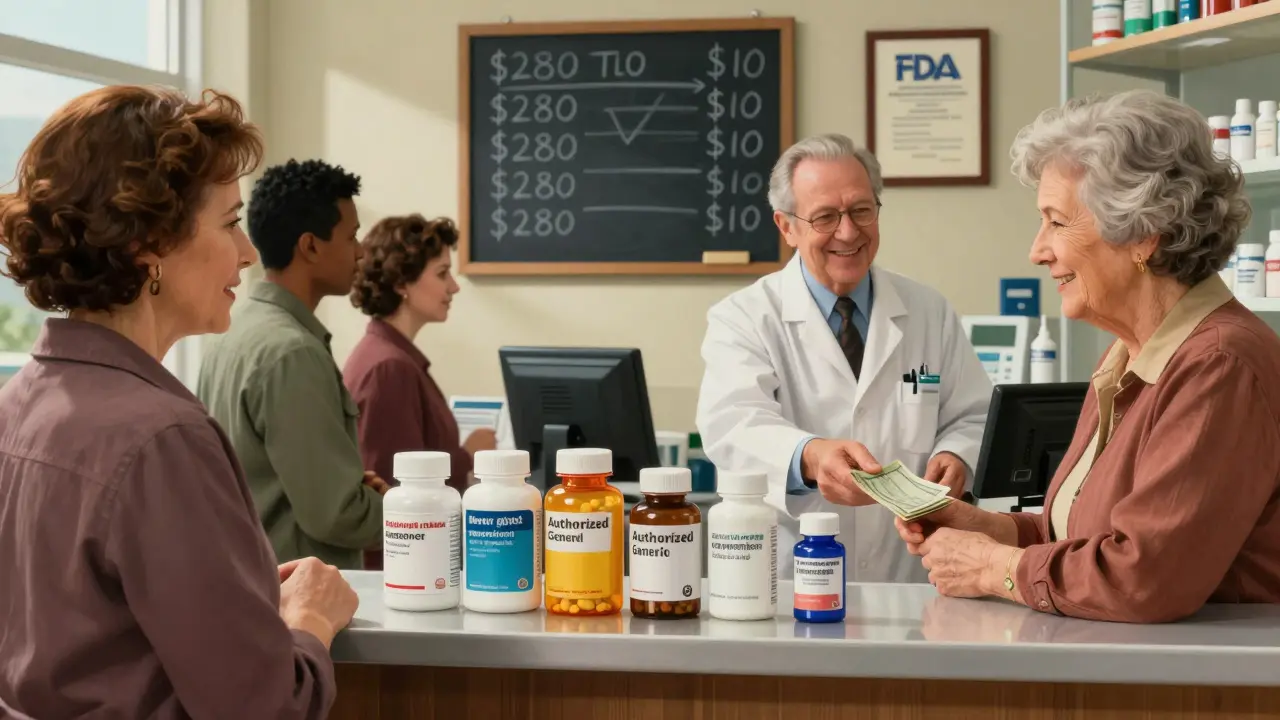
The moment that 180-day window ends, other generic companies rush in. And prices don’t just dip-they plummet. The FDA found that with just one generic, prices average 83% of the brand price. With two generics, that drops to 66%. By the time the third one arrives, it’s down to 49%. And by the fifth? Prices stabilize at around 17% of the original cost.The steepest drop? Between the second and third entrants. That’s when the market shifts from controlled competition to a free-for-all. Take Crestor, the cholesterol drug. When the first generic entered in 2016, it sold for about $280 a month. By the time eight generics were on the market a year later, the price was $10. That’s not a typo. It’s the law of supply meeting the law of demand.
Authorized Generics: The Brand’s Secret Weapon
Here’s where things get tricky. The brand company doesn’t just sit back and watch its profits vanish. Many launch what’s called an authorized generic-a version made by the brand’s own company or a subsidiary, sold under a generic label. And they time it perfectly.In 2019, Merck launched an authorized generic for Januvia on the exact day the first generic hit the market. Within six months, it grabbed 32% of the market. That meant the first generic’s share dropped from 75% to under 50%. Revenue? Cut by 30-40%. The FDA says 65% of brand companies do this for high-value drugs. It’s legal. It’s strategic. And it’s devastating to the first entrant.
Why Some Generics Never Make It Past the Starting Line
Just because a company gets FDA approval doesn’t mean it can sell. Getting on pharmacy benefit manager (PBM) formularies is a whole other battle. In 2022, 68% of generic contracts used a “winner-take-all” model-meaning only one manufacturer gets full placement. Even if you’re the fifth generic approved, if you didn’t land that contract, you’re stuck with 5-10% market share.It takes 9 to 12 months for a new generic to get formulary access. Meanwhile, the first entrant has already locked in deals with the biggest PBMs. That’s why some markets have five generics on the shelf but only two actually selling. The others? They’re sitting on shelves, waiting for a contract that never comes.
Manufacturing Is the Hidden Bottleneck
Making generic drugs sounds simple. But it’s not. The first generic often owns its own factory. Subsequent entrants? They outsource to contract manufacturing organizations (CMOs). In fact, 78% of second-and-later entrants rely on CMOs, compared to just 45% of the first. That’s cheaper-but riskier.The FDA found that 62% of generic drug shortages involve products with three or more manufacturers. Why? Because CMOs juggle dozens of clients. A quality issue at one plant can knock out multiple generics at once. And when that happens, prices spike back up-until another batch is approved. It’s a cycle of scarcity and oversupply that keeps the market unstable.
Patent Games and Regulatory Delays
Brand companies don’t just rely on authorized generics. They file citizen petitions-requests to the FDA to delay approval of a generic. Between 2018 and 2022, they filed over 1,200 of them. Each one delays a new generic by an average of 8.3 months. And they’re often filed after the first generic is already approved, targeting the next ones in line.Some patent settlements even include agreements to stagger entry. Take Humira’s biosimilars: six companies agreed to enter the market between 2023 and 2025, spreading out competition instead of crashing prices all at once. These deals are legal under current law, even though they reduce competition.

Why Prices Don’t Always Drop the Same Way
Not all generics are created equal. Cardiovascular drugs like statins see prices drop to 12-15% of the brand with five competitors. But oncology drugs? They stay at 35-40%. Why? Because they’re harder to make. Special handling, sterile environments, complex formulations-these raise the bar. Only a few companies can do it.Same goes for complex generics and 505(b)(2) drugs. These aren’t simple pills. They’re inhalers, patches, injectables. They require more testing, more time, more money. So competition stays limited. Two or three players max. Prices hover at 30-40% of brand. That’s why the market is splitting into two tracks: low-cost, high-volume generics and high-barrier, low-competition products.
Consolidation Is Quietly Reshaping the Market
The number of companies making generics has dropped sharply. In 2018, there were 142 active ANDA holders. By 2022, that number was down to 97. Why? Because the margins are too thin. Many small players can’t survive the price wars. They get bought out. Or they quit.The average number of competitors in a multi-generic market fell from 5.2 to 3.8 in just four years. That’s slowing down price erosion. It’s not that the system is working better. It’s that fewer players are left standing.
What Comes Next? The Future of Generic Competition
By 2027, experts predict 70% of simple generics will have five or more competitors, with prices at 10-15% of brand. But complex generics? They’ll stay at 2-3 players, with prices at 30-40%. And authorized generics? Half of the top-selling drugs will have one by then.Some experts, like former FDA Commissioner Scott Gottlieb, say we need market-based fixes-long-term contracts, restricted entry for simple drugs, or even price floors. Others, like Harvard’s Aaron Kesselheim, warn that too many companies chasing too few profits leads to shortages and instability.
The truth? The system works exactly as it was designed. The Hatch-Waxman Act created a balance: encourage innovation, reward first movers, and let competition drive prices down. But over time, the rules have been gamed. Authorized generics, citizen petitions, staggered entry, winner-take-all contracts-they’ve all twisted the original intent.
What’s clear? If you’re entering after the first generic, you’re not just competing on price. You’re competing on timing, contracts, manufacturing reliability, and legal strategy. And in this game, the first mover doesn’t always win. But the smartest mover? They always do.
Jackie Be
December 20, 2025 AT 17:10So basically the first guy gets rich while everyone else fights over crumbs and the brand company sneaks in with their own fake generic to steal the spotlight?? 😒
This system is a joke.
Jon Paramore
December 20, 2025 AT 20:30The 180-day exclusivity window is a classic regulatory arbitrage - it incentivizes patent challenges but creates a monopoly rent extraction window. Post-exclusivity, the price elasticity curve collapses exponentially due to supply-side saturation, but only if manufacturing capacity and PBM formulary access align. Most later entrants fail not on efficacy, but on supply chain logistics and contract negotiation latency.
CMO dependency introduces systemic risk: single-point failures cascade across multiple ANDAs. The FDA’s 62% shortage statistic isn’t about quality control - it’s about fragmented, undercapitalized manufacturing ecosystems.
John Hay
December 22, 2025 AT 05:31I’ve seen this up close. A friend’s company spent $7M on a patent challenge, got the 180 days, then got crushed when the brand dropped their authorized generic on day one. No warning. No mercy. It’s not capitalism. It’s corporate warfare dressed up as policy.
And don’t get me started on PBMs - they’re the real villains. Winner-take-all contracts? That’s not competition. That’s collusion with middlemen.
Ben Warren
December 22, 2025 AT 20:52The Hatch-Waxman Act was never intended to be a vehicle for predatory financial engineering. The original intent - to balance innovation with access - has been systematically dismantled by legal loopholes, regulatory capture, and the commodification of public health. The authorized generic is not merely a business tactic; it is a moral failure of the pharmaceutical-industrial complex.
When a company that once profited from a patent now manufactures the very generic it spent years litigating against, it reveals a profound corruption of the fiduciary duty owed to patients. The FDA’s silence on this practice is complicity. The system is not merely gamed - it is broken by design, and those who profit from it are not entrepreneurs - they are profiteers.
There is no ethical justification for delaying generic entry through citizen petitions. There is no public health rationale for staggered biosimilar launches. These are not market mechanisms - they are anti-competitive maneuvers enabled by regulatory inertia.
Until Congress repeals the provisions that allow these abuses and imposes mandatory price floors for complex generics, we will continue to see artificial scarcity, manufactured shortages, and the erosion of trust in the entire system. This is not innovation. This is exploitation dressed in white coats.
Cara C
December 24, 2025 AT 17:39It’s wild how much of this is invisible to patients. We just see the price drop from $300 to $10 and think ‘huh, generics are cheap!’
But behind that? A whole war of contracts, factories, and legal chess moves. No wonder drug prices feel so random.
Maybe we need a public option for generics - like a government-run version that just cuts out all the middlemen and greed.
Grace Rehman
December 26, 2025 AT 13:03So the brand companies are basically like that one friend who says ‘I’ll let you borrow my car’… then parks their own identical car right next to yours and says ‘oh you’re using it? Cool, now we’re both here.’
And the FDA just shrugs?
And the PBMs? They’re the bouncer at a club who only lets one person in even if 20 people have tickets.
And we wonder why healthcare is a nightmare?
It’s not a system. It’s a sitcom written by Wall Street.
Swapneel Mehta
December 26, 2025 AT 19:05India makes most of the API for these generics. When our factories get hit by monsoons or power outages, prices spike everywhere. We’re not just competing with each other - we’re competing with weather and infrastructure.
Maybe the real fix is investing in global manufacturing resilience, not just more lawsuits.
Teya Derksen Friesen
December 27, 2025 AT 21:57It’s fascinating how the market bifurcates - simple pills become commodities, while injectables and inhalers become niche luxury goods. The same logic applies to tech: basic apps are free, but enterprise SaaS costs six figures.
Generics aren’t failing. They’re evolving. The challenge is whether society values accessibility over profit - and right now, the answer is clearly profit.
Stacey Smith
December 29, 2025 AT 11:17America invented this system. Now we’re the ones getting screwed by foreign manufacturers and lazy regulators.
Time to bring the factories back. No more outsourcing our medicine to China or India.
If we want cheap drugs, we need to make them here - with American workers, American standards, American pride.
Orlando Marquez Jr
December 29, 2025 AT 17:08The structural dynamics described here reflect a sophisticated equilibrium between regulatory incentives and market forces. The 180-day exclusivity period functions as a necessary subsidy for patent litigation, which is inherently high-risk and capital-intensive. The emergence of authorized generics, while ethically contentious, remains a legally permissible expression of vertical integration within the pharmaceutical supply chain.
Moreover, the concentration of formulary access through PBM contracts represents a consolidation of purchasing power - a phenomenon observable across multiple sectors, from healthcare to retail.
The real policy challenge lies not in eliminating these mechanisms, but in recalibrating them to preserve competition without compromising manufacturing stability. This requires transparent data-sharing, standardized contract terms, and FDA oversight that prioritizes supply continuity over procedural delays.
Dan Adkins
December 31, 2025 AT 00:34Let me be perfectly clear: the entire generic drug ecosystem is a legally sanctioned cartel disguised as free-market competition. The 180-day window is a monopoly subsidy. Authorized generics are anti-competitive collusion. PBM winner-take-all contracts are monopolistic rent-seeking. And the FDA? A passive enabler.
When the first entrant is deliberately sabotaged by the very brand they defeated - and the government allows it - this is not capitalism. This is feudalism with a corporate logo.
Patients are not customers. They are collateral damage in a game where the rules were written by lawyers, not physicians.
Reform is not optional. It is a moral imperative.