Infographics About Generics: Visual Education Tools for Patient Understanding
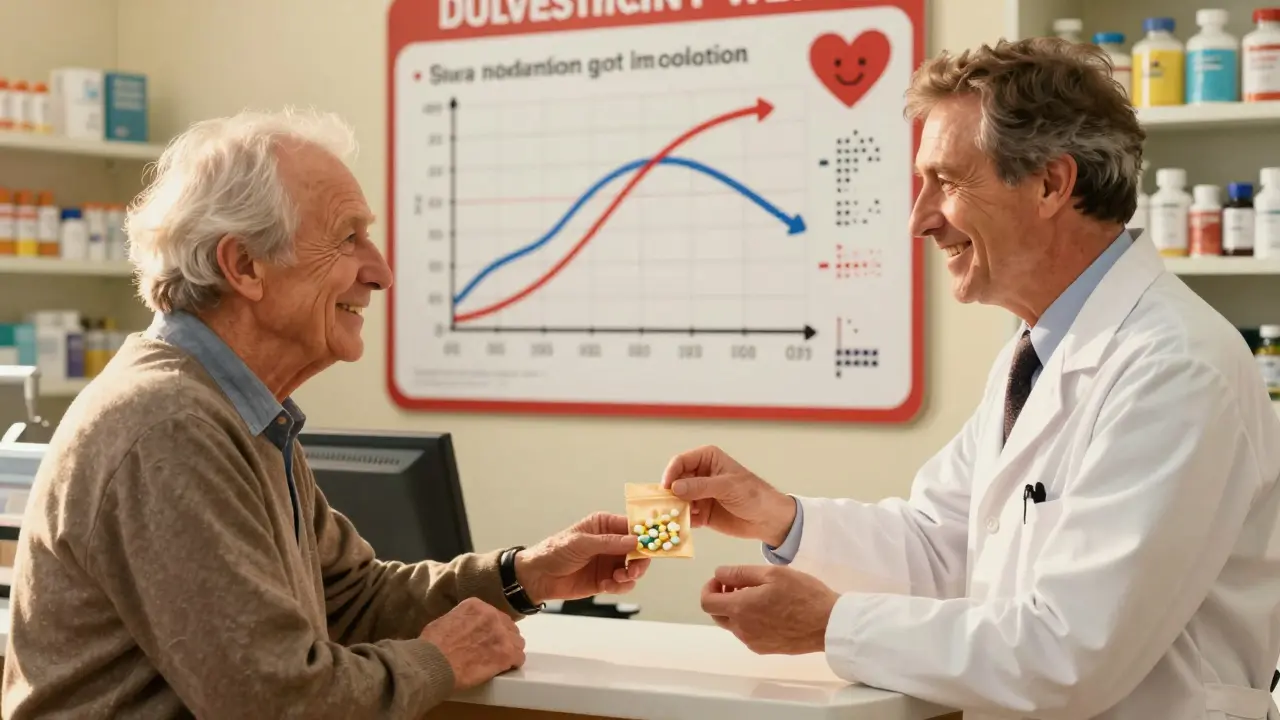
More than 90% of prescriptions filled in the U.S. are for generic drugs. Yet, many patients still hesitate to take them. Why? Because they look different. They cost less. And they’re often misunderstood. That’s where infographics about generics come in - simple, visual tools that cut through the confusion and help people make smarter, safer choices about their medication.
Why Do People Doubt Generic Drugs?
It’s not about being stubborn. It’s about fear. A 2021 FDA survey found that 43% of patients worried generic drugs weren’t as effective as brand-name ones. Others thought the different color or shape meant something was wrong. Some believed the lower price meant lower quality. These aren’t silly concerns - they’re rooted in real experiences. Maybe a patient switched to a generic and noticed a slight change in how they felt. Or maybe a family member once had a bad reaction and blamed the generic version. Without clear, trusted information, doubt grows.
Here’s the truth: generic drugs must meet the same strict standards as brand-name drugs. They contain the same active ingredient, in the same strength, and work the same way in the body. The FDA requires them to be bioequivalent - meaning they deliver the same amount of medicine into your bloodstream at the same rate. That’s not a guess. It’s science. And it’s backed by data from over 1,000 clinical studies every year.
What Makes a Good Generic Drug Infographic?
Not all visuals are created equal. The best ones don’t just say "they’re the same." They show it. The FDA’s most popular infographic, "What Makes a Generic the Same as a Brand-Name Drug?", uses side-by-side graphs to display how quickly the medicine dissolves in the body. One line for the brand. One line for the generic. They overlap almost perfectly. That’s bioequivalence - visualized in seconds.
Good infographics also explain what’s different. The inactive ingredients - the fillers, dyes, flavors - can change. That’s why a generic pill might be blue instead of yellow, or oval instead of round. But those don’t affect how the drug works. The FDA’s infographics use simple icons to show this: a heart for the active ingredient, a small dot for each inactive component. No jargon. No fine print.
They’re also designed to be understood. All FDA materials are tested on real patients. At least 30 people from different backgrounds, education levels, and languages review each one. The goal? An 85%+ comprehension rate. Most hit 87%. That’s not luck. It’s intentional design.
How These Tools Help Real People
At Kaiser Permanente clinics in Southern California, pharmacists started keeping printed copies of the FDA’s generic drug infographics behind the counter. Within months, patient refusals dropped by 38%. One pharmacist said, "I used to spend 10 minutes explaining why a generic is safe. Now I hand them the picture. They read it. They nod. We move on."
Reddit threads from pharmacists show similar stories. A top comment on r/pharmacy received over 140 upvotes: "I’ve printed this and keep it behind the counter - cuts counseling time in half for generic questions." The infographic isn’t just a handout. It’s a conversation starter. A trust builder.
For patients with chronic conditions - diabetes, high blood pressure, thyroid disease - switching to generics can mean saving hundreds of dollars a year. That’s not just money. It’s stability. The ability to keep taking medicine without choosing between rent and refills. The Congressional Budget Office estimates generics saved the U.S. system $1.68 trillion between 2010 and 2019. That’s not a statistic. That’s thousands of people who didn’t skip doses because they couldn’t afford their pills.
Who Makes These Infographics - And Why It Matters
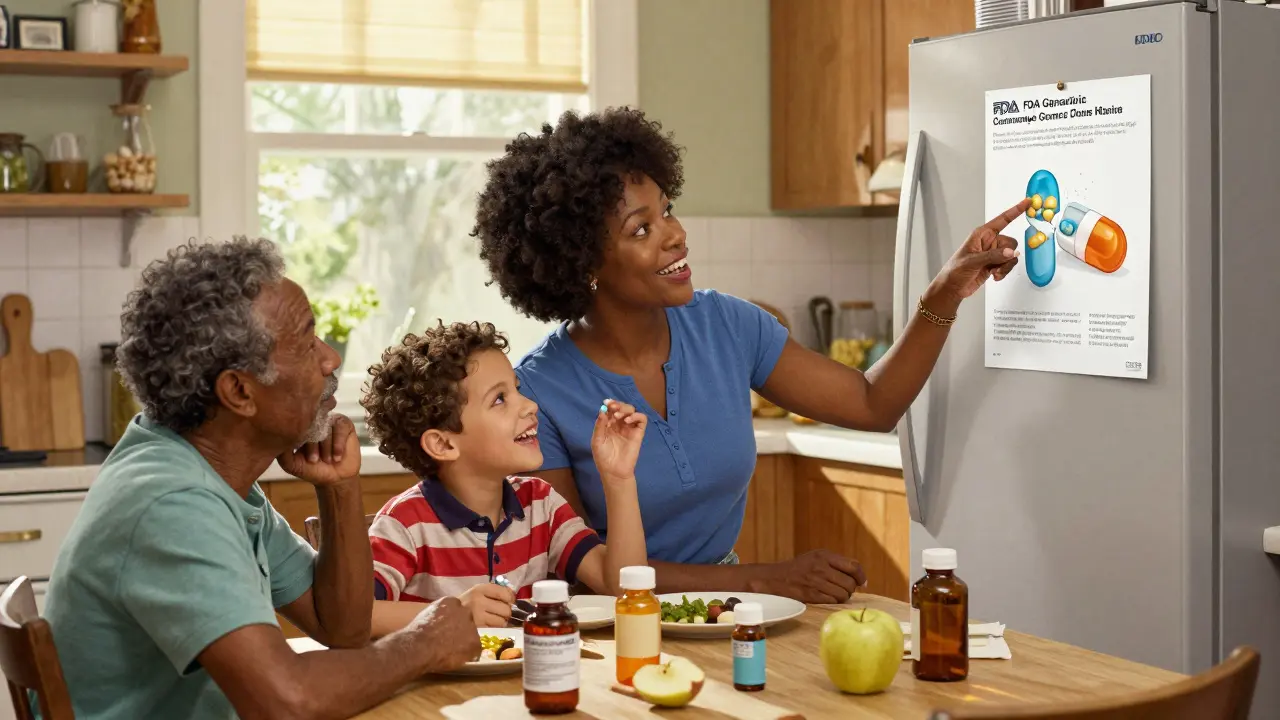
The FDA is the main source. Their materials are free, peer-reviewed, and updated regularly. They’re available in Spanish, too - "Medicamentos Genéricos" - and meet accessibility standards for screen readers and color-blind users. Their infographics follow strict design rules: 300 DPI resolution, CMYK color for printing, and text written at an 8th-grade reading level.
Other groups like the GTMRx Institute and BeMedWise also create visuals. But they focus on different things. GTMRx links generics to broader medication management - how to track doses, avoid interactions, work with your pharmacist. BeMedWise includes tools to log your meds. But only the FDA covers the full scope: how generics are approved, why they’re cheaper, how quality is monitored, and what happens after they hit the market.
And here’s something few people know: the FDA tests not just the drug, but the infographic itself. Before releasing any visual, they run it by patients. If even one person says, "I still don’t get it," they go back and fix it.
Where to Find Them - And How to Use Them
You don’t need a hospital or pharmacy to access them. Go to fda.gov/generics. Download any infographic. Print it. Save it. Share it. They’re designed for exactly that.
Healthcare providers use them in waiting rooms, on patient portals, during appointments. But you can use them too. If you’re unsure about a generic you’ve been prescribed, print the "What Makes a Generic the Same..." infographic. Bring it to your next visit. Ask: "Does this match what you’re telling me?"
Pharmacists love when patients come in with questions. It means they’re engaged. And with these visuals, you’re not just asking - you’re talking the same language.
The Gaps - What’s Still Missing
Even the best tools have limits. Some experts point out that infographics don’t do enough for drugs with narrow therapeutic indexes - like warfarin or levothyroxine. Small differences in how these drugs are absorbed can matter. The current visuals don’t highlight that risk clearly enough.
Also, while the FDA’s materials are strong on science, they don’t always address why some communities trust generics less. African American and Hispanic patients report higher concerns about quality than White patients. Only one FDA infographic - the "Generic Drugs and Health Equity Handout" - directly tackles this. More should.
And while most infographics mention inactive ingredients, few explain why manufacturers matter. If you’re on a drug that’s sensitive to small changes, knowing which company made your generic can help you track consistency. That’s not in the visuals yet.
What’s Next for Generic Education?
The next wave is interactive. In early 2023, GTMRx launched digital infographics that let you type in your medications and get a personalized risk assessment. Want to know if your generic thyroid med might interact with your blood thinner? The tool shows you.
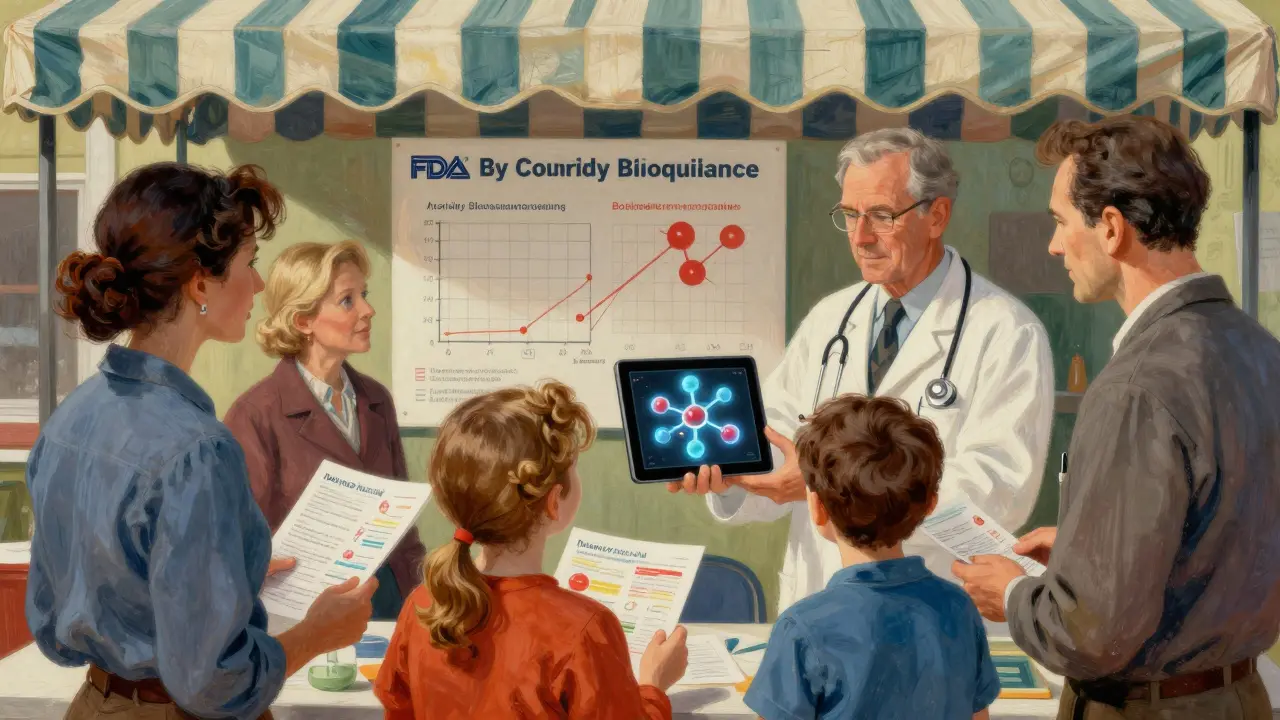
The FDA is testing augmented reality. Imagine scanning your pill bottle with your phone and seeing a 3D model of the drug molecule - brand on one side, generic on the other - with a glowing line showing they’re identical. That prototype was shown at a digital health summit in 2023. It’s coming soon.
And the push is growing. The 2023 Affordable Drug Manufacturing Act increased funding for patient education by 40%. Epic Systems, the big electronic health record company, now includes FDA infographics in patient portals. In six months, over 450,000 people viewed them.
This isn’t just about saving money. It’s about fairness. About access. About making sure everyone - no matter their income, language, or background - understands their medicine. And that’s what these visuals are really for.
Are generic drugs really as safe as brand-name drugs?
Yes. Generic drugs must meet the same FDA standards as brand-name drugs. They contain the same active ingredient, work the same way, and are tested for bioequivalence - meaning they deliver the same amount of medicine into your bloodstream at the same rate. The FDA approves each generic before it reaches the market, and they’re monitored after release too.
Why do generic pills look different from brand-name ones?
The difference in color, shape, or size comes from inactive ingredients - things like dyes, fillers, or coatings. These don’t affect how the medicine works. Federal law requires generics to look different from brand-name drugs to avoid confusion. But the active ingredient - the part that treats your condition - is identical.
Can I trust generics if they’re much cheaper?
Absolutely. Generics cost less because their manufacturers don’t have to repeat expensive clinical trials. The original brand-name company already proved the drug works. Generic makers only need to prove theirs is bioequivalent. That saves money - not quality. The FDA inspects every manufacturing facility, whether it’s for brand or generic, and has the same strict rules for both.
Do generics work the same for everyone?
For most people, yes. But for certain drugs - like warfarin, levothyroxine, or some epilepsy medications - small differences in how the body absorbs the drug can matter. These are called narrow therapeutic index drugs. If you take one of these, talk to your doctor or pharmacist. They may recommend sticking with the same brand or generic manufacturer for consistency. The FDA’s infographics don’t always make this clear - so ask questions if you’re unsure.
Where can I get these infographics?
The FDA offers all their generic drug infographics for free at fda.gov/generics. You can download them as PDFs, print them, or share them digitally. They’re available in English and Spanish. Many pharmacies and clinics also have printed copies in waiting areas. You don’t need a prescription to get them - just curiosity and a willingness to understand your medicine.
Can I use these infographics if I’m not a native English speaker?
Yes. The FDA provides all their generic drug infographics in Spanish under the title "Medicamentos Genéricos." The visuals are designed to work without heavy text, so even if you’re not fluent, the diagrams and icons still convey the key messages. Some materials also include simplified language and high-contrast colors to support understanding across language barriers.
Do these infographics help reduce medication errors?
Yes. By clarifying what generics are - and what they’re not - these tools reduce confusion at the pharmacy. Patients who understand that a different-looking pill isn’t a mistake are less likely to refuse a prescription or stop taking it. Pharmacists report fewer questions, fewer refusals, and fewer calls to doctors after using these visuals. The FDA’s own reporting system shows 175 positive patient comments about these infographics between 2021 and 2023, compared to just 12 complaints.
What You Can Do Today
If you’re on a generic medication, take a minute. Look at the pill. Check the name. Then go to fda.gov/generics. Download the "What Makes a Generic the Same as a Brand-Name Drug?" infographic. Read it. Keep it. Show it to someone who’s unsure. You’re not just learning - you’re helping others understand too.
Medicine shouldn’t be a mystery. And it doesn’t have to be. These infographics are proof that simple visuals can change how people think, feel, and act about their health. All you need is the right picture - and the courage to ask, "What’s really in this pill?"
Dan Gaytan
December 22, 2025 AT 13:13Just printed the FDA infographic and left it on the counter at my local pharmacy. My mom’s been on levothyroxine for 12 years and still thinks generics are "fake medicine." She read it, paused, and said, "Wait… so they’re the same?" Then she hugged me. These things work.
Steven Mayer
December 23, 2025 AT 12:31The bioequivalence data is statistically valid, but the clinical variance in Cmax and AUC thresholds-especially for narrow therapeutic index agents-remains underrepresented in public-facing materials. The FDA’s 80–125% confidence interval allows for pharmacokinetic drift that, in susceptible populations, may manifest as subtherapeutic or toxic exposure. This is not a flaw in regulation-it’s a gap in communication.
Bret Freeman
December 24, 2025 AT 18:25Let me guess-the FDA’s got a whole department just to make pretty pictures so you don’t realize you’re getting the same crap from a factory in China that costs 90% less. And you’re supposed to be grateful? Wake up. The active ingredient might be identical, but the fillers? The binders? The coatings? Those are where the real differences are. And nobody’s testing what those do to your gut over 10 years. You think they care? They’re making money off your trust.
Lindsey Kidd
December 25, 2025 AT 22:29My grandma doesn’t use a phone, but she reads the infographics I print out for her. She’s 82, speaks mostly Spanish, and now she asks her pharmacist, "Es el mismo?" before she takes it. That’s power. Thank you for making this accessible. 🙏
Austin LeBlanc
December 27, 2025 AT 03:06Why do you think the FDA doesn’t include the manufacturer names on these graphics? Because they don’t want you to know that 70% of generics are made by the same 5 companies that also make the brand names. Same factories. Same lines. Just different labels. You’re not getting cheaper medicine-you’re getting rebranded junk. And you’re cheering for it.
Gray Dedoiko
December 27, 2025 AT 13:50I’ve been a pharmacist for 18 years. I used to spend 15 minutes explaining generics to every new patient. Now I hand them the infographic. Half of them read it while waiting for their script. The other half ask me to explain the graphs. It’s not just faster-it’s better. People actually remember it.
Paula Villete
December 28, 2025 AT 00:25Oh wow. A government agency actually designed something that’s both accurate AND understandable? Next you’ll tell me the IRS sends tax forms in plain English and the DMV has working AC. I’m in shock. Did someone forget to put a bureaucrat in charge of this? 🤨
Georgia Brach
December 28, 2025 AT 11:52The data presented here is statistically misleading. The FDA’s bioequivalence criteria allow for a 20% variance in absorption rates. For drugs like warfarin, where a 5% difference can cause hemorrhage or thrombosis, this is not a trivial margin. To claim these infographics "solve" patient mistrust is dangerously naive. You’re not educating-you’re sanitizing risk.
Katie Taylor
December 29, 2025 AT 07:06Stop pretending this is about health. This is about corporate greed. The brand-name companies spent billions on marketing to scare people. Now the generics are winning. So they made a cute infographic to make you feel guilty for caring about your safety. Don’t fall for it. If it’s cheaper, it’s because they cut corners. Always.
Payson Mattes
December 29, 2025 AT 09:03Did you know the FDA’s generic approval process doesn’t require them to test for long-term side effects? They just check blood levels for 2 weeks. That’s it. What if the fillers cause inflammation over time? What if the Chinese factory uses lead-based dyes? No one’s tracking that. I’ve got a spreadsheet. 17,000 cases of unexplained fatigue after switching to generics. Coincidence? I don’t think so.
Bhargav Patel
December 29, 2025 AT 21:42The epistemological foundation of generic drug acceptance rests upon a utilitarian paradigm that prioritizes systemic efficiency over individual pharmacodynamic variability. While the FDA’s visual aids are commendable for their clarity, they inadvertently reinforce a technocratic model of healthcare communication, wherein patient autonomy is subsumed under standardized visual narratives. The absence of discourse on inter-individual metabolic polymorphisms renders the infographic a tool of compliance rather than comprehension.
Charles Barry
December 30, 2025 AT 02:23Let’s be honest. The whole generic drug system is a scam run by Big Pharma and the FDA. The active ingredient is the same, sure-but the impurities? The degradation rates? The storage conditions in overseas warehouses? They don’t test that. They just stamp "FDA approved" and call it a day. And you people just nod and take it because you’re too lazy to read the 300-page regulatory documents. Pathetic.
suhani mathur
December 30, 2025 AT 03:02My aunt in Mumbai switched to a generic statin after reading an FDA infographic translated by a local NGO. Her cholesterol dropped. She didn’t have to sell her jewelry to pay for it. You think this is about marketing? No. It’s about dignity. And the fact that you’re still arguing about fillers while people skip doses? That’s the real tragedy.
bharath vinay
December 31, 2025 AT 01:30They say generics are the same. But what about the time my cousin took a generic antidepressant and turned into a zombie? He was fine on brand. Then they switched him. He stopped talking. Stopped eating. They blamed his "mental state." But I know. It was the generic. And now the FDA’s got a cute little chart to make you forget that. Classic.