Language Barriers and Medication Safety: How to Get Help
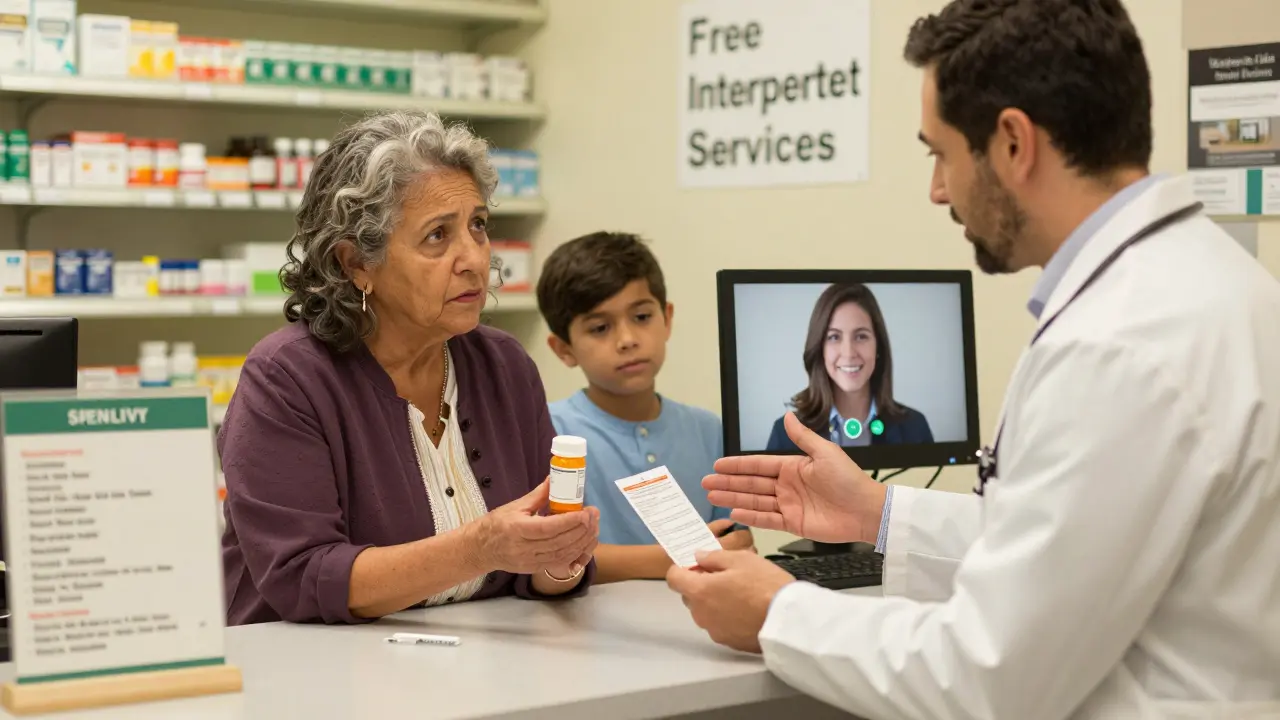
When you or someone you care about is taking medication, getting the instructions right isn’t just helpful-it’s life-or-death. But if you don’t speak English well, understanding what to take, when to take it, or how much to take can be a dangerous gamble. Studies show that patients with limited English proficiency (LEP) are twice as likely to have a medication error compared to English-speaking patients. A 2022 study from the Children’s Hospital of Philadelphia found that 17.7% of children in LEP families experienced a medication error, compared to just 9.6% in English-speaking families. These aren’t small mistakes. They’re hospital trips, allergic reactions, overdoses, and sometimes worse.
Why Language Barriers Lead to Medication Errors
It’s not just about not understanding the word "twice daily." It’s about not knowing what "dropperful" means, or whether "for thirty days" means you stop after 30 days or need to refill. A 2021 study in the Bronx found that 31% of pharmacies couldn’t print prescription labels in Spanish-even though most of their patients spoke Spanish. In Milwaukee, half of pharmacies admitted they rarely or never provided non-English instructions or translated medication guides. That’s not a glitch. It’s a system failure. And when there’s no professional interpreter, families are left to fill the gap. One in nine pharmacies in the U.S. still rely on children, friends, or relatives to translate medication instructions. But untrained interpreters miss critical details. A 2023 NCBI review found that up to 25% of family interpretations contain dangerous errors-like confusing "10 mg" with "100 mg," or mixing up "take with food" and "take on an empty stomach." One Reddit user shared how their Spanish-speaking mother was given the wrong insulin dose because the pharmacy used Google Translate. She ended up in the hospital.What Works: The Best Ways to Get Help
The good news? We know exactly what reduces these risks-and it’s not complicated.- Professional interpreters-in person, over the phone, or via video-are the gold standard. Studies show they cut medication errors by up to 50%. A hospital in New Jersey cut LEP-related medication mistakes by 40% in just one year after hiring trained interpreters.
- Translated medication labels-not just the name of the drug, but the instructions. Things like "take with water," "avoid alcohol," or "do not crush" need to be clear in the patient’s language.
- Directly observed dosing-where a nurse or pharmacist watches you take your medicine-works even when language is a barrier. It’s simple, human, and effective. A 2017 study in the Journal of General Internal Medicine showed it reduced errors by 30% for patients on blood thinners like Coumadin.
- Teach-back method-instead of just handing you a pamphlet, the provider asks, "Can you show me how you’ll take this?" If you can’t explain it correctly, they try again. This cuts misunderstandings by half.
What Doesn’t Work (And Why)
Many places still try to cut corners. Here’s what fails-and why.- Family members-They care, but they’re not trained. They might say "take it in the morning" when the real instruction is "take it at bedtime." They might not know medical terms like "hypertension" or "anticoagulant."
- Google Translate or apps-These tools don’t understand context. "Take one tablet by mouth" might translate as "Put one tablet in your mouth," which sounds fine-but if the tablet is a time-release capsule, swallowing it whole matters. Apps can’t explain that.
- Waiting until you ask-Many patients don’t speak up because they’re afraid of being judged, embarrassed, or told they’re "too hard to help." A 2023 KFF survey found 37% of LEP adults had fewer than half of their visits with a provider who spoke their language. Fifteen percent had zero language-concordant visits in three years.

What You Can Do Right Now
You don’t have to wait for the system to fix itself. Here’s what you can do today:- Ask for an interpreter-At every appointment, say: "I need an interpreter." You have a legal right to one under Title VI of the Civil Rights Act. Hospitals and pharmacies receiving federal funds must provide them.
- Ask for written instructions in your language-Don’t accept just English. Ask: "Can you print this in [your language]?" If they say no, ask to speak to a supervisor.
- Use the teach-back method-After the provider explains your meds, say: "Can you let me show you how I’ll take this?" If you can’t do it right, they need to try again.
- Bring a trusted person-If you have a friend or neighbor who speaks both languages, bring them. Make sure they’re calm and focused-not distracted or emotionally overwhelmed.
What Providers Should Be Doing
Healthcare systems have a responsibility. But many don’t meet even basic standards:- Only 32% of hospitals have a system to identify LEP patients before they arrive. That means interpreters are often called last-minute-or not at all.
- Many pharmacy systems can’t print non-English labels. Even if they have the translation, their software doesn’t support it.
- Staff often don’t know how to use video interpreters. They’ll leave the room, talk over the patient, or rush the call.
- Universal language identification-Ask every patient, "What language do you speak at home?" at check-in. Simple. Systematic. Required.
- Contract with a professional service-Don’t rely on volunteers. Use certified medical interpreters. Companies like LanguageLine or Certified Languages International offer 24/7 phone and video services.
- Translate high-risk meds first-Start with blood thinners, insulin, seizure meds, and heart drugs. These are the ones that kill when misunderstood.

The Bigger Picture
This isn’t just about communication. It’s about equity. The U.S. Census Bureau projects that by 2030, one in four Americans will speak a language other than English at home. If we don’t fix this now, we’re setting up a healthcare system where millions can’t safely take their medicine. Some hospitals are getting it right. In Seattle, a clinic started using video interpreters for all medication reviews. Within six months, medication-related ER visits from LEP patients dropped by 45%. In New York, a pharmacy began printing bilingual labels for the top 10 most prescribed drugs. They saw a 38% drop in refill errors. The technology exists. The research is clear. The law requires it. What’s missing is consistent action.Frequently Asked Questions
Do I have to pay for an interpreter at the pharmacy or hospital?
No. Under Title VI of the Civil Rights Act, any healthcare provider that gets federal funding-this includes most hospitals, clinics, and pharmacies-must provide interpreters at no cost to you. You should never be asked to pay for interpretation services. If someone tries to charge you, ask to speak to a manager or file a complaint with the Office for Civil Rights.
What if my language isn’t commonly spoken, like Hmong or Somali?
Even for less common languages, professional interpretation services have access to over 200 languages. Most phone and video services can connect you with an interpreter within 30 seconds. If a provider says they can’t find someone for your language, ask them to use a national service like LanguageLine or the National Council on Interpreting in Health Care. They’re required to make a good-faith effort.
Can I use my phone to translate medication instructions?
It’s better than nothing, but it’s not safe. Translation apps can’t handle medical context. They might translate "take with food" as "eat with it," which sounds fine-but if the drug is meant to be taken before meals, that’s wrong. Always ask for a human interpreter or written instructions in your language. Use apps only to double-check, not to make decisions.
What should I do if I got the wrong dosage because of a language barrier?
Call your provider or go to the nearest emergency room immediately. Then, ask for a formal incident report. Document everything: the date, the medication, what you were told, and what actually happened. You can also file a complaint with your state’s health department or the Office for Civil Rights. Mistakes like this are preventable-and you have the right to demand better.
Are there free resources to help me understand my prescriptions?
Yes. The National Council on Interpreting in Health Care offers free multilingual medication guides. The FDA’s website has plain-language guides for common drugs. Local community health centers often have bilingual health educators who can walk you through your prescriptions. Ask your clinic if they have a patient advocate or community health worker who speaks your language.
Katherine Rodriguez
March 12, 2026 AT 16:30Why are we even talking about this like it's a new problem? We've had non-English speakers in this country for decades and still no one in charge wants to fix the system. It's always 'we'll get to it' until someone dies. And then it's back to business as usual.
Pharmacies don't print labels in Spanish? Cool. So what? Let them figure it out. I didn't learn Spanish so their grandma can live longer.
I'm tired of being forced to care about people who refuse to learn the language of the country they live in. It's not my job to translate your insulin dose.
Stop making healthcare about identity and start making it about responsibility. Learn English. Or don't take the medicine. Simple.
Devin Ersoy
March 14, 2026 AT 12:44Oh honey, let me grab my monocle and tell you how the system is collapsing under the weight of its own incompetence. We're not just talking about mislabeled pills here-we're talking about a full-blown cultural farce where pharmacies are using Google Translate like it's a sacred scripture.
Imagine: a man in Milwaukee, holding a vial of warfarin, squinting at a label that says 'take with food' in broken Tagalog, while his 8-year-old daughter whispers 'it says eat nachos' in the background.
Meanwhile, in the boardroom, some guy in a suit is calculating ROI on interpreters versus ER visits. Spoiler: the ER visits are cheaper. Because apparently, human life is just a line item in a PowerPoint deck titled 'Efficiency Through Apathy.'
And don't get me started on the 'teach-back method.' It's like asking a toddler to explain quantum physics while juggling. But hey, at least we tried, right?
Scott Smith
March 15, 2026 AT 13:01This is one of those issues where the solution is obvious but rarely implemented. Professional interpreters aren't a luxury-they're a standard of care. Just like sterile needles or calibrated dosing devices.
Every hospital has protocols for allergic reactions, for drug interactions, for overdose prevention. But when it comes to language, we treat it like an optional side quest.
The teach-back method? It's low-tech, high-impact. No app. No translation service. Just a person asking, 'Can you show me?' It’s human. It’s effective. And it costs nothing but attention.
Why aren’t we doing this everywhere? Because we’ve normalized neglect. And that’s not just lazy-it’s dangerous.
Sally Lloyd
March 16, 2026 AT 07:11Let’s be real-this isn’t about language. It’s about control.
Who benefits from keeping non-English speakers confused? Pharmaceutical companies. Insurance providers. The entire bureaucratic machine that thrives on complexity.
Think about it: if everyone understood their meds perfectly, they’d know exactly what they’re being prescribed, how much it costs, and whether it’s even necessary.
But if they’re stumbling through half-translated labels and rushed phone calls? They’re more likely to comply, to refill, to stay in the system.
And don’t tell me about 'Title VI.' The law is a suggestion with a stamp. Real change? It only happens when the cost of inaction becomes unbearable. And right now? It’s still cheaper to let people die quietly.
Emma Deasy
March 16, 2026 AT 19:32Oh. My. GOSH. This is not just a public health crisis-it is a moral catastrophe of staggering proportions.
Imagine: a child, trembling, holding a vial of insulin, because their parent, who speaks only Mandarin, was handed a slip of paper that said, 'Take one pill at 9 AM'-but the 'one' was smudged, and the '9' looked like a '6'-and the pharmacy, in its infinite wisdom, did not provide a translation-because 'it was too expensive.'
And then-oh, the horror-there is a hospitalization. A near-death experience. A family shattered by bureaucracy. A system that values profit over life.
And yet, we sit here-quietly-accepting this as normal? We need federal mandates. We need national audits. We need public shaming. We need a national day of mourning for every life lost because someone didn't speak English.
This is not a 'problem.' This is a sin.
tamilan Nadar
March 17, 2026 AT 13:10In India, we have over 22 official languages. People take pills every day without English labels. We use symbols. Colors. Icons. A red dot means 'take after food.' A blue dot means 'take before.' No translation needed.
Why are we stuck on text? Why not use universal visual cues? Simple. Cost-effective. Works across borders.
Also, in rural India, we use local health workers who know the language, the culture, the context. Not apps. Not phones. Not kids. Real people.
Maybe the U.S. doesn't need more interpreters. Maybe it needs better design.
Adam M
March 18, 2026 AT 20:03Stop making excuses. If you can't read English, don't take the medicine. Simple.
Rosemary Chude-Sokei
March 19, 2026 AT 01:23I appreciate the depth of research presented here. The data is unequivocal: language barriers directly correlate with preventable harm. What strikes me most is the disparity between known solutions and actual implementation.
It is not a question of capability. It is a question of prioritization.
Healthcare institutions that claim to uphold patient safety must operationalize linguistic equity with the same rigor as infection control or medication reconciliation.
The teach-back method, professional interpreters, and bilingual labeling are not 'nice-to-haves.' They are clinical necessities.
And yet, we continue to treat them as charitable add-ons. This is not merely inefficient-it is ethically indefensible.
Noluthando Devour Mamabolo
March 19, 2026 AT 03:36OMG this is so REAL 😭💔
My aunt in Johannesburg had a stroke because the pharmacist gave her the wrong dose of her blood pressure med. She couldn't read the English label. The 'take once daily' was written in tiny font. She thought it meant 'take once every 24 hours'-but the pharmacist didn't check. Just handed it over.
Now she's on a feeding tube. And the pharmacy? They said 'we don't have Zulu labels.'
Like... why? We have QR codes now. Why not QR code that plays audio in your language? Or a chatbot with a human backup?
It's 2025. We have AI. We have translation APIs. We have smartphones. Why are people still dying because of a lack of print labels? 🤦♀️
Also-can we please make 'teach-back' mandatory? Like seatbelts? Like hand sanitizer? This should be a standard of care. Period.
Leah Dobbin
March 19, 2026 AT 16:22It’s amusing how everyone acts like this is some shocking revelation. The truth is, if you’re not fluent in English, you’re not meant to be in this system. The system is designed for English speakers. That’s not discrimination-it’s efficiency.
And as for ‘professional interpreters’? Who pays for that? The taxpayer? The hospital? The pharmaceutical company? Someone always pays. And guess who ends up footing the bill? The people who speak English and work hard to afford their own meds.
Maybe instead of translating every pill bottle, we should be encouraging integration. Language is the first step. Not a service.
Ali Hughey
March 21, 2026 AT 15:31THIS IS A COVER-UP. A DELIBERATE PLOT.
Do you think the government doesn’t know about this? Of course they do.
Why? Because if non-English speakers die from medication errors, they’re not voting. They’re not demanding change. They’re not filing lawsuits. They’re not on social media.
And who benefits? The same people who profit from the opioid crisis. The same ones who lobbied against the Affordable Care Act. The same ones who want a population that’s too confused, too scared, too isolated to fight back.
They don’t want you to have an interpreter. They want you to be silent.
And if you’re reading this? You’re one of the lucky ones. You can read English. But what about the next person? The one who can’t? They’re already dead. And no one’s talking about it.
Wake up. This isn’t about language. It’s about control.
Alex MC
March 22, 2026 AT 08:09I’ve seen this firsthand. My neighbor’s mom, who speaks only Vietnamese, was given the wrong dosage of her heart medication. She didn’t say anything because she didn’t want to seem 'difficult.'
When we finally got her to a clinic with a real interpreter, we found out she’d been taking double the dose for six months.
She’s fine now. But it took someone else noticing she was off-balance.
What I’ve learned: it’s not about the language. It’s about the silence.
Patients don’t speak up because they’re scared. Providers don’t act because they’re overwhelmed.
But if we all just paused for five minutes-asked, listened, repeated-it could save a life.
It’s not complicated. It’s just human.
rakesh sabharwal
March 23, 2026 AT 23:14Let’s be honest: this isn’t about language. It’s about incompetence. You can’t have a modern healthcare system that relies on children translating insulin dosages. That’s not cultural diversity-that’s systemic failure.
And yet, we keep pretending it’s a 'challenge' instead of a scandal.
The fact that pharmacies can’t print labels in Spanish? That’s not a technical issue. That’s a moral one.
Meanwhile, in India, we’ve been using color-coded pill dispensers for decades. No translation needed. No interpreter required. Just a red capsule for morning, blue for night.
Why can’t the U.S. do this? Because bureaucracy is more important than life.
And don’t get me started on 'Google Translate.' That’s not innovation. That’s negligence dressed up as technology.
Aaron Leib
March 25, 2026 AT 21:23This is one of those rare topics where the fix is simple, cheap, and already proven.
Professional interpreters? Yes.
Translated labels? Yes.
Teach-back? Yes.
So why aren’t we doing it? Because it requires consistency. And consistency requires leadership.
I work in a clinic that started using video interpreters for all new prescriptions. We didn’t need new software. We didn’t need new staff. We just needed to change one habit: ask, then wait.
Within three months, medication errors dropped by half.
The best part? Patients started trusting us more. They didn’t feel like a burden. They felt like people.
It’s not rocket science. It’s just care.