Medicaid Coverage for Prescription Medications: What’s Included in 2026

If you’re on Medicaid and need prescription drugs, you might assume your meds are fully covered. But that’s not always true. Medicaid pays for a lot of medications-but not all of them. And even when a drug is covered, you might still face hurdles like prior authorization, step therapy, or high copays. Understanding how it actually works can save you time, money, and frustration.
What Medicaid Covers (And What It Doesn’t)
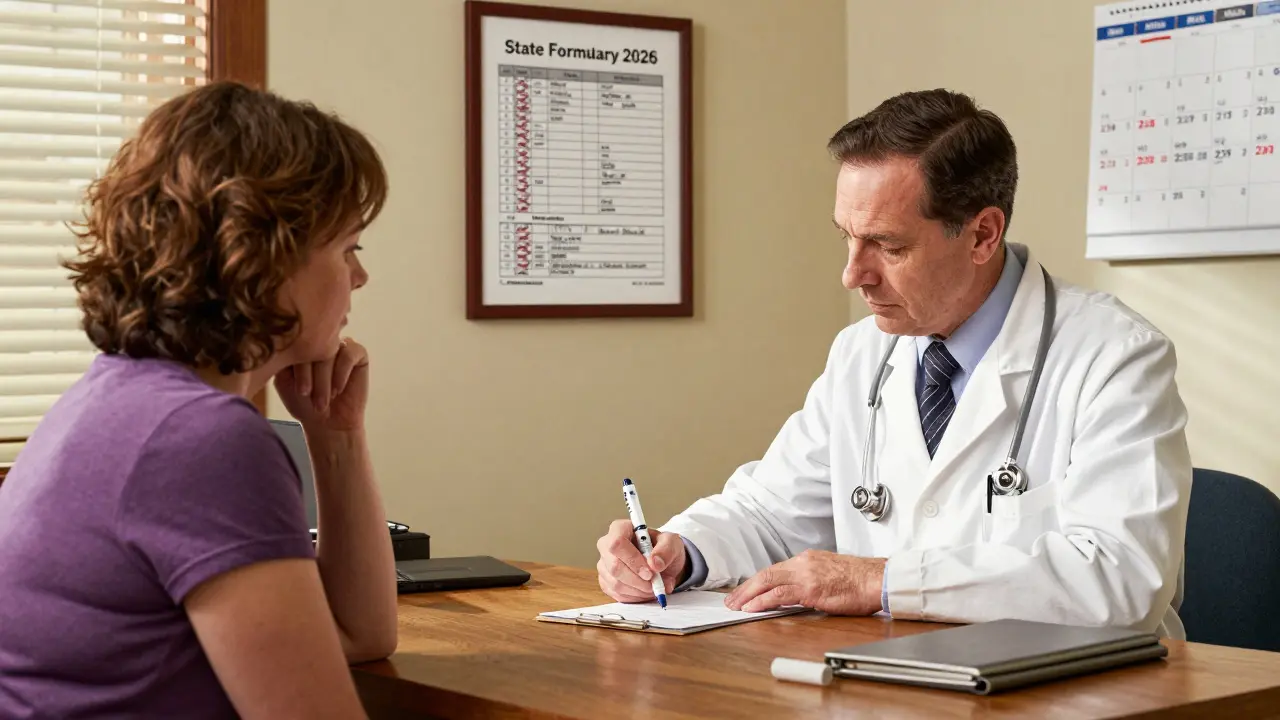
All 50 states and Washington, D.C. cover outpatient prescription drugs under Medicaid. That’s not optional-it’s standard. But here’s the catch: each state decides which specific drugs are included. There’s no national list. Instead, every state builds its own Preferred Drug List (PDL), also called a formulary.
These lists are split into tiers. Tier 1 is usually generic drugs-cheap, effective, and widely used. Think metformin for diabetes or lisinopril for high blood pressure. These often cost you just $1 to $5 per prescription. Tier 2 includes brand-name drugs that don’t have a generic version yet. These cost more-maybe $20 to $40. Tier 3 or 4? That’s where specialty drugs live: treatments for cancer, rheumatoid arthritis, or hepatitis C. These can cost hundreds or even thousands, and getting them approved is harder.
Some drugs are completely excluded. For example, in North Carolina as of October 2025, medications like Trulance, Uceris, and Vanos Cream were removed from the formulary because the state couldn’t get a good enough rebate from the manufacturer. If a drug doesn’t offer a financial incentive to the state, it gets cut-even if it’s medically useful.
How Step Therapy Works (And Why It’s a Pain)
Before you can get a non-preferred drug, many states require you to try and fail on at least two preferred alternatives first. This is called step therapy or trial and failure.
Let’s say you have depression and your doctor wants to prescribe Wellbutrin XL. But your state’s formulary lists Lexapro and Zoloft as preferred. You’ll need to try those two first. If they don’t work-or cause bad side effects-you can appeal. But that means waiting weeks, filling out paperwork, and possibly going without proper treatment in the meantime.
Thirty-eight states use this two-step rule. North Carolina is one of them. In 2024, a Reddit thread with over 200 upvotes showed people struggling with this exact issue. One user wrote: “I had to take two SSRIs that made me feel like a zombie before they’d even consider Wellbutrin. By then, I was in crisis.”
There are exceptions. If only one preferred drug exists in a class, or if your condition is too severe, your doctor can request an exception. But that requires documentation-medical notes, lab results, even letters from your provider proving why the preferred drugs won’t work.
Prior Authorization: The Paperwork Hurdle
Even if a drug is on the formulary, you might still need prior authorization. This means your doctor has to call or submit a form to your state’s Medicaid office or pharmacy benefit manager (PBM) to prove you need it.
For drugs like insulin pens, cancer treatments, or certain mental health meds, this is routine. In North Carolina, prior authorizations for premixed insulin in Type 1 Diabetes patients can last up to three years-once approved, you’re good until then. But for others, it’s a new request every few months.
According to the Medicare Rights Center’s 2024 survey, 63% of Medicaid users experienced delays because of prior authorization. The average wait for approval was 7.2 business days. If denied, and you appeal, it takes another 14.5 days on average.
But here’s the good news: 78% of denials were overturned when the doctor provided complete medical records. The key? Don’t just ask your doctor for the drug-ask them to write a detailed letter explaining why alternatives failed.
Costs You Might Still Pay
Medicaid doesn’t mean free drugs. Copays vary by state and drug tier. In most states, generics cost $1-$5. Brand-name drugs? $10-$40. Specialty drugs? Up to $50 or more.
But if you qualify for Extra Help (also called the Low-Income Subsidy), your costs drop dramatically: $0 premium, $0 deductible, $4.90 for generics, $12.15 for brands. Once you hit $2,000 in total drug costs for the year, you pay nothing for the rest. And here’s the kicker: if you’re on full Medicaid, you automatically qualify for Extra Help. Yet, about 1.2 million eligible people don’t even know they’re eligible.
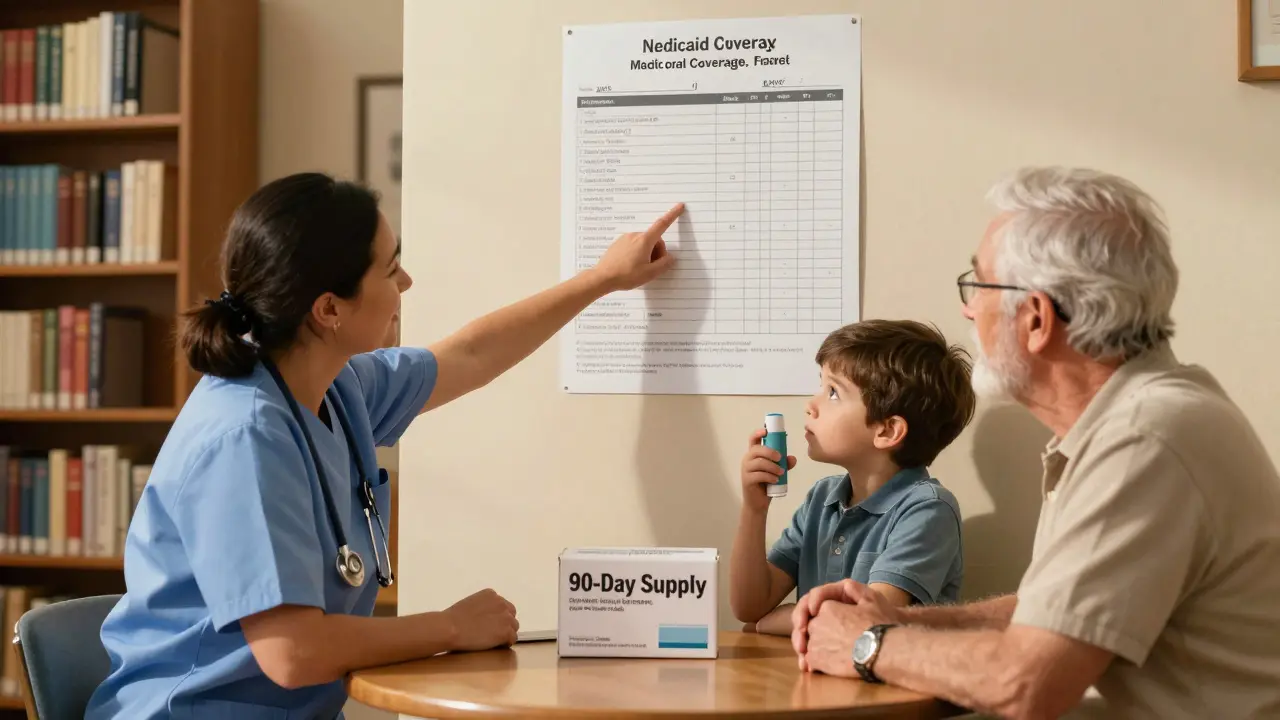
Also, you must use in-network pharmacies. Some states push you toward mail-order for maintenance meds (like blood pressure or thyroid pills). You might get a 90-day supply for the same price as a 30-day at the corner pharmacy.
Why Some Drugs Get Removed From the List
Medicaid doesn’t just pick drugs based on medical need. It picks them based on price. The program relies on the Medicaid Drug Rebate Program, started in 1990, which forces drugmakers to pay rebates to states in exchange for being on the formulary.
States negotiate these rebates hard. If a drug doesn’t offer a good enough discount, it gets cut. That’s why drugs like Diastat, Colazal, and Apriso disappeared from North Carolina’s list in 2025-not because they were unsafe, but because the manufacturer wouldn’t lower the price enough.
States also use the Federal Upper Limit (FUL) to cap payments for generics. As of 2025, the FUL is set at 250% of the average manufacturer price, minus 17.1%. If a pharmacy tries to charge more than that, Medicaid won’t pay it. This keeps prices down-but sometimes means a cheaper generic isn’t even available because the pharmacy can’t afford to sell it at the capped price.
What’s Changing in 2026
Big changes are coming. Starting in 2026, CMS (Centers for Medicare & Medicaid Services) will require states to prove their formularies don’t create unreasonable barriers to care. That means if a drug is medically necessary and no alternatives exist, states can’t just deny it because it’s expensive.
Also, the Inflation Reduction Act’s $2,000 out-of-pocket cap for Medicare Part D now applies to dual-eligible beneficiaries (those on both Medicare and Medicaid). That’s a huge win for older adults on Medicaid who need expensive drugs.
And there’s pressure to change the FUL calculation. The Medicare Payment Advisory Commission (MedPAC) suggested lowering it from 250% to 225% of the average manufacturer price. That could save Medicaid $1.2 billion a year-money that could go toward covering more specialty drugs.
How to Navigate It All
Here’s what you can do right now:
- Check your state’s current Preferred Drug List. Search “[Your State] Medicaid formulary 2025” or visit your state’s Medicaid website.
- Ask your pharmacist if your drug is on the list. They can tell you the tier and if prior auth is needed.
- If your drug is denied, ask your doctor for a letter explaining medical necessity. Don’t accept “no” without documentation.
- Enroll in Extra Help if you’re eligible. You’re probably already qualified if you have full Medicaid.
- Use mail-order pharmacies for long-term meds. You’ll save money and avoid running out.
Many people feel lost in this system. But you’re not alone. State Health Insurance Assistance Programs (SHIPs) offer free counseling. They help people understand their coverage, fill out appeals, and find cheaper alternatives. You can find your local SHIP by calling 1-877-839-2675.
Who Gets Hit Hardest?
People with chronic conditions-diabetes, mental illness, autoimmune diseases-are most affected by formulary changes. Specialty drugs for rare diseases often get excluded or require endless paperwork.
Older adults on both Medicare and Medicaid pay the most. They make up only 15% of Medicaid users but account for 38% of drug spending. A single course of a new gene therapy could cost $2 million. States are scrambling to find ways to pay for them without breaking the budget.
Children, on the other hand, are better protected. Medicaid covers nearly all essential pediatric drugs, including vaccines, asthma inhalers, and ADHD meds. That’s by design-children are a priority.
Final Thoughts
Medicaid gives millions of Americans access to life-saving drugs. But it’s not a simple “take what you need” system. It’s a complex web of state rules, rebates, tiers, and paperwork. The system works because it saves money-but it sometimes saves money at the cost of patient access.
Knowing how your formulary works, what steps you need to take, and where to get help can make all the difference. Don’t assume your doctor’s prescription will be covered. Check it. Ask questions. Fight denials with documentation. And never forget: if you’re on Medicaid, you’re entitled to help navigating this system. Use it.
Does Medicaid cover all prescription drugs?
No. Medicaid covers outpatient prescription drugs in all states, but each state creates its own list of approved medications called a Preferred Drug List (PDL). Some drugs are excluded if the manufacturer doesn’t offer a sufficient rebate, or if there are cheaper alternatives available. Always check your state’s current formulary before assuming a drug is covered.
Why do I have to try other drugs first before getting the one my doctor prescribed?
This is called step therapy or trial and failure. States use it to control costs by requiring patients to try lower-cost, preferred drugs before covering more expensive ones. In 38 states, you must fail two preferred drugs before getting a non-preferred one. Exceptions exist for medical necessity, but you’ll need documentation from your doctor to qualify.
What is prior authorization, and how do I get it?
Prior authorization is when your doctor must get approval from Medicaid before a drug is covered. This is common for specialty drugs, high-cost medications, or those with safety risks. Your doctor submits clinical records showing why the drug is necessary. If denied, you can appeal-with complete medical documentation, 78% of denials are overturned.
Can I get help paying for my prescriptions if I’m on Medicaid?
Yes. If you have full Medicaid coverage, you automatically qualify for Extra Help (Low-Income Subsidy), which lowers your drug costs to $0 premium, $0 deductible, $4.90 for generics, and $12.15 for brand-name drugs. Once you hit $2,000 in annual spending, you pay nothing for covered drugs. About 1.2 million eligible people don’t enroll-don’t be one of them.
What if my drug was removed from the Medicaid formulary?
If your drug was removed, it likely didn’t meet the state’s rebate requirements. You can ask your doctor to request an exception based on medical necessity. You can also check if a generic or alternative drug is available on the formulary. Contact your state’s Medicaid office or a SHIP counselor for help navigating the appeal process.
How do I find out what drugs are covered in my state?
Visit your state’s Medicaid website and search for “Preferred Drug List” or “formulary.” Most states publish updated lists quarterly. You can also call your pharmacy or Medicaid customer service. Pharmacies can check the formulary in real time when filling your prescription.
Are mail-order pharmacies required for Medicaid prescriptions?
Not required, but strongly encouraged for maintenance medications like blood pressure or diabetes drugs. Many states offer 90-day supplies through mail-order at lower copays than retail pharmacies. Using mail-order can save you money and reduce trips to the pharmacy.
Michael Burgess
January 2, 2026 AT 05:03Man, I had to go through step therapy for my antidepressant last year. Took 3 months just to get my doc to fight for Wellbutrin. By then, I was a mess. Medicaid’s got the best intentions, but the bureaucracy? It’s a goddamn obstacle course. 😩
Brittany Wallace
January 3, 2026 AT 07:12It’s wild how drug pricing is basically a negotiation between states and pharma giants… and we’re the ones stuck in the middle. Like, I get cost control, but when your life depends on a pill, it shouldn’t feel like you’re begging for mercy. 🌱
innocent massawe
January 4, 2026 AT 09:00Same in Nigeria-drugs are either too expensive or not available. But here at least there’s a system. Kinda. 😅
Liam Tanner
January 5, 2026 AT 19:26Extra Help is automatic if you’re on full Medicaid? I didn’t know that. I’ve been paying $40 for my insulin for years. Gonna call my caseworker tomorrow. Thanks for the tip.
veronica guillen giles
January 7, 2026 AT 15:10Oh wow, so Medicaid’s just a fancy version of ‘try this cheaper poison first’? Brilliant. Who thought up this genius system? Definitely not someone who’s ever had to wait 6 weeks for a mental health med. 🙄
Wren Hamley
January 8, 2026 AT 06:15Formularies are a mess. I had a friend get denied for a skin cream because it wasn’t on the list-turns out it was the only thing that stopped her eczema from bleeding. She had to sell her laptop to pay out of pocket. This ain’t healthcare. It’s a game.
Hank Pannell
January 10, 2026 AT 01:40There’s a structural irony here: the Medicaid Drug Rebate Program was designed to reduce net costs, yet it incentivizes exclusion over access. The FUL cap further distorts market dynamics by creating artificial shortages of generics-pharmacies can’t profitably dispense them at the mandated price. So we get ‘cost containment’ via de facto rationing. The 2026 CMS ‘unreasonable barriers’ rule is a start, but without binding formulary inclusion thresholds, it’s just regulatory theater. We need a tiered access model tied to clinical necessity, not rebate percentage.
Lori Jackson
January 11, 2026 AT 00:18People who complain about step therapy just don’t understand fiscal responsibility. If you can’t afford to pay for your meds, maybe you shouldn’t be on them. There are cheaper options-use them. This isn’t a luxury spa, it’s a public program. Stop acting like your prescription is a right.
Palesa Makuru
January 11, 2026 AT 20:42Oh honey, you think this is bad? In South Africa, we don’t even have formularies-we have ‘if it’s in stock, you get it’. And if it’s not? Well, you just… don’t. Your ‘hurdles’ are luxury problems. You’re lucky you have a system at all. 🤷♀️
erica yabut
January 13, 2026 AT 11:46People who don’t know about Extra Help are just lazy. If you can’t read a Medicaid website, maybe you shouldn’t be managing your own healthcare. It’s right there. Like, how hard is ‘search [state] Medicaid formulary’? I’m not even mad, just disappointed.
Tru Vista
January 15, 2026 AT 07:45Mail order? I hate that. I can’t even spell ‘prior auth’ right. 😴
Sarah Little
January 17, 2026 AT 00:56Wait, so if I’m on Medicaid, I’m automatically eligible for Extra Help? I’ve been paying $35 for my thyroid med for 2 years. I’m calling my pharmacy now. Thank you for this. I didn’t even know.
Ian Ring
January 17, 2026 AT 18:58Thank you for the detailed breakdown-this is exactly the kind of clarity that’s missing from official portals. I’ve been trying to explain this to my mom for months. The 78% appeal success rate with documentation? That’s the key. I’m printing this out for her doctor tomorrow. 🙏