Medication Reviews: When Seniors Should Stop or Deprescribe Medicines
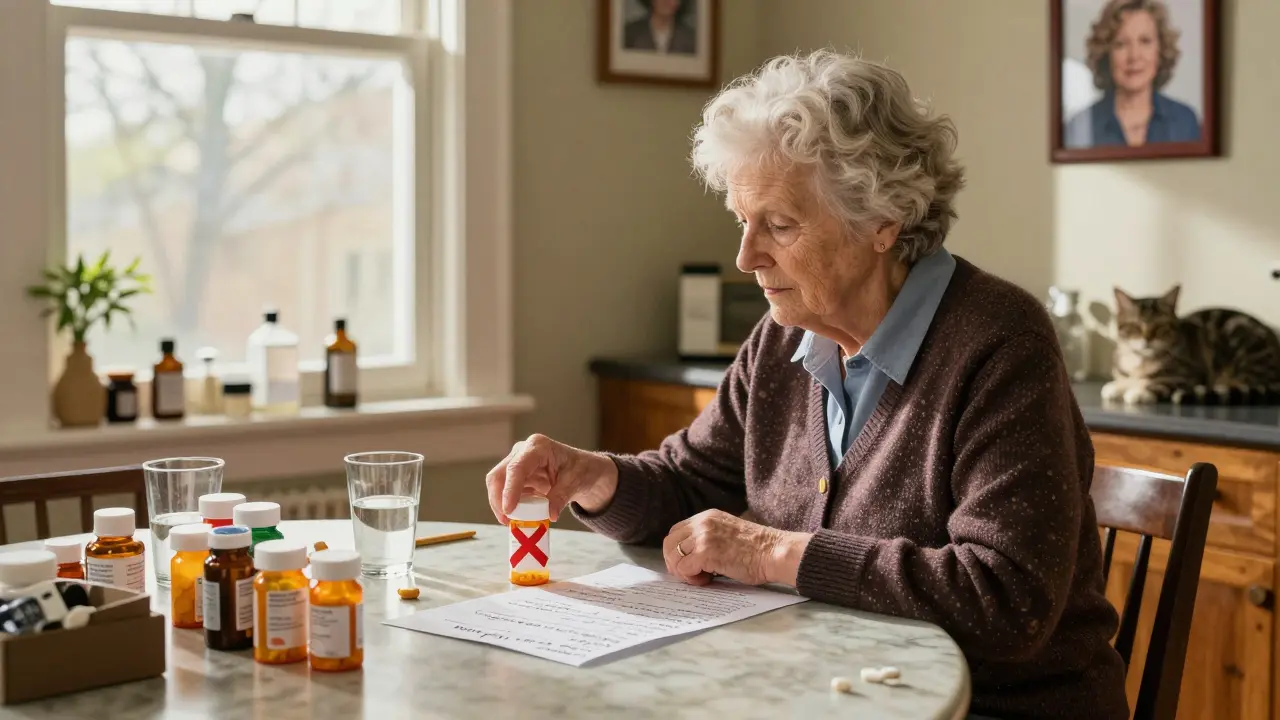
Why Seniors Often Take Too Many Medicines
It’s common for older adults to be on five, ten, or even more medications. Some are for heart disease, others for arthritis, diabetes, high blood pressure, acid reflux, or sleep problems. But here’s the problem: many of these drugs were started years ago, and no one ever stopped to ask if they’re still helping.
Medications aren’t like shoes-you don’t just keep wearing them because they fit once. Over time, the body changes. Kidneys slow down. Liver function drops. Conditions improve or fade. What once saved your life might now be causing dizziness, confusion, falls, or stomach bleeding. And the more pills you take, the higher the risk.
In the U.S., the number of seniors taking five or more medications tripled between 1994 and 2014. In Scotland and Australia, the trend is just as sharp. The cost? Over $30 billion a year in preventable hospital visits and emergency care just from bad drug reactions in older adults. That’s not just money-it’s lost independence, broken hips, and scared families.
What Is Deprescribing? It’s Not Just Stopping Pills
Deprescribing isn’t about cutting pills randomly. It’s a careful, planned process of stopping or lowering doses of medicines that no longer match the person’s goals, health, or life stage. The term was first used in 2003 by an Australian doctor, and since then, it’s become a standard part of good geriatric care.
Think of it like this: when a doctor prescribes a new drug, they don’t just hand it over and walk away. They explain why, set a goal, check in later, and adjust. Deprescribing does the same thing-but in reverse. It asks: Is this drug still doing more good than harm?
It’s not about reducing the total number of pills. It’s about removing the ones that are outdated, risky, or unnecessary. A 90-year-old with advanced dementia doesn’t need a cholesterol pill meant to prevent a heart attack in 10 years. A woman with severe arthritis who can barely walk doesn’t need a sleep aid that makes her stumble at night. These aren’t just side effects-they’re safety hazards.
When It’s Time to Talk About Stopping
There are clear moments when a medication review isn’t optional-it’s urgent.
- New symptoms appear. If your parent suddenly feels dizzy, confused, has falls, or develops a rash, ask: Could this be from a drug? Many older adults are misdiagnosed because doctors assume it’s aging, not a reaction to medicine.
- Life expectancy has changed. If someone has late-stage cancer, advanced dementia, or is now fully dependent on others for daily care, preventive drugs (like statins or aspirin for heart disease) often offer no real benefit. The risks outweigh the distant, theoretical gains.
- They’re on high-risk drugs. Some medications are especially dangerous for seniors. Benzodiazepines (like Valium or Xanax) for sleep or anxiety increase fall risk by up to 50%. Anticholinergics (used for bladder issues, allergies, or depression) can cause memory loss and confusion. These are top candidates for review.
- Medicines are just being renewed. How many times have you heard, “I’ve been on this for 15 years, and my doctor just keeps renewing it”? That’s not care-it’s autopilot. Every refill should be a chance to ask: Why am I still taking this?

How Deprescribing Actually Works
Good deprescribing follows a clear path:
- Review the full list. Gather every pill, patch, inhaler, and supplement. Don’t forget over-the-counter drugs like antacids or sleep aids. Many seniors don’t tell doctors about these because they think they’re “not real medicine.”
- Match each drug to a goal. For each medication, ask: What was it meant to do? Is that goal still relevant? Has the person’s health changed enough to make it obsolete?
- Use trusted tools. Doctors use guides like the Beers Criteria or STOPP to spot high-risk drugs for seniors. These aren’t magic lists-they’re based on decades of research on what causes harm in older bodies.
- Stop one at a time. Never cut multiple drugs at once. If you stop two and the person feels worse, you won’t know which one caused it. Slow, single changes let you see what’s working.
- Watch closely. After stopping a drug, check in weekly for two to four weeks. Watch for returning symptoms (like heartburn after stopping a proton pump inhibitor) or new ones (like anxiety after stopping a sedative).
- Involve the person. The patient’s values matter. If someone wants to avoid hospital visits more than they want to live longer with a few extra pills, that’s their call. Deprescribing is a conversation, not a command.
Who Should Be Doing This?
It’s not just the doctor’s job. A good deprescribing team includes:
- Clinical pharmacists. They’re trained to spot drug interactions and unnecessary prescriptions. In hospitals and clinics, pharmacist-led reviews cut inappropriate meds by 20-40%.
- Geriatricians. These doctors specialize in aging. They know how frailty, memory loss, and mobility changes affect how drugs work.
- Family and caregivers. They see daily changes-like a parent forgetting to take pills, or acting more confused after a new prescription. Their observations are critical.
- The senior themselves. They’re the only one who knows how they feel. If they say, “I don’t feel better on this,” that’s data. Don’t dismiss it.
Many people think, “My GP knows everything.” But most general practitioners aren’t trained in deprescribing. They’re pressured by time, and guidelines rarely tell them how to stop drugs-only how to start them.
What Happens When You Stop?
Some people worry: “If I stop this pill, will my condition come back worse?”
It’s a fair fear. But research shows something surprising: when seniors stop inappropriate meds, they don’t get sicker-they often get better.
Studies show:
- Adverse drug events drop by 17-30%.
- Hospital readmissions fall by 12-25%.
- People report better sleep, clearer thinking, and more energy.
- Quality of life scores improve-even when chronic conditions like high blood pressure stay unchanged.
Take proton pump inhibitors (PPIs), the common acid reflux drugs. Many seniors take them for years-even when they don’t have symptoms. Stopping them safely, under supervision, works for 60-80% of people. Their heartburn doesn’t return. Their stomach doesn’t explode. They just feel lighter.
Same with sleeping pills. Many seniors use them because they can’t sleep. But after stopping, most adjust within a week or two. Their sleep improves naturally. And they stop falling in the bathroom at night.

Barriers to Deprescribing-And How to Beat Them
It’s not easy. Here’s why it doesn’t happen more often:
- Doctors don’t know how. Medical training focuses on adding treatments, not removing them. Few doctors have been taught how to stop a drug safely.
- Patients are scared. “My last doctor said this was life-saving.” That’s a powerful belief. It takes trust to question it.
- Pharmacies keep refilling. Automatic refills make it easy to keep taking pills-even when they’re no longer needed.
- There’s no checklist. No one says, “At age 80, stop statins if you’re not active.” Without clear guidance, doctors stick to the default.
The fix? Start small. Ask your doctor: “Can we review my meds?” Bring a list. Ask which ones are for prevention, and which are for active symptoms. If you’re on a drug for something you no longer have-like high cholesterol after a stroke-ask if it’s still needed.
Use free tools like Deprescribing.org (a trusted resource from Canada) to get patient-friendly guides on common drugs. Print them. Bring them to your appointment.
Real-Life Example: Margaret, 84
Margaret was on nine medications: blood pressure, cholesterol, diabetes, acid reflux, sleep aid, painkiller, arthritis pill, vitamin D, and aspirin. She’d been on most since her 70s. She started falling once a month. Her memory felt foggy. She couldn’t walk to the mailbox without getting winded.
Her pharmacist did a review. They found:
- Her cholesterol was low. She hadn’t had a heart issue in 15 years. Statin stopped.
- Her acid reflux was mild. PPI was causing bone loss. Stopped.
- Her sleep aid was making her confused. Switched to sleep hygiene plan.
- Her aspirin was for primary prevention-she had no heart disease. Stopped.
Three months later, she fell zero times. Her energy improved. She started gardening again. Her doctor said: “I didn’t realize how much she was carrying.”
Final Thought: Your Meds Aren’t Forever
Medications aren’t tattoos. They’re tools. And tools get retired when they’re no longer useful-or when they’re dangerous.
For seniors, less can mean more: more safety, more clarity, more freedom. A medication review isn’t about giving up. It’s about choosing what truly matters now.
If you’re caring for an older adult-or if you’re one-ask this question: “Is this still helping, or just taking up space in my pillbox?” That’s the first step to better health.
Oluwapelumi Yakubu
January 5, 2026 AT 07:45Man, I seen this in my village back in Lagos - old folks on 12 pills, no one checking if they still work. One uncle took blood pressure meds even after his BP dropped to 80/50 and he was dizzy all day. Family thought it was just aging. Turned out, stop the meds, he started walking to market again. Deprescribing ain’t just Western science - it’s common sense with a medical label.
saurabh singh
January 6, 2026 AT 04:21As someone who’s seen my grandma go from ‘I need this for my heart’ to ‘I feel like myself again’ after cutting three meds - this is life-changing. In India, we don’t talk about this enough. Elders are told ‘take it or die’ - but the truth? Sometimes taking less lets you live more. We need community pharmacists to do these reviews, not just doctors who rush through 10-minute visits.
Charlotte N
January 6, 2026 AT 21:47I’ve been thinking about this since my mom got her first statin at 72... she never had heart issues... just cholesterol numbers... and now she’s on 7 meds... and she’s always tired... I don’t know if I’m overthinking it... but what if... maybe... we’re just... keeping her on things because... it’s easier than asking questions...
Chris Cantey
January 7, 2026 AT 22:53Deprescribing is just another form of medical nihilism dressed up as wisdom. If you stop treating symptoms, you’re not curing aging - you’re surrendering to it. The body decays. Medicine is the only thing standing between us and chaos. You can’t just ‘let go’ of pharmacology like it’s a bad habit.
Jacob Milano
January 8, 2026 AT 22:07This is the most important post I’ve read all year. I used to think my dad’s confusion was dementia - turns out it was the anticholinergic he’d been on since 2008. We stopped it. Two weeks later, he remembered my name. He remembered my daughter’s birthday. He cried. I cried. This isn’t medicine - it’s dignity.
bob bob
January 9, 2026 AT 18:18My aunt took PPIs for 18 years. She never had heartburn. Just got them because her doctor said ‘it’s harmless.’ Then she broke her hip. Turns out long-term PPIs = weak bones. She’s off it now. No reflux. Stronger legs. And she’s back knitting. I’m telling everyone I know.
Enrique González
January 10, 2026 AT 21:22My grandfather was on 11 meds. We cut 4. He stopped falling. He started laughing again. The doctor said, ‘You’re lucky you didn’t have a stroke.’ I said, ‘We didn’t stop meds to avoid a stroke - we stopped them so he could enjoy his coffee without feeling like a zombie.’ Sometimes less is more - and sometimes more is just noise.
Uzoamaka Nwankpa
January 11, 2026 AT 22:53I’m just so tired... everyone says ‘ask your doctor’ but my mom’s doctor won’t even look at her med list. He just nods and says ‘keep taking it.’ I’ve printed the Beers Criteria. I’ve highlighted the risky ones. I’ve written notes. I’ve begged. He says ‘she’s fine.’ But she’s not fine. She’s just quiet now. And I don’t know how to make him see.
Akshaya Gandra _ Student - EastCaryMS
January 12, 2026 AT 23:24my teacher showed us this in class and i was like wow i never thought about this like my grandma takes 6 pills and i always thought she was being responsible but now i think maybe she just dont wanna argue with the dr and also she forgets if she took it or not and the pharmacist just keeps refilling like its a subscription
Allen Ye
January 13, 2026 AT 13:48There’s a deeper philosophical layer here that most people miss - we treat medicine as a permanent extension of identity. ‘I am the person who takes blood pressure pills.’ ‘I am the person who needs sleeping aids.’ But aging isn’t about accumulating treatments - it’s about shedding illusions. The pillbox becomes a shrine to a version of ourselves that no longer exists. Deprescribing isn’t medical - it’s existential. It’s asking: Who are you now, not who you were when you got the prescription? And if the answer is ‘someone who just wants to feel the sun on their face without dizziness,’ then every unnecessary pill is a cage. We’ve turned healing into habit. We’ve turned care into compliance. And we’ve forgotten that the goal isn’t to prolong life - it’s to make life worth living. The body doesn’t need more drugs. It needs more presence. More quiet. More time without the chemical fog. And if we’re brave enough to stop, we might just find out that what we thought was illness was just the sound of a life being lived - too loudly, too medicated, too afraid to be still.
Terri Gladden
January 15, 2026 AT 11:11OMG I JUST REALIZED MY MOM IS ON ALL THESE PILLS AND SHE CAN’T EVEN WALK TO THE BATHROOM WITHOUT FALLING AND NO ONE TOLD ME THIS WAS A THING I THOUGHT IT WAS JUST ‘GETTING OLD’ BUT NOW I’M SCARED I’M GOING TO LOSE HER BECAUSE WE DIDN’T ASK AND I’M SO MAD AT THE DOCTOR AND I JUST WANT TO CRY AND ALSO I NEED TO PRINT THIS ARTICLE AND TAKE IT TO HER NEXT APPOINTMENT AND I HOPE SHE DOESN’T GET ANGRY BUT I CAN’T NOT DO THIS ANYMORE
en Max
January 15, 2026 AT 12:24Based on current clinical guidelines, the deprescribing paradigm aligns with the principles of geriatric pharmacotherapy as outlined in the 2023 Beers Criteria update and the STOPP/START v2 framework. The longitudinal data from the 2019 JAMA Internal Medicine cohort study demonstrates a statistically significant reduction in polypharmacy-related adverse events (p < 0.01) when structured medication reviews are implemented by interdisciplinary teams. The absence of standardized protocols in primary care settings remains a systemic barrier, necessitating policy-level intervention to incentivize deprescribing as a reimbursable service. Additionally, patient autonomy must be operationalized through shared decision-making tools, ensuring that therapeutic goals are aligned with patient-reported outcomes - particularly in palliative and frail populations.
mark etang
January 15, 2026 AT 15:37To all healthcare professionals and caregivers: This is not merely a clinical suggestion - it is a moral imperative. The overprescription of medications to our elderly population constitutes a silent epidemic of iatrogenic harm. We owe it to our parents, our grandparents, our neighbors - to question, to review, to act. The time for passive compliance is over. The time for intentional, compassionate, evidence-based deprescribing is now. Let us not be the generation that prescribed comfort over clarity. Let us be the generation that restored dignity - one pill at a time.
Angie Rehe
January 17, 2026 AT 00:49As a pharmacist who’s seen this for 20 years - I’m so tired of automatic refills. I’ve had patients come in with 17 medications, 11 of which were discontinued 5 years ago. The system is broken. EHRs auto-renew. Doctors don’t audit. Pharmacies profit. And the elderly? They just keep swallowing. I’m not a villain - I’m a witness. And I’m done staying quiet. If you’re on a drug you don’t need - I’ll help you stop. No judgment. Just facts. And a list of the 5 most dangerous ones for seniors. Let’s fix this.