Medication Safety at Night: How to Avoid Deadly Mistakes When You're Exhausted
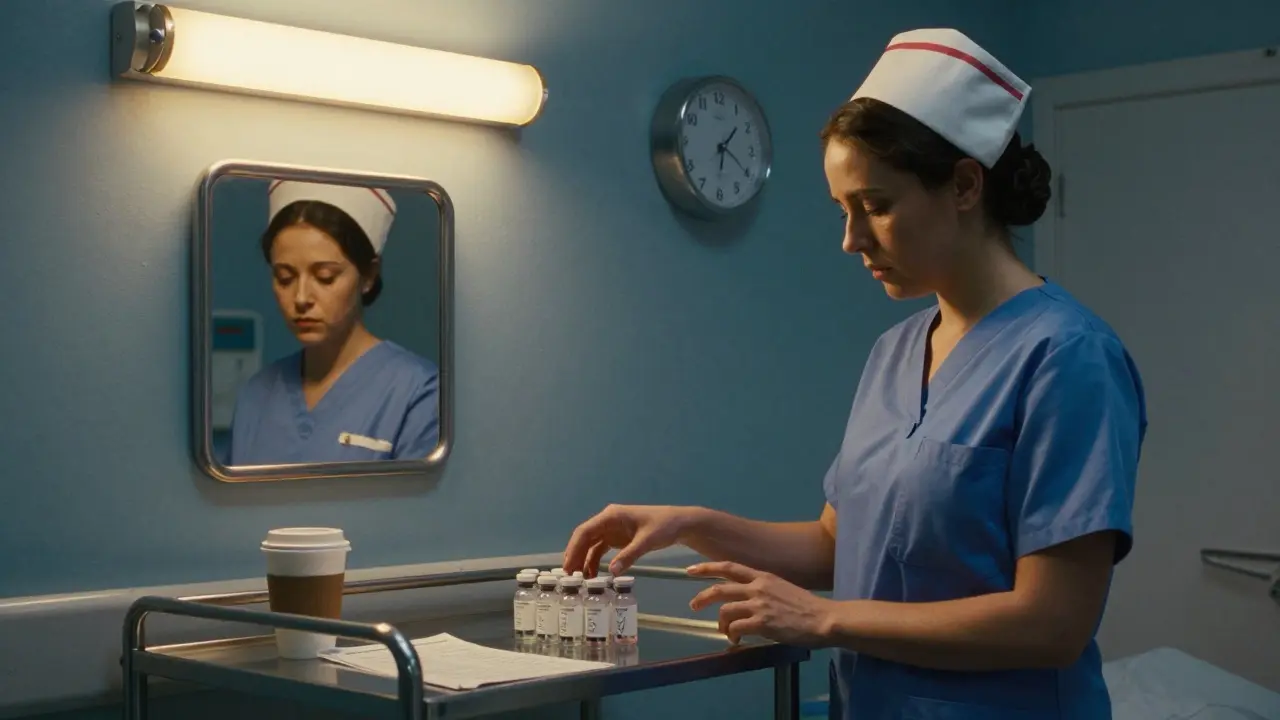
It’s 3 a.m. The hospital is quiet. The monitors beep in rhythm. You’ve been on your feet for 14 hours. Your eyes feel gritty. Your coffee is cold. You reach for the vial of insulin-same as yesterday, same as every night. But your brain isn’t working like it should. You misread the dose. You almost give it to the wrong patient. You catch yourself just in time. This isn’t a horror story. It’s a routine night for too many healthcare workers.
Why Night Shifts Make Medication Errors More Likely
When you’re tired, your brain doesn’t just slow down-it starts making mistakes you wouldn’t normally make. A 2023 review of 38 studies found that fatigue is a factor in 82% of medication errors during night shifts. That’s not a small risk. That’s the norm.
Your cognitive abilities drop sharply after 12 hours of work. Memory, attention, and decision-making weaken. Studies show that after a full night without sleep, your performance drops to levels similar to someone with a blood alcohol concentration of 0.05%. That’s legally impaired in many countries. And yet, you’re still handling life-or-death doses of medication.
It’s not just about being tired. Your body’s natural rhythm is flipped. Melatonin, the sleep hormone, peaks at night. But you’re awake. Cortisol, the alertness hormone, should be rising-but it’s suppressed. Your brain is fighting biology. And when biology loses, patients pay the price.
The Medications That Make Fatigue Worse
Here’s something no one talks about enough: some of the drugs you take to stay awake-or to sleep-are making the problem worse.
If you’re taking diphenhydramine (Benadryl) for allergies or sleep, you’re adding fuel to the fire. It causes drowsiness in 50-60% of users. Even if you think you’re fine, your reaction time and memory are still impaired. The same goes for zolpidem (Ambien), which leaves 15-20% of people groggy the next day. Benzodiazepines like diazepam? They linger in your system, causing residual sedation in 30% of users.
Even pain meds like oxycodone or antidepressants like trazodone can make you sleepy. And if you’re taking them on top of a 12-hour shift? You’re not just tired-you’re medicated into a fog.
The CDC’s NIOSH recommends switching to non-sedating alternatives. For allergies, try loratadine (Claritin) instead of diphenhydramine. For sleep, talk to your doctor about non-pharmacological options. Your next patient might depend on it.
How Fatigue Changes the Way You Think
Fatigue doesn’t just make you slow. It makes you careless in predictable ways.
- You skip double-checks because “I know this one.”
- You misread labels because your eyes glaze over.
- You confuse similar-sounding drugs: morphine and hydromorphone, heparin and insulin.
- You forget to verify the patient’s name, assuming you’ve seen them before.
A 2022 study of 12,450 providers found medical errors increased by 12.1% during night shifts. But the real danger? The errors you don’t even notice. You think you’re fine. You feel “used to it.” But your brain is running on autopilot-and autopilot gets things wrong.
And it’s not just about the meds. Communication suffers too. A 2018 study showed a 33% drop in effective communication when doctors were sleep-deprived. You might not say the wrong thing-but you might not say the right thing clearly enough. That’s how mistakes slip through.
The False Promise of Caffeine and Naps
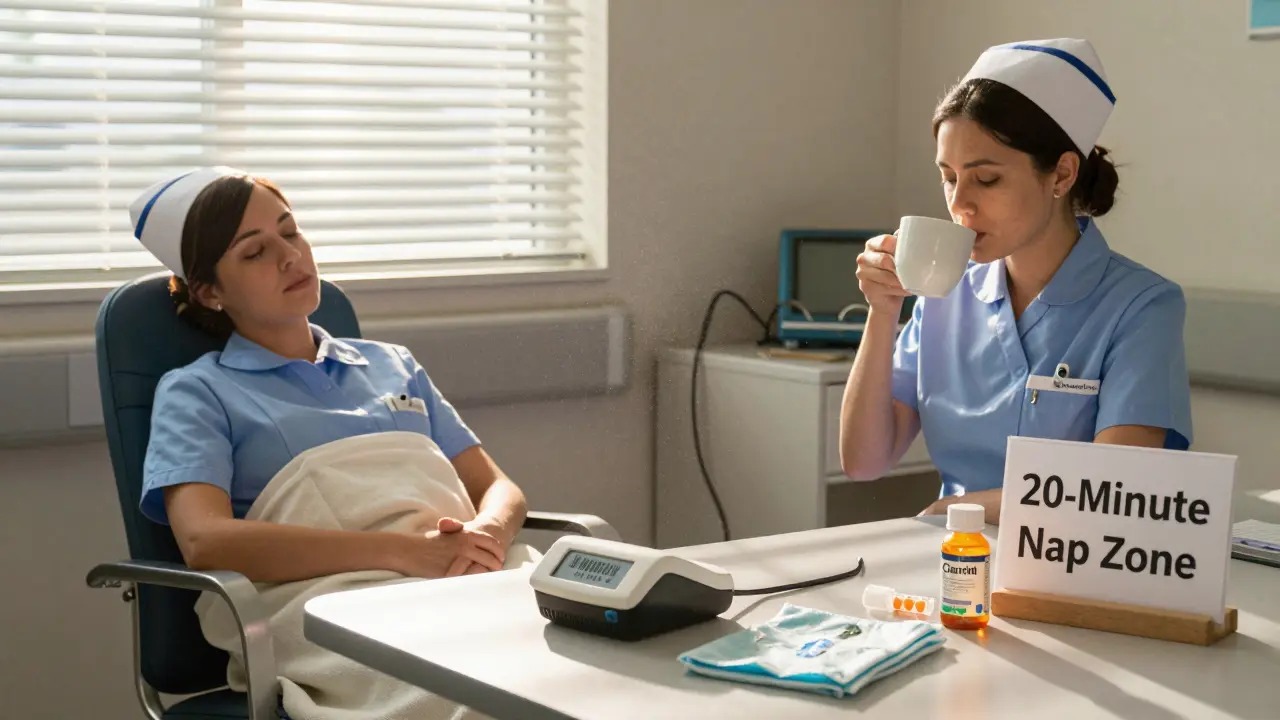
You’ve heard the advice: drink coffee. Take a nap. It’s not bad advice-but it’s not enough.
Caffeine helps. A cup of coffee can boost alertness for 1-3 hours. But it doesn’t fix memory loss. It doesn’t restore your ability to catch subtle errors. And if you’re relying on it to get through a 16-hour shift, you’re setting yourself up for a crash later.
Naps? They help too-but only if done right. A 20-minute power nap can improve alertness by 12-15%. A 90-minute nap? Only 8% improvement. And here’s the catch: if you wake up from deep sleep, you’ll feel worse for the next 30 minutes. That’s called sleep inertia. Your brain is still stuck in sleep mode. You might feel groggy, disoriented, or even more confused than before.
And here’s the truth no one wants to admit: no amount of caffeine or napping can replace a full night of sleep. If you’ve been working nights for three days straight, your cognitive performance is still 25% below normal-even after a nap. Recovery takes days, not minutes.
What Actually Works: System Changes Over Willpower
Blaming tired nurses or doctors doesn’t fix the problem. The system needs to change.
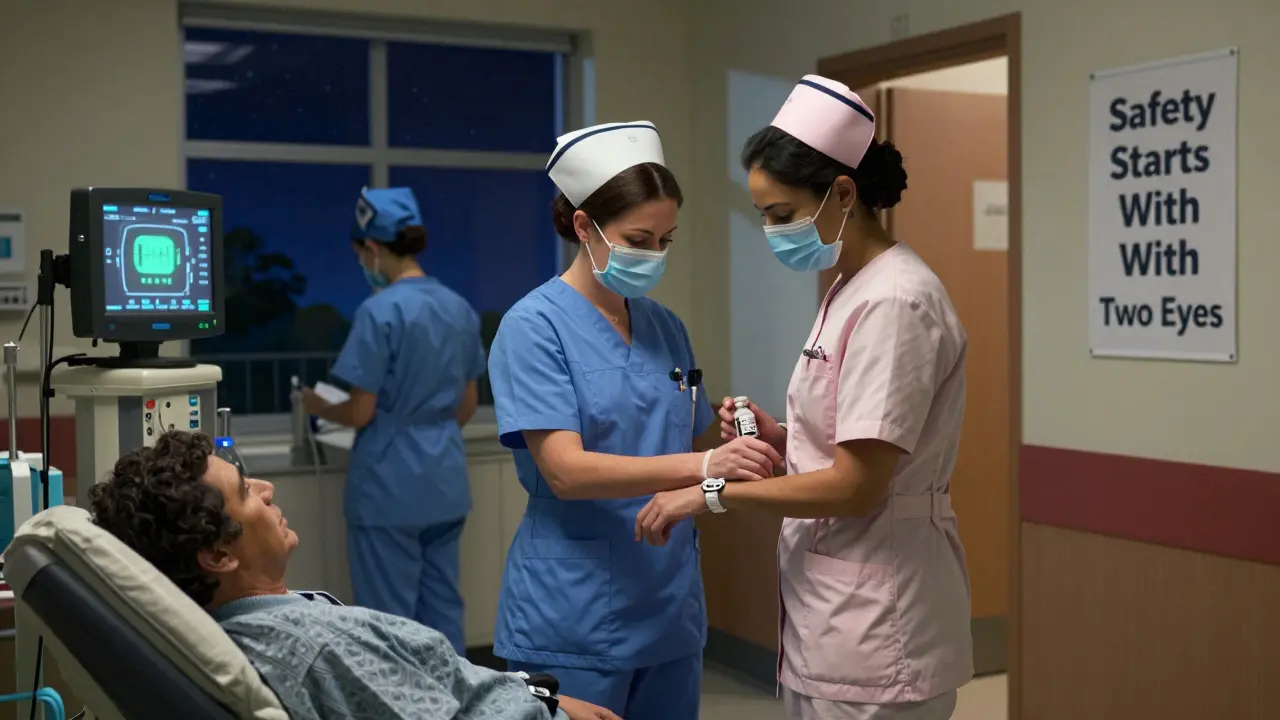
Studies show that using automated alerts and clinical reminders reduces medication errors by 18%. Barcode scanning for medications cuts errors by up to 40%. Double-checks by a second person? They’re not a luxury-they’re a lifeline.
Some hospitals are starting to use “fatigue risk management systems.” These aren’t just policies. They’re tools: scheduling software that limits consecutive night shifts, mandatory rest breaks, quiet rooms for naps, and even lighting that mimics daylight to help regulate circadian rhythms.
And it’s working. Emergency departments that implemented scheduled naps saw a 15% drop in errors. ICUs that enforced 10-minute breaks every two hours reduced near-misses by 22%.
But the most powerful fix? Limiting shifts to 12 hours-and never letting staff work more than three nights in a row. When people work four or more consecutive nights, their error rate jumps by 38%. That’s not a coincidence. That’s a pattern.
What You Can Do Right Now
You can’t always control your schedule. But you can control your habits.
- Check your meds. If you’re taking anything that makes you sleepy, talk to your doctor. Switch to non-sedating options.
- Use the double-check. Even if you’re rushed. Even if you’re sure. Two pairs of eyes catch more mistakes than one.
- Use technology. Scan barcodes. Confirm patient IDs. Don’t skip steps because you’re tired.
- Take a 20-minute nap before your shift. If you can, nap before your night starts. It’s more effective than napping during it.
- Hydrate. Eat protein. Avoid sugar. Sugar spikes make you crash. Protein and water keep you steady.
- Speak up. If you’re too tired to think clearly, say so. Your team needs to know. No one should be forced to work when their brain is shutting down.
The Real Cost of Fatigue
Medication errors from fatigue cost the U.S. healthcare system $20 billion a year. That’s not just money. It’s lives. One wrong dose can mean organ failure, brain damage, or death.
And it’s not just patients. Healthcare workers are paying too. Night shift workers have a 40% higher risk of depression, a 28% higher risk of diabetes, and a 22% higher risk of heart disease. You’re not just tired-you’re burning out.
Medication safety at night isn’t about being perfect. It’s about building systems that don’t rely on perfection. It’s about recognizing that humans aren’t machines. We need sleep. We need rest. We need support.
Next time you’re on night shift, don’t just push through. Protect yourself. Protect your patient. And if you can, push for change. Because no one should have to choose between their health and their patient’s life.
Priyanka Kumari
January 13, 2026 AT 18:56As a night-shift nurse in Mumbai, I’ve seen this play out too many times. No one talks about how the system sets us up to fail. We’re told to ‘push through’ while being denied proper rest, then blamed when mistakes happen. The real fix isn’t caffeine or naps-it’s staffing, scheduling, and respect. I’ve started asking for double-checks before every high-risk med. No one rolls their eyes anymore. Change starts with one person saying ‘no’ to burnout.
Adam Vella
January 14, 2026 AT 07:56It is an empirical truth, grounded in circadian neurobiology, that the human prefrontal cortex exhibits a 37% reduction in executive function during the biological night phase-particularly between 02:00 and 06:00. The notion that ‘willpower’ can overcome this is not merely naive; it is epistemologically unsound. The pharmacological confounders you cite-diphenhydramine, zolpidem-are not merely sedatives; they are cognitive suppressants that induce a state of iatrogenic delirium. The solution lies not in individual behavioral modification, but in institutional epistemic humility: mandatory AI-assisted double-check protocols, automated dispensing systems with biometric patient verification, and shift rotations governed by chronobiological algorithms, not hospital admin convenience.
Clay .Haeber
January 14, 2026 AT 16:49Oh wow, a whole essay on how tired nurses make mistakes? Groundbreaking. Next you’ll tell me water is wet and oxygen is breathable. Meanwhile, my cousin’s a nurse who drinks 5 espressos, takes 10-minute power naps in the supply closet, and still outperforms 80% of the day shift. Maybe the real problem isn’t fatigue-it’s people who think they’re too fragile to do their job. Also, ‘non-sedating antihistamines’? You mean like the ones that don’t work? I’ll stick with Benadryl and a prayer, thanks.
Alan Lin
January 15, 2026 AT 11:08Let me be unequivocal: this is not a personal failure. It is a systemic catastrophe. Every time a nurse is expected to function at peak cognitive capacity after 14 hours of labor, we are committing institutional violence. The data is irrefutable. The moral imperative is clear. If your hospital does not have a fatigue risk management system with mandatory rest breaks, scheduled naps, and shift limits, then you are not a healthcare provider-you are a liability. I’ve personally advocated for policy changes in three hospitals. It’s not easy. But lives are not negotiable. Speak up. Demand better. And if you’re too tired to do it today? Rest. Your patient deserves you fully awake.
Trevor Whipple
January 16, 2026 AT 18:57bro i was on 3 nights in a row last week and i mixed up heparin and insulin like 3 times… i thought i was just tired but turns out i was just dumb. i started scanning barcodes after that. no more ‘i know this one’ crap. also, stop taking ambien. it makes you feel like a zombie that forgot how to walk. i switched to melatonin and now i at least remember my own name in the morning. ps: coffee is a lie.
John Pope
January 17, 2026 AT 12:07Let’s be real: we’re not talking about fatigue. We’re talking about capitalism’s war on human biology. You think hospitals care about your circadian rhythm? Nah. They care about bed occupancy rates and overtime budgets. The ‘double-check’? A bureaucratic checkbox, not a safety net. The ‘nap room’? A PR stunt with a recliner and a flickering fluorescent light. Meanwhile, the CEO’s bonus is tied to ‘efficiency metrics’ that punish you for taking 10 minutes to breathe. This isn’t a medical issue-it’s a class issue. We’re not broken. The system is. And until we burn it down and rebuild it with sleep as a human right, nothing changes.
Avneet Singh
January 17, 2026 AT 14:30While the empirical correlation between fatigue and medication error is statistically significant (p < 0.01), the paper conspicuously omits confounding variables: nurse-to-patient ratios, EMR usability, and institutional culture of psychological safety. Moreover, the reliance on self-reported data introduces significant recall bias. One must also interrogate the selection criteria of the 38 studies cited-were they all from high-income countries with standardized protocols? The solution space is not as monolithic as presented. A systems approach must account for heterogeneity in clinical environments. Simply mandating barcodes without addressing workflow integration is technocratic fetishism.
Nelly Oruko
January 17, 2026 AT 23:17you ever just… stop? 🤔 i used to think pushing through was strength. now i know it’s just pride. took a 20-min nap before my last shift. didn’t even close my eyes fully. just sat there. quiet. and when i stood up? i felt like me again. not a ghost. not a machine. just… human. we’re allowed to need rest. it’s not weakness. it’s survival. 💤
Angel Tiestos lopez
January 19, 2026 AT 06:48bro this is why i stopped doing nights. not because i’m weak-because i’m wise. your brain on 3am is like a phone with 1% battery and 20 apps open. it’s not gonna last. i switched to days. got a cat. started meditating. my patients are safer. i’m happier. and yeah, i still take benadryl for allergies… but only if i’m gonna be awake for 20 hours. and even then, i triple-check. 🙏✨ no one’s coming to save you. but you can save yourself. and your patient. sleep is the ultimate antibiotic.