Monoclonal Antibody Biosimilars: Examples and Clinical Uses

When you hear the word "generic," you probably think of a cheap pill that does the same thing as the brand-name drug. But when it comes to monoclonal antibody biosimilars, that simple idea doesn’t hold up. These aren’t copies in the way aspirin is a copy of a brand-name painkiller. They’re complex, living-like proteins made in living cells - and getting them right is one of the toughest challenges in modern medicine.
Think of it this way: if a small-molecule drug is like a simple key, a monoclonal antibody is like a custom-made lock with 150,000 tiny parts. Even the tiniest change in how it’s made - a shift in sugar molecules attached to the protein, or a slight twist in its 3D shape - can affect how it works in the body. That’s why biosimilars aren’t called "generics." They’re called biosimilars: highly similar, but not identical. And that’s okay, as long as they work just as safely and effectively as the original.
What Makes Monoclonal Antibody Biosimilars Different
Monoclonal antibodies are proteins designed to target specific cells in the body - like cancer cells or overactive immune cells. They’re made by growing cells in bioreactors, not by mixing chemicals in a lab. Because they’re made by living systems, no two batches are exactly alike. Even the original manufacturer can’t make the exact same molecule twice. That’s why biosimilar companies don’t need to recreate the original drug perfectly. They just need to prove their version behaves the same way in the body.
The U.S. Food and Drug Administration (FDA) says biosimilars must show "no clinically meaningful differences" in safety, purity, and potency compared to the reference product. The European Medicines Agency (EMA) agrees. Both agencies require a mountain of data: hundreds of lab tests comparing molecular structure, animal studies, and clinical trials in thousands of patients. The goal? To prove that switching from the original drug to the biosimilar won’t change outcomes.
One of the biggest technical hurdles? Glycosylation - the sugar chains attached to the antibody. A 2011 study found that some patients had allergic reactions to cetuximab because of a specific sugar structure (alpha-1,3-galactose) in the original drug. That same sugar can appear in biosimilars if the manufacturing process isn’t tightly controlled. So biosimilar makers don’t just copy the drug - they reverse-engineer the entire production system to match it.
Approved Monoclonal Antibody Biosimilars and What They Treat
As of 2023, the FDA has approved over 20 monoclonal antibody biosimilars. Here are the big ones, and the conditions they’re used for:
- Bevacizumab biosimilars (Avastin): Used for colorectal, lung, and brain cancers. Six biosimilars are approved: Mvasi, Zirabev, Alymsys, Vegzelma, Avzivi, and Jobevne.
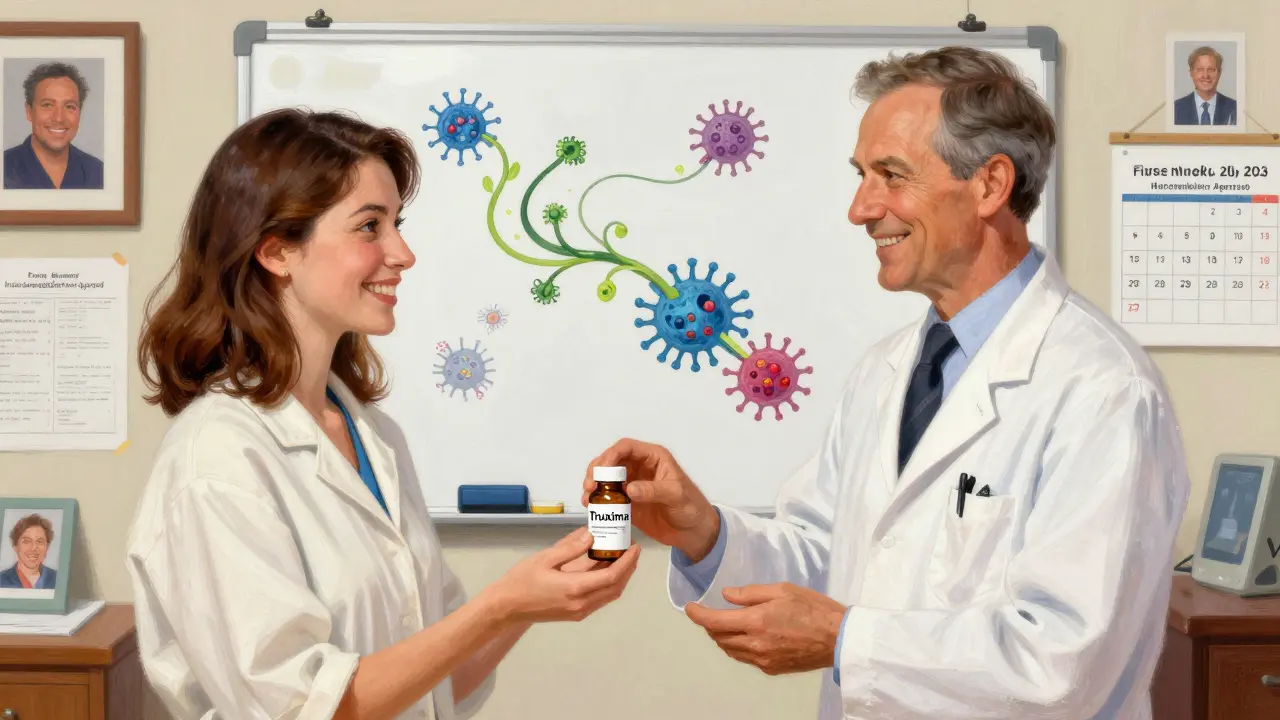
- Rituximab biosimilars (Rituxan): Used for non-Hodgkin’s lymphoma, chronic lymphocytic leukemia, and rheumatoid arthritis. Three approved: Truxima, Ruxience, and Riabni.
- Trastuzumab biosimilars (Herceptin): Used for HER2-positive breast and stomach cancers. Six approved: Ogivri, Herzuma, Ontruzant, Trazimera, Kanjinti, and Hercessi.
- Infliximab biosimilars (Remicade): Used for Crohn’s disease, ulcerative colitis, and rheumatoid arthritis. The first monoclonal antibody biosimilar ever approved - in the EU in 2013. Remsima became the first in the U.S. to be labeled "interchangeable" in July 2023.
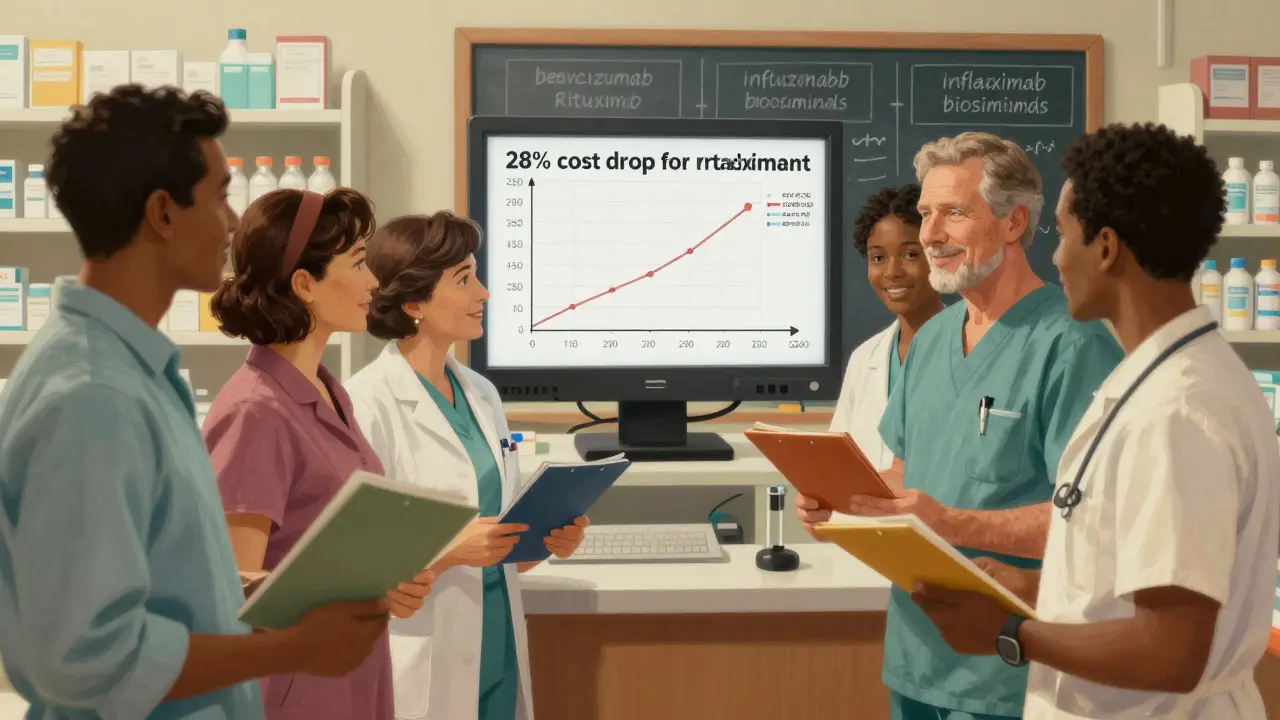
These aren’t just lab curiosities. They’re being used in hospitals every day. A 2022 study in JAMA Oncology tracked 1,247 patients who switched from rituximab to Truxima. The results? No drop in effectiveness. No rise in side effects. And a 28% drop in cost per treatment cycle.
Why Cost Matters - And How Much Is Saved
Biosimilars aren’t cheap, but they’re significantly cheaper than the originals. The original Herceptin cost over $70,000 per year in the U.S. before biosimilars hit the market. Today, biosimilars like Ogivri and Kanjinti cost 15-30% less. That doesn’t sound like much until you multiply it by thousands of patients.
Industry analysts at Evaluate Pharma predict monoclonal antibody biosimilars will save the U.S. healthcare system $250 billion between 2023 and 2028. Bevacizumab, trastuzumab, and rituximab biosimilars will make up 78% of those savings. That’s billions of dollars that can go back into cancer care, mental health services, or just keeping premiums lower for patients.
And it’s not just about price. When biosimilars enter the market, even the original drug companies often lower their prices. That’s called the "biosimilar effect." It’s not a giveaway - it’s competition. And it’s working.
Interchangeability: The Next Big Step
There’s a special category within biosimilars called "interchangeable." That means a pharmacist can swap the biosimilar for the original drug without asking the doctor - just like they do with generic pills. In July 2023, Celltrion’s Remsima (infliximab) became the first monoclonal antibody biosimilar to get this designation from the FDA.
To qualify, a company must prove that switching back and forth between the reference product and the biosimilar doesn’t increase risk. That’s a higher bar than regular biosimilarity. It requires multiple switch studies - patients alternating between the two drugs over months - to show no drop in effectiveness or rise in side effects. It’s not easy. But once a biosimilar gets this stamp, it becomes much easier for hospitals and pharmacies to adopt it.
Challenges Still in the Way
Despite the progress, adoption isn’t automatic. Many doctors still hesitate. A 2022 survey by the American Society of Clinical Oncology found only 58% of oncologists felt "very confident" prescribing biosimilars. Some of that comes from lack of education. Some comes from fear - even though data shows they’re safe.
Patent lawsuits are another roadblock. On average, each monoclonal antibody biosimilar faces 14.7 patent challenges before it can launch. These legal battles can delay entry by years. And even when biosimilars are approved, pharmacy benefit managers (PBMs) sometimes block them from formularies unless they offer deeper discounts than the original.
Then there’s immunogenicity - the risk that the body sees the biosimilar as foreign and mounts an immune response. The EMA reported 12 cases of unexpected immune reactions across 1.2 million patient-years of exposure. That’s a rate of 0.001%. Same as the reference products. Still, it’s a concern, especially for long-term treatments like those for rheumatoid arthritis.
What’s Coming Next
The pipeline is full. As of September 2023, the FDA had 37 monoclonal antibody biosimilars in review. The biggest focus? Biosimilars for Humira (adalimumab) and Keytruda (pembrolizumab). Humira was the top-selling drug in the world for years - and its biosimilars are now entering the market. Hyrimoz, approved in late 2023, is just the beginning.
Researchers are also working on biosimilars for newer types of biologics - bispecific antibodies that target two cancer markers at once, and antibody-drug conjugates that deliver chemo directly to tumors. The EMA plans to release new guidelines for these complex products by mid-2024.
IQVIA predicts that by 2027, monoclonal antibody biosimilars will make up 35% of all biologic prescriptions in the U.S. - up from 18% in 2022. Cancer treatments will drive most of that growth, making up 62% of the volume.
Bottom Line
Monoclonal antibody biosimilars are not a future idea. They’re here. They’re used. They’re saving money. And they’re not compromising safety. If you or someone you know is on a drug like Herceptin, Rituxan, or Avastin, ask your doctor: is a biosimilar an option? The answer might be yes - and it could mean lower costs without sacrificing care.
The science behind these drugs is complex, but the outcome is simple: more patients can get life-saving treatment - and the system doesn’t have to break to make it happen.
Are monoclonal antibody biosimilars the same as generics?
No. Generics are chemically identical copies of small-molecule drugs, like ibuprofen or metformin. Biosimilars are highly similar versions of complex biological drugs made from living cells. They can’t be exact copies because of natural variations in how cells produce proteins. But they must prove no clinically meaningful differences in safety or effectiveness.
How do I know if a biosimilar is safe for me?
All FDA- and EMA-approved biosimilars have undergone rigorous testing in clinical trials involving thousands of patients. Studies show their safety and effectiveness match the original drug. If your doctor recommends a biosimilar, they’ve reviewed the data. If you’re concerned, ask for the specific study results or check the agency’s approval summary - both are publicly available.
Can I switch from the original drug to a biosimilar?
Yes - and many patients already have. For non-interchangeable biosimilars, your doctor must prescribe the biosimilar specifically. For interchangeable biosimilars (like Remsima), your pharmacist can switch you without contacting your doctor. Studies show switching doesn’t increase risk. In fact, it often reduces cost without affecting outcomes.
Why are biosimilars cheaper if they’re so complex to make?
They’re not cheap to make - but they’re cheaper than the original. The original company spent billions developing the drug and securing patents. Biosimilar makers don’t repeat those early costs. They focus on proving similarity, which requires less money than original R&D. Plus, competition drives prices down. That’s why biosimilars typically cost 15-30% less.
Are there any risks from switching to a biosimilar?
The risks are no higher than with the original drug. Large studies tracking tens of thousands of patients show identical rates of side effects - including immune reactions, infections, and allergic responses. The EMA found 0.001% of patients had unexpected immune responses, same as the reference product. The real risk? Not getting treatment because you can’t afford it.
Devin Ersoy
March 12, 2026 AT 13:00Emma Deasy
March 12, 2026 AT 19:44tamilan Nadar
March 12, 2026 AT 22:58Aaron Leib
March 13, 2026 AT 01:07Amisha Patel
March 14, 2026 AT 14:51Elsa Rodriguez
March 15, 2026 AT 00:00Serena Petrie
March 15, 2026 AT 02:35Buddy Nataatmadja
March 15, 2026 AT 08:18mir yasir
March 15, 2026 AT 19:46Stephanie Paluch
March 17, 2026 AT 15:25tynece roberts
March 18, 2026 AT 03:21