Obsessive-Compulsive Disorder: Understanding Intrusive Thoughts and How ERP Therapy Works
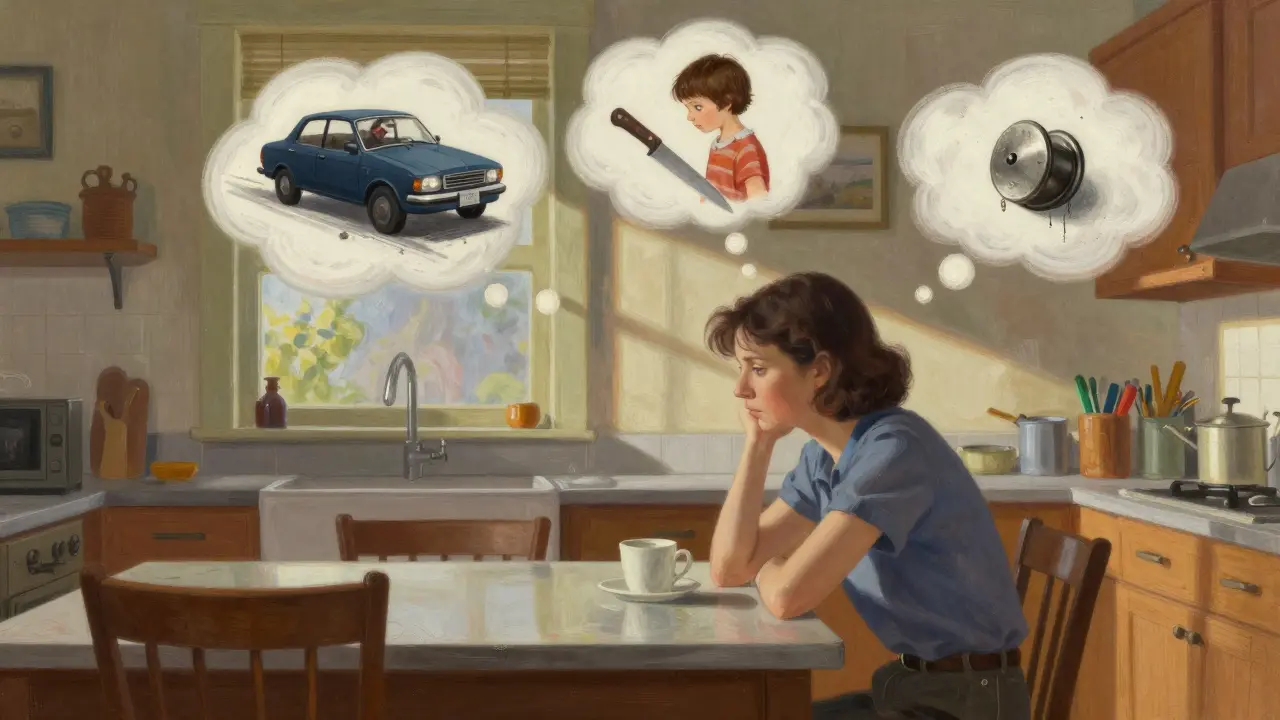
Imagine waking up and immediately thinking, What if I accidentally ran over someone while driving to work? You didn’t see anyone. You know you didn’t hit anyone. But the thought sticks. It comes back. Again. And again. You check the news. You replay the drive in your head. You avoid driving for days. That’s not just a bad thought. That’s OCD.
Obsessive-Compulsive Disorder isn’t about being neat or organized. It’s not a quirk. It’s a real, neurobiological condition that traps people in a cycle of terrifying thoughts and exhausting rituals. About 1.2% of U.S. adults live with it every year, and many suffer in silence for years before getting the right help. The worst part? These thoughts aren’t real. They don’t mean you’re dangerous. They don’t mean you’re broken. They’re just noise in the brain - loud, relentless, and impossible to ignore.
What Are Intrusive Thoughts in OCD?
Intrusive thoughts are sudden, unwanted images, urges, or ideas that pop into your mind. Everyone has them. Maybe you’ve thought, What if I jumped in front of a train? or What if I yelled something horrible at my boss? Most people shrug it off. But for someone with OCD, these thoughts feel like a red alert. They don’t just appear - they stick. And they come with a price: intense fear, guilt, or disgust.
The content of these thoughts follows common patterns. About 25% of people with OCD are haunted by contamination fears - germs, toxins, dirt. Another 20-25% wrestle with harm obsessions: fear of hurting someone, intentionally or by accident. About 15-20% are stuck on symmetry - things must be perfectly aligned, counted, or ordered. And 10-15% battle taboo thoughts: sexual, religious, or identity-related images that feel deeply wrong, even though they’re completely out of character.
One Reddit user wrote, I have violent thoughts over ten times a day. I’ve never hurt anyone. I love my family. But I’m terrified I’ll lose control. That’s the heart of it. These thoughts aren’t desires. They’re the opposite. They’re ego-dystonic - meaning they clash with who you are. That’s why they hurt so much. You don’t want them. You hate them. And yet, you can’t make them go away.
How OCD Traps You in a Cycle
OCD doesn’t work like a simple fear. It’s a loop: obsession → anxiety → compulsion → temporary relief → obsession again.
Let’s say you have a contamination obsession. You touch a doorknob. Instantly, your brain screams, You’re going to get sick. Your child will die. The anxiety spikes. You rush to wash your hands - 10 times, 20 times, until they’re raw. The fear fades… for a few minutes. Then the thought comes back. And the cycle starts again.
Neuroscience shows this isn’t just in your head. Brain scans reveal hyperactivity in the orbitofrontal cortex and caudate nucleus - areas tied to error detection and habit formation. When someone with OCD sees a trigger, these regions go into overdrive. The brain thinks something’s wrong. And it demands action. The more you act, the stronger the signal becomes. It’s like a faulty alarm system that keeps going off - and the only way to silence it is to keep pressing the button.
Compulsions can be physical or mental. Handwashing, checking locks, counting steps - those are visible. But many people suffer silently. They repeat prayers. They mentally review conversations. They avoid certain words or colors. One patient spent 4 hours a day silently repeating, I’m not a bad person to neutralize thoughts about harming others. No one knew. She thought she was alone.
Why ERP Therapy Is the Gold Standard
Medication helps some. But the most effective treatment - by far - is Exposure and Response Prevention, or ERP. It’s not talk therapy. It’s not mindfulness. It’s not about understanding why you have the thoughts. It’s about changing how you respond to them.
ERP was developed in the 1960s and refined by Dr. Edna Foa in the 1980s. Today, it’s the only treatment backed by decades of research and endorsed by the American Psychological Association as first-line care. Studies show 60-80% of people who complete ERP see a major drop in symptoms. And those gains last. Sixty-five percent still have relief five years later.
Here’s how it works:
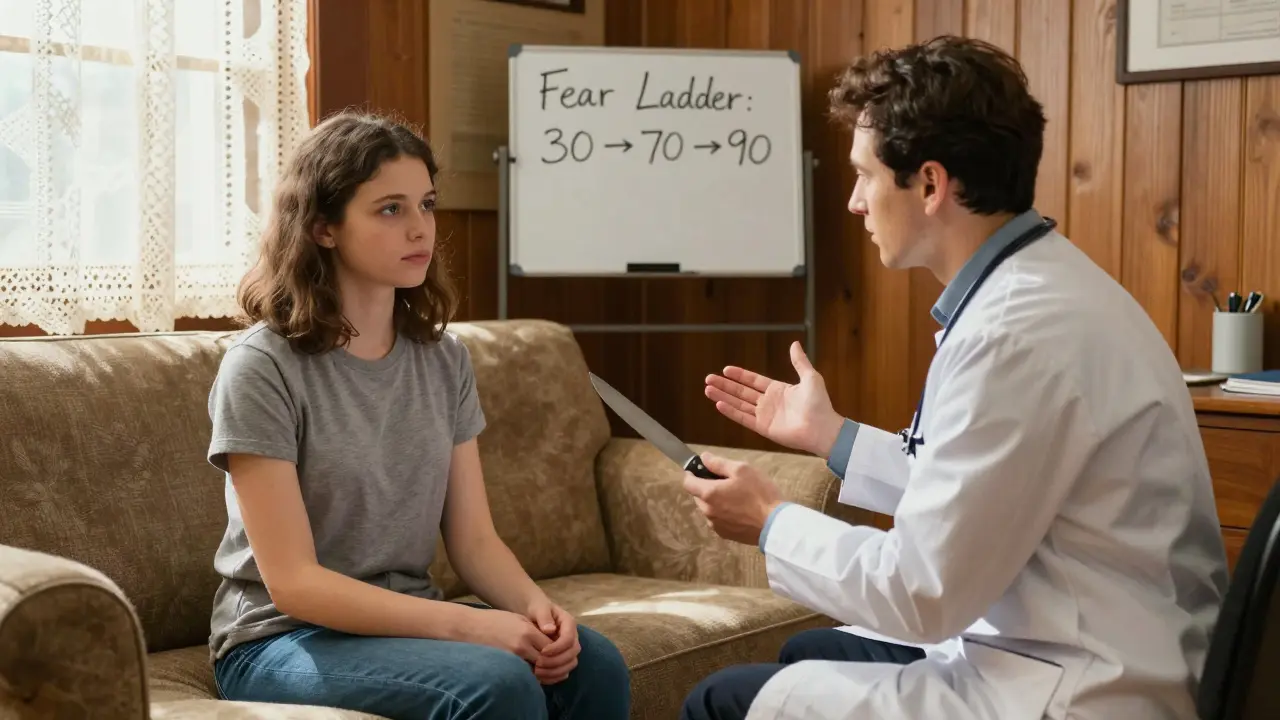
- Exposure: You’re gently guided to face the thing that scares you - not in a scary way, but in a controlled, step-by-step way. If you fear harming others, you might hold a kitchen knife while sitting with a loved one. If you fear contamination, you touch a public restroom door handle without washing.
- Response Prevention: You resist the urge to perform the compulsion. No washing. No checking. No mental reviewing. No reassurance-seeking. You sit with the anxiety.
At first, anxiety spikes. That’s normal. Your brain screams, This is dangerous! But if you don’t escape, the anxiety doesn’t kill you. It fades. After 30-60 minutes, the fear drops. Your brain learns: Oh. That didn’t happen. I didn’t die. I didn’t hurt anyone. Over time, the thought loses its power.
Therapists use a “fear ladder.” You rate triggers from 0 to 100. Touching a doorknob might be 30. Shaking hands with a stranger? 70. You start low and climb slowly. Each step is practice. Each step is proof that the fear is a lie.
Why Other Treatments Often Fail
Many people try talk therapy first. They talk about their fears. They analyze them. They try to reason them away. That makes OCD worse. Why? Because rumination - endlessly thinking about the thought - is just another compulsion. It’s mental checking. It’s avoidance in disguise.
Medication, like SSRIs (fluoxetine, sertraline), helps about 40-60% of people. But side effects - nausea, weight gain, sexual dysfunction - make many quit. And even when meds help, symptoms often return if you stop.
Combining ERP with medication gives the best results - 80-85% response rates. But ERP alone works. And it works without drugs. The goal isn’t to feel calm. It’s to feel uncomfortable… and survive it.
Barriers to Getting Help
Here’s the cruel truth: most people with OCD never get ERP.
Why? Because only 10% of U.S. therapists are trained in it. In rural areas, 75% of counties have zero specialists. Many doctors misdiagnose OCD as anxiety, depression, or even psychosis. One patient waited 12 years before getting the right diagnosis.
Stigma is another wall. Sixty percent of people fear telling employers. Parents hide their child’s rituals because they think it’s “just a phase.” People with taboo thoughts - fear of being gay, fear of being a pedophile - stay silent for decades, convinced they’re monsters.
Telehealth has helped. Forty-five percent of patients now get treatment online - up from 5% before the pandemic. But insurance still lags. Only 60% cover telehealth ERP the same as in-person visits.

What’s New in OCD Treatment?
Technology is stepping in. In 2023, the FDA approved the first digital therapeutic for OCD: the nOCD app. It guides users through ERP exercises with video coaching and progress tracking. A 2022 study in JAMA Psychiatry found it worked for 55% of people with mild OCD.
Researchers are also using fMRI to predict who will respond to ERP. Stanford’s 2023 study found brain patterns could forecast success with 78% accuracy. That means future treatment could be personalized - not trial and error.
For those who don’t respond to ERP, new options are emerging. Transcranial magnetic stimulation (TMS) - a non-invasive brain stimulation technique - showed a 45% response rate in treatment-resistant cases in a 2023 study in the New England Journal of Medicine.
And yes - “Pure O” is now officially recognized. That’s OCD with mostly mental compulsions. No visible rituals. Just endless mental battles. It affects 20% of people with OCD. And it’s just as real.
You’re Not Alone
There are 125,000+ people on Reddit’s r/OCD community sharing their stories. They’re not dangerous. They’re not weak. They’re just stuck in a brain that won’t shut up.
One 14-year-old went from 4-5 hours of compulsions a day to under 30 minutes after six months of ERP. She said, I didn’t know I could feel normal again.
If you’re reading this and you’re suffering - you don’t have to live like this. ERP isn’t easy. But it’s worth it. You don’t need to be fixed. You just need to learn that your thoughts don’t control you. And that’s something you can learn.
Start by finding a therapist trained in ERP. Use the International OCD Foundation’s directory. Ask if they’ve treated people with your type of obsession. Don’t settle for general CBT. Don’t wait for the perfect time. The sooner you start, the faster you heal. Early intervention within two years of symptoms doubles recovery rates.
Your thoughts don’t define you. ERP can help you prove that.
Are intrusive thoughts normal?
Yes, everyone has intrusive thoughts now and then - like imagining dropping a baby or yelling at a boss. The difference is how you react. Most people let them pass. People with OCD interpret them as dangerous, immoral, or significant, which triggers intense anxiety and compulsions to neutralize the fear.
Can ERP therapy make OCD worse at first?
Yes, it often does. In the first 2-3 weeks, anxiety typically increases because you’re facing fears without using your usual escape routes. This is called a “flare-up.” It’s not a sign it’s not working - it’s proof you’re doing it right. Most people see major improvement after 6-8 weeks if they stick with it.
Do I need medication to do ERP?
No. ERP works on its own. Many people improve without any drugs. But for some, especially those with severe symptoms, combining ERP with SSRIs (like fluoxetine or sertraline) leads to better results - about 80-85% response rates. Medication isn’t required, but it can help reduce the initial anxiety enough to make ERP more manageable.
What if I have taboo thoughts about sex or religion?
You’re not alone. About 10-15% of people with OCD have these types of obsessions. They’re often the hardest to talk about because they feel so shameful. But they’re not real. They don’t reflect your values or desires. ERP helps you sit with the discomfort without acting on it - mentally or physically. Many people find relief by learning that their thoughts are just brain noise, not moral failures.
How long does ERP therapy take?
Most people do 12-20 weekly sessions, with daily homework (1-2 hours). Some see improvement in 8 weeks. Full recovery often takes 3-6 months. It’s not a quick fix, but the results last. The key is consistency - not perfection. Showing up, even when it’s hard, is what changes the brain.