Osteonecrosis of the Jaw from Medications: Key Dental Warning Signs to Watch For
MRONJ Risk Assessment Tool
Assess Your Risk
This tool estimates your risk of medication-related osteonecrosis of the jaw (MRONJ) based on your treatment and dental history. Results are for informational purposes only and do not replace professional medical advice.
Imagine going to the dentist for a routine cleaning, then weeks later, you notice a piece of bone sticking out of your gum. It doesn’t heal. It hurts. Your dentist says it’s an infection, but antibiotics don’t help. What you’re experiencing might be something far more serious: osteonecrosis of the jaw from medications. It’s rare, but when it happens, it can change your life.
What Exactly Is Osteonecrosis of the Jaw?
Osteonecrosis of the jaw (ONJ), especially when caused by medications, is called MRONJ-medication-related osteonecrosis of the jaw. It’s when the bone in your jaw dies and becomes exposed through the gums, and it doesn’t heal for more than eight weeks. This isn’t a simple toothache or gum infection. It’s a breakdown in the bone’s ability to repair itself.
The condition was first clearly identified in the early 2000s, mostly in cancer patients receiving high-dose intravenous bisphosphonates. But now, it’s also seen in people taking oral bisphosphonates for osteoporosis. The medications themselves aren’t the problem-they save lives. Bisphosphonates like alendronate (Fosamax), risedronate (Actonel), and zoledronic acid (Reclast) stop bone loss. Denosumab (Prolia) does something similar. They prevent fractures in people with weak bones. But they also slow down how fast your jawbone heals after injury or stress.
Who’s at Risk?
The risk isn’t the same for everyone. If you’re taking oral bisphosphonates for osteoporosis, your chance of developing MRONJ is extremely low-about 1 in 10,000 to 1 in 100,000 per year. That’s rarer than being struck by lightning. But if you’re on intravenous bisphosphonates for cancer that’s spread to the bone, your risk jumps to 1% to 10%. That’s 100 to 1,000 times higher.
Denosumab, while newer, carries a similar risk level to IV bisphosphonates. The longer you take these drugs-especially beyond three to four years-the higher your risk becomes. And it’s not just the medication. Dental procedures are the biggest trigger. Tooth extraction is the most common cause, with a 3.2% chance of triggering ONJ in people on these drugs. Routine cleanings, fillings, or crowns? No significant risk.
The Warning Signs You Can’t Ignore
MRONJ doesn’t come with a flashing red light. It creeps in slowly. Here’s what to watch for, especially if you’re on one of these medications:
- Pain or swelling in your jaw-not just after a procedure, but weeks later. About 87% of people with MRONJ report persistent pain.
- Gum tissue that won’t heal-especially after a tooth is pulled. If your socket is still open after four weeks, that’s a red flag.
- Exposed bone-you might see or feel a hard, white or yellowish piece of bone sticking out of your gum. This is the defining feature of MRONJ.
- Loose teeth-not because of gum disease, but because the bone holding them is dying. Around 63% of cases involve loose teeth.
- Pus or bad taste in your mouth-a sign of infection around the exposed bone. About 58% of patients report this.
- Numbness or heaviness-a feeling like your jaw is full of lead. This happens in 42% of cases and suggests nerve involvement.
Many people mistake these signs for a regular tooth infection. That’s why diagnosis is often delayed. One patient on a support forum said, "I went to three dentists before someone finally said, ‘Have you been on Fosamax?’"
What Triggers It?
MRONJ rarely happens out of nowhere. Most cases follow a dental procedure-especially extractions. But it can also start from dentures rubbing too hard, from periodontal disease, or even from minor trauma like biting your cheek. The problem isn’t the injury. It’s that your jaw can’t fix itself.
Bisphosphonates and denosumab block the cells that break down old bone (osteoclasts). That’s good for your spine and hips-it stops bones from crumbling. But in the jaw, that same blockage means microfractures from chewing or brushing don’t get repaired. Over time, the bone weakens. If the gum tissue gets damaged, the bone underneath can’t regenerate. It dies. And once it’s exposed, bacteria take hold.
How to Prevent It
The best way to avoid MRONJ is to stop it before it starts. If you’re about to start a bisphosphonate or denosumab treatment:
- See your dentist at least 4 to 6 weeks before your first dose. This is non-negotiable if you’re on IV therapy. For oral meds, 2 to 4 weeks is enough.
- Get everything done now. Pull problematic teeth, fix crowns, treat gum disease. Do it before the medication starts.
- Tell your dentist every medication you’re on. Many patients say their dentist never asked. Don’t assume they know.
- Use chlorhexidine mouthwash. A 0.12% rinse twice daily can lower your risk by 37% if you’re already on medication.
- Keep your mouth clean. Brush twice a day, floss daily. Poor oral hygiene increases your risk.
If you’re already on the medication, don’t stop it without talking to your doctor. The risk of breaking a hip or spine is far greater than the risk of MRONJ. But do keep up with regular dental checkups. Just avoid invasive procedures unless absolutely necessary.
What If It’s Already Happening?
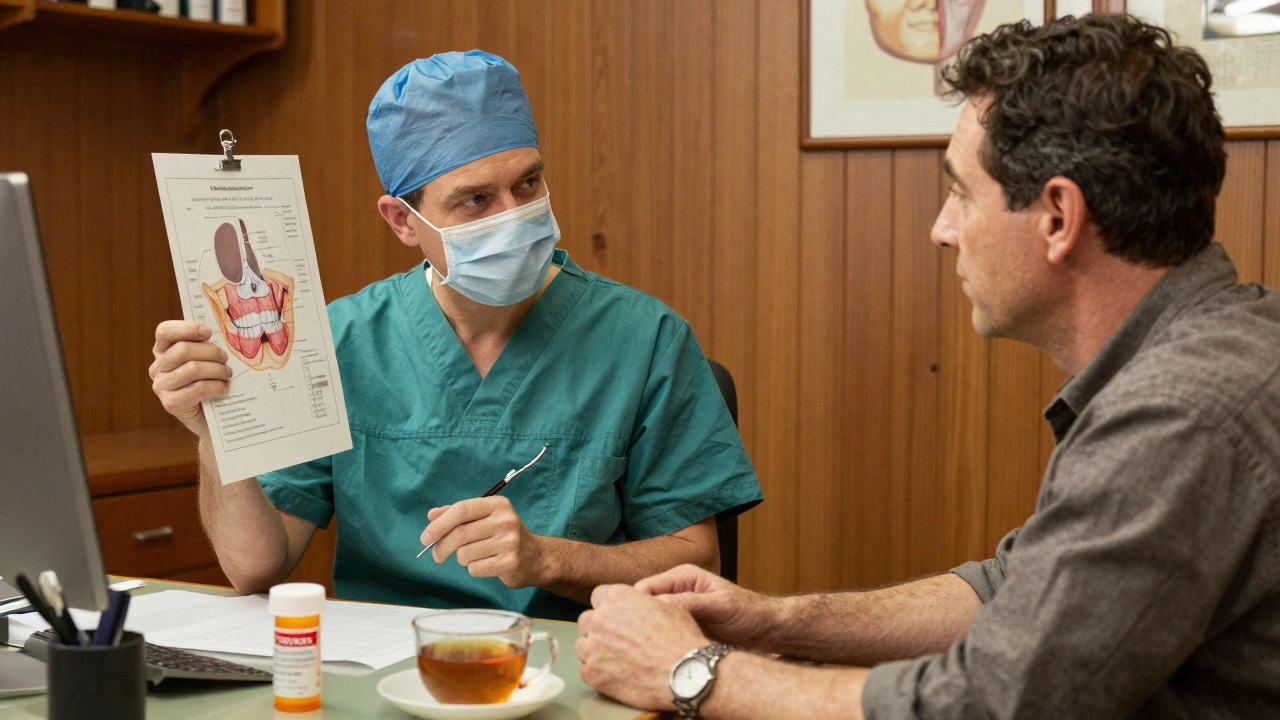
If you’ve got exposed bone and it’s been more than eight weeks, you need a specialist-preferably an oral surgeon or periodontist who’s seen MRONJ before. Treatment isn’t about fixing the bone. It’s about managing it.
Early-stage MRONJ (Stage 1) might just need antibiotics, mouth rinses, and gentle cleaning. No surgery. Stage 2 or 3? You might need removal of dead bone, but even then, surgeons avoid aggressive cutting unless it’s unavoidable. The goal is to reduce pain and prevent infection from spreading.
There’s new hope. A drug called teriparatide (Forteo), which actually builds new bone, has helped 78% of early-stage patients heal in recent studies. It’s not approved for this use yet, but doctors are starting to use it off-label with good results.
What You Should Know About Your Doctor
Many patients say they were never warned. A 2023 survey found 65% of cancer patients on IV bisphosphonates weren’t told about dental risks before starting treatment. That’s unacceptable. The FDA has required warning labels since 2021. Your doctor or oncologist should have given you a pamphlet or at least mentioned it.
If they didn’t, ask. Say: "I’m starting [medication name]. What do I need to do about my teeth?" If they don’t have an answer, ask for a referral to a dentist who understands MRONJ. Most academic dental centers have protocols. Private practices? Not always.
What’s Changing Now?
Things are getting better. In 2023, the European Medicines Agency required drug companies to include patient education materials with high-risk osteoporosis meds. U.S. dental schools now teach MRONJ recognition-up from 42% in 2015 to 87% today. And new tools are coming.
The NIH is testing a risk-prediction algorithm called OPA that will soon give you a personalized score based on your genetics, medication history, and dental health. By 2025, it could tell you if you’re in the 0.01% risk group or the 1% group.
For now, the message is simple: Know your meds. Know your mouth. If you’re on a bone drug and your jaw doesn’t feel right-don’t wait. See a dentist who knows what to look for.
Scott van Haastrecht
December 5, 2025 AT 10:37Let me be clear: if your doctor didn’t warn you about this before prescribing bisphosphonates, they’re negligent. I’ve seen three patients with jaw necrosis-all were told the meds were "safe" and "routine." One lost half his jaw. No emojis. No drama. Just a broken body and a lawsuit waiting to happen.
Bill Wolfe
December 6, 2025 AT 20:37It’s fascinating, isn’t it, how modern pharmacology has achieved such remarkable feats in systemic bone preservation-yet simultaneously created a localized iatrogenic catastrophe in the mandibular architecture? The irony is almost poetic: we stabilize the spine and femur, only to let the jaw become a necrotic wasteland. The pharmaceutical industry, in its infinite wisdom, markets these drugs as life-saving, while quietly burying the dental implications under layers of fine print and off-label ignorance. One must ask: who benefits? The patient? Or the quarterly earnings report?
Ollie Newland
December 7, 2025 AT 16:28As a dental hygienist in London, I see this more than people realize. The key is early intervention-especially with patients on long-term bisphosphonates. We use a pre-treatment checklist now: med history, CBCT if needed, and a 6-week buffer before any extraction. The 0.12% chlorhexidine rinse? Non-negotiable. Most patients don’t know their meds affect healing. It’s not about fear-it’s about informed consent. And yes, we’ve had cases where patients came in with exposed bone and zero idea why. That’s on the prescribers.
Rebecca Braatz
December 8, 2025 AT 03:58THIS IS SO IMPORTANT. If you’re on Fosamax, Prolia, or any of these meds-don’t wait until it’s too late. Talk to your dentist BEFORE you start. Get your teeth in order. Brush. Floss. Rinse. Don’t be the person who says "I didn’t know." You know now. Share this. Save someone’s jaw. You’re not being paranoid-you’re being proactive. Your smile matters.
Michael Feldstein
December 9, 2025 AT 00:41I’ve been on alendronate for 5 years for osteoporosis. I didn’t know any of this until I read this post. I just had a cleaning last month-should I be worried? My dentist never mentioned anything. I’m going to call them tomorrow and ask if they’ve ever seen MRONJ. Thanks for the heads-up. I feel like I just got a second chance.
Gareth Storer
December 10, 2025 AT 11:43Oh, so now we’re blaming the drugs? Next you’ll tell me the moon landing was faked because the astronauts didn’t get scurvy. If your jaw dies, maybe you’re just bad at brushing. Or maybe you’re one of those people who think medicine is a magic wand. Chill. It’s rare. Your dentist isn’t a necromancer.
Pavan Kankala
December 11, 2025 AT 03:47Let’s be real-this isn’t about medication. It’s about the pharmaceutical cartel controlling your body. They don’t want you healing naturally. They want you dependent. Bone marrow transplants? They’re not telling you about the real cures-turmeric, bone broth, and fasting. But no, you’ll swallow a pill that turns your jaw into a tomb. Wake up. The system wants you broken.
Martyn Stuart
December 12, 2025 AT 16:45It’s critical to note, however, that while the risk of MRONJ is statistically low-particularly for oral bisphosphonates-it remains a serious, irreversible, and often misdiagnosed condition; and, as such, every patient on these agents must be proactively screened, educated, and monitored-ideally by a multidisciplinary team including both their prescriber and a dentist trained in pharmacologic bone disorders.
Jessica Baydowicz
December 13, 2025 AT 09:13I’m a nurse and I’ve had patients cry because their jaw wouldn’t heal after a simple extraction. One woman said she felt like her body betrayed her. This isn’t just medical-it’s emotional. If you’re on these meds, treat your mouth like it’s made of glass. And if your doctor won’t talk about it? Find a new one. Your jaw is worth fighting for.
Shofner Lehto
December 14, 2025 AT 18:43My dad’s on Prolia. He didn’t know any of this. I printed out this post and took it to his oncologist. They actually apologized and gave him a referral to a specialist dentist. We’re getting his teeth checked next week. This info saved us from disaster. Thank you.