Strength Training for Fat Loss: How to Program for Real Results
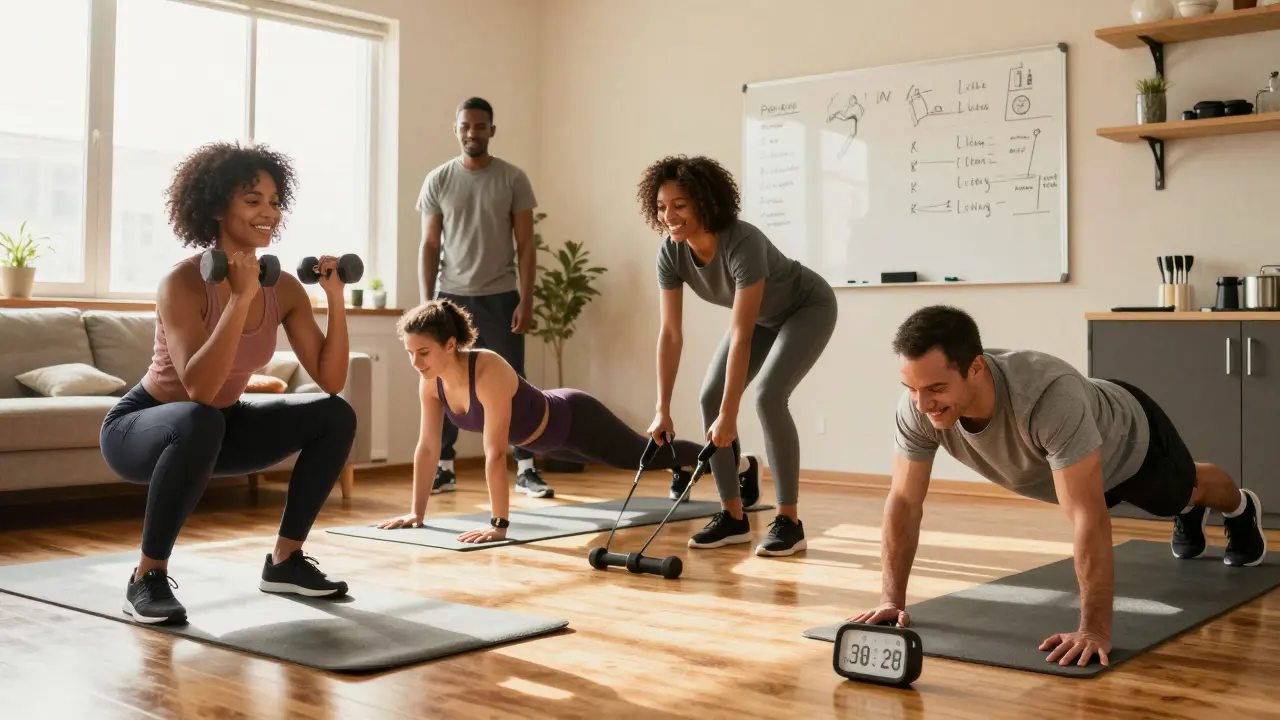
Most people think fat loss means endless cardio, early morning runs, or skipping meals. But if you’ve been doing that for months and still don’t see changes in your mirror, you’re not alone. The truth is, strength training is the most effective tool you’re not using for real fat loss. It doesn’t just burn calories during the workout-it rewires your body to burn more fat every single day, even when you’re sitting still.
Why Strength Training Beats Cardio for Fat Loss
Cardio burns calories while you’re doing it. Strength training burns calories while you’re doing it, and for hours after. That’s called EPOC-excess post-exercise oxygen consumption. A 2018 study in the Journal of Sports Science & Medicine found that after a heavy strength session, your body keeps burning 6-15% more calories for up to 72 hours. That’s not a small edge. That’s the difference between losing 1 pound a week and 1.8 pounds. But here’s the bigger picture: when you lose weight with only cardio, you lose muscle too. Studies show cardio-only dieters lose up to 1.2 pounds of muscle for every 25 pounds of weight lost. That’s not just wasting effort-it’s slowing your metabolism. Every pound of muscle you lose drops your daily calorie burn by 6-10 calories. Lose 5 pounds of muscle? That’s 30-50 fewer calories burned every day. Over a year, that’s 11,000-18,000 extra calories you’ll need to cut just to stay the same weight. Strength training flips that. It preserves muscle while you lose fat. A 2022 meta-analysis in Obesity Reviews reviewed 28 studies and found people who lifted weights kept 95.3% of their lean mass during weight loss. Cardio groups kept only 87.6%. That 7.7% difference? That’s your metabolism staying strong.How to Structure Your Strength Program for Fat Loss
This isn’t about lifting heavy for size. It’s about lifting smart to burn fat and keep muscle. Here’s how to build it:- Rep range: 8-12 reps for big lifts like squats, deadlifts, and bench presses. 12-15 reps for isolation moves like bicep curls or leg extensions.
- Sets: 3-5 per exercise. More sets = more metabolic stress = more fat burned.
- Rest: 2-3 minutes between heavy sets. Shorter rests (30-60 seconds) when doing supersets or circuits.
- Tempo: Control the movement. Lower the weight for 2-3 seconds. Push up fast. This keeps tension on the muscle longer, which boosts calorie burn.
Start with full-body workouts 3 times a week. Each session should include:
- One lower-body compound (squats, lunges, or deadlifts)
- One upper-body push (bench press, push-ups, or overhead press)
- One upper-body pull (rows, pull-ups, or lat pulldowns)
- One core move (planks, hanging leg raises, or Russian twists)
That’s it. Four exercises. Thirty to forty-five minutes. No fancy machines needed. Dumbbells, resistance bands, or a barbell will do.
Progressive Overload: The Secret Sauce
If you’re doing the same weights every week, you’re not making progress-you’re just going through the motions. Fat loss needs constant adaptation. That’s where progressive overload comes in.Every 1-2 weeks, increase the weight by 5-10% when you hit the top of your rep range. For example:
- Week 1: 3 sets of 12 reps with 20 lb dumbbells
- Week 2: 3 sets of 12 reps with 20 lb dumbbells
- Week 3: 3 sets of 10 reps with 22 lb dumbbells
That’s it. You don’t need to max out. You just need to get stronger, slowly. A 2023 analysis of 500 Amazon reviews for the Women’s Health 4-Week Strength Training Plan found that 87% of users who got the best results tracked their weights and increased them weekly. The ones who didn’t? They plateaued by week 3.
Cardio? Yes-but the Right Kind
You don’t need to run marathons. But you do need some cardio. The key is balance.- Two days a week: one steady-state (30-45 minutes of brisk walking, cycling, or elliptical at 65-75% max heart rate)
- One day a week: one HIIT session (20 minutes: 30 seconds all-out effort, 90 seconds easy, repeat 6-8 times)
This combo burns fat without wrecking your recovery. A 2023 study from Speediance tracked 157 people for 8 weeks. The group doing 3 strength days + 2 cardio days lost 1.8 pounds of fat per week. The group doing only cardio lost 1.3. The group doing only strength lost 1.1. The combo won.
Nutrition: You Can’t Out-Train a Bad Diet
Strength training won’t fix poor eating. But it makes eating smarter. You need protein to rebuild muscle. Aim for 1.6-2.2 grams of protein per kilogram of body weight. That’s about 100-140g for a 150-pound person.Split your plate like this:
- 40% protein (chicken, fish, eggs, tofu, Greek yogurt)
- 30% carbs (oats, sweet potatoes, fruit, whole grains)
- 30% fats (avocado, nuts, olive oil, cheese)
And eat protein within 45 minutes after your workout. A 2023 University of Birmingham study showed that timing boosts muscle protein synthesis by 22% compared to waiting 3 hours. That means more muscle retained, more fat burned.
What to Track (Besides the Scale)
The scale lies. You can be losing fat and gaining muscle-and the number won’t move. Or worse, it might go up.Instead, track:
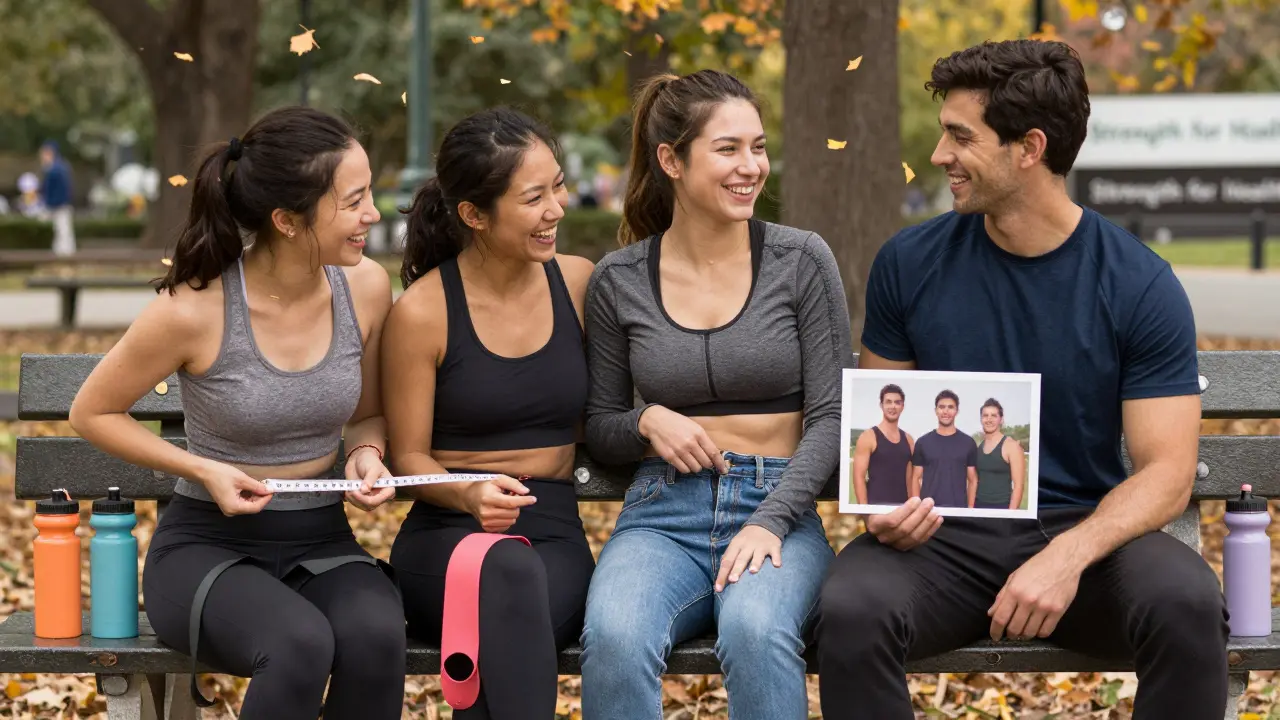
- Measurements: waist, hips, chest, thighs (take them every 2 weeks)
- Progress photos: same lighting, same time of day, same clothes
- Strength gains: Are you lifting heavier? Doing more reps?
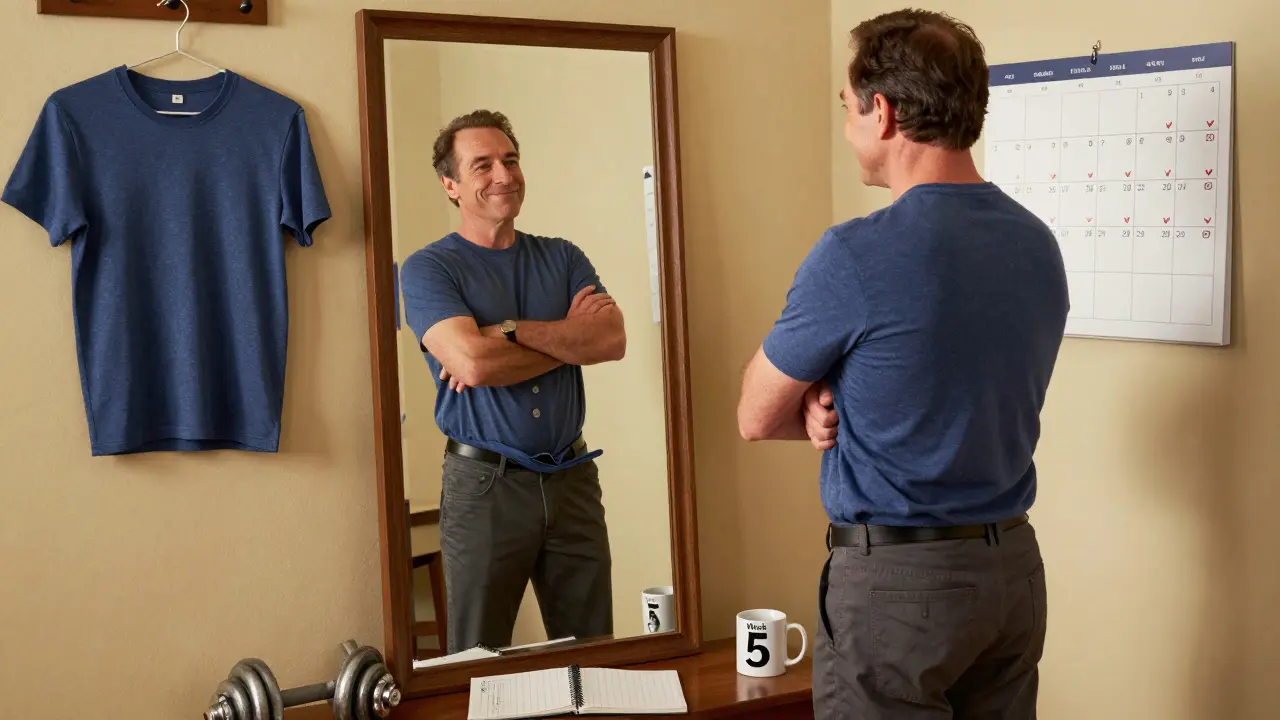
- How your clothes fit: This is the most reliable sign of fat loss
In the Speediance 8-week trial, 78% of participants said the scale confused them between weeks 3 and 4. But their waistlines shrank. Their shirts got looser. Their energy shot up. That’s real progress.
Common Mistakes and How to Avoid Them
- Skipping form for weight: Bad form = injury risk. Watch videos. Film yourself. Ask a trainer. Spend 2 weeks mastering squats before adding weight.
- Doing too much too soon: You don’t need to train 6 days a week. Three solid strength sessions + two light cardio days are enough. Overtraining kills recovery and burns out motivation.
- Ignoring soreness: DOMS (delayed onset muscle soreness) is normal. It peaks at 48 hours. Foam rolling and 10-15 minutes of walking afterward cuts soreness duration by 35%, according to a 2022 study in the Journal of Strength and Conditioning Research.
- Quitting before week 3: Most people give up because the scale doesn’t budge. But muscle growth and fat loss take time. The biggest transformations happen after week 4.
Real People, Real Results
On Reddit, user ‘FitJourney2023’ lost 48 pounds in 6 months with 3x weekly strength training and intermittent fasting. The scale showed 32 pounds down. But his body fat dropped from 32% to 19%. The other 16 pounds? Muscle he gained while losing fat. Another user, ‘CardioQueen99’, did pure cardio for 8 months and lost 25 pounds. She looked ‘skinny fat’-thin but soft. She added strength training. In 3 months, she lost another 8 pounds of fat and gained visible muscle. Her clothes changed. Her confidence changed. These aren’t outliers. They’re the rule.The Future Is Here
Technology is making strength training smarter. Apple Fitness+ now has 25-minute metabolic strength workouts. WHOOP tracks your ‘muscle preservation score’ during weight loss. Tonal’s AI-powered system adjusts weights in real time based on how you move. These aren’t gimmicks-they’re tools that help you stay consistent.And the data backs it up. The American College of Sports Medicine says 83% of certified trainers now prioritize strength training for fat loss-up from 57% in 2018. Corporate wellness programs like Johnson & Johnson’s ‘Strength for Health’ see 27% higher participation than traditional weight loss plans.
Strength training isn’t just a workout. It’s a long-term strategy. It’s not about looking a certain way for a beach season. It’s about building a body that burns fat effortlessly, stays strong, and lasts decades.
Can I lose fat with strength training alone without cardio?
Yes, you can lose fat with strength training alone if your nutrition is on point. Strength training increases your resting metabolism, so you burn more calories even at rest. But adding light cardio twice a week helps create a bigger calorie deficit and improves heart health. It’s not required, but it speeds things up.
How long until I see results from strength training for fat loss?
Most people notice changes in how their clothes fit by week 3-4. Visible muscle definition and measurable fat loss usually appear between weeks 6-8. The scale might not move much at first because you’re gaining muscle while losing fat. That’s a good thing. Focus on measurements, photos, and strength gains-not the number.
Do I need to lift heavy to lose fat?
You don’t need to lift maximum weights, but you do need to challenge your muscles. Lifting weights that make the last 2-3 reps of each set hard is enough. That’s usually 70-80% of your max. The goal isn’t to get huge-it’s to keep your muscles active and growing so your metabolism stays high.
Is strength training safe for beginners?
Absolutely. Start with bodyweight exercises or light dumbbells. Focus on learning proper form before adding weight. Many beginners worry about injury, but the biggest risk is doing too much too fast. Slow progress, consistent effort, and good technique make strength training one of the safest and most effective ways to lose fat.
Why does my weight stay the same even though I’m losing fat?
Muscle is denser than fat. When you lose fat and gain muscle at the same time, your weight might not change much-but your body shape will. A pound of muscle takes up 22% less space than a pound of fat. So even if the scale doesn’t budge, your waistline shrinks, your arms look tighter, and your jeans fit better. That’s real fat loss.
How often should I change my strength routine?
Change your routine every 4-6 weeks to avoid plateaus. Swap out exercises, adjust rep ranges, or try supersets. For example, after 4 weeks of squats, switch to Bulgarian split squats. After 6 weeks of 3 sets of 10 reps, try 4 sets of 8 reps with heavier weights. Your body adapts fast-keep it guessing.
If you’ve been stuck in the cardio cycle, it’s time to try something different. Strength training isn’t just for bodybuilders. It’s for anyone who wants to lose fat, keep muscle, and feel stronger every day. Start light. Stay consistent. Track progress. And don’t quit before week 3. The best version of your body isn’t on the scale-it’s in the mirror.
Nicholas Miter
January 26, 2026 AT 21:56Been doing this for 6 months now. Scale didn’t move for 3 weeks, but my shirts got loose and my knees stopped creaking. Guess muscle is sneaky like that.
Also, foam rolling after workouts? Life changer. Not gonna lie, I used to skip it. Now I do it while watching Netflix. Zero effort, 100% recovery boost.
TONY ADAMS
January 27, 2026 AT 06:36bro i just do cardio and eat salad. why u make this so hard? i just wanna be skinny.
George Rahn
January 28, 2026 AT 23:58One must contemplate the metaphysical implications of muscular hypertrophy as a societal counterweight to the nihilistic tyranny of sedentary capitalism. The barbell, dear interlocutor, is not merely steel and rubber-it is the Sisyphusian defiance of entropy itself.
Cardio, by contrast, is the opiate of the masses, a dopamine-slicked distraction peddled by the treadmill-industrial complex. To lift is to reclaim agency. To sweat is to commune with the ancestral fire that forged our species.
Let the scale lie. Let the mirror speak truth. Let the bones remember what the soul has forgotten: strength is not a goal-it is a covenant.
Ashley Karanja
January 30, 2026 AT 03:55I just want to say how much this resonates with me emotionally 💖
As someone who struggled with disordered eating and overtraining for years, I finally found peace when I stopped chasing the scale and started honoring my body’s adaptive capacity through progressive overload and protein timing.
The 1.6–2.2g/kg protein window? That’s not just biochemistry-it’s self-love in macro form.
And the fact that muscle density takes up 22% less space than fat? That’s not a statistic-it’s a revolution in self-perception. I used to cry when the scale didn’t budge. Now I take a photo, text my sister, and go for a walk. Healing isn’t linear, but strength training? It’s the most compassionate form of movement I’ve ever known.
Also, HIIT on Wednesdays with my dog? Best. Day. Ever. 🐶❤️
Curtis Younker
February 1, 2026 AT 00:02YOOOO I JUST HIT A NEW PERSONAL BEST ON DEADLIFTS LAST WEEK-405 LBS! 🙌
And yeah, I lost 18 lbs of fat over 5 months without touching a treadmill. My wife said I look like I’m wearing a different person’s skin. Best compliment ever.
Don’t overthink it. Just show up. Three days a week. Eat your protein. Sleep like your life depends on it (because it does).
You got this. I believed in you before you even clicked read. Now go lift something heavy.
Ryan W
February 1, 2026 AT 19:49Let’s be real-this article is 90% common sense dressed up with academic citations and Amazon review cherry-picking.
Yes, strength training preserves muscle. Yes, EPOC exists. But you’re ignoring that total daily energy expenditure (TDEE) is the *only* variable that matters for fat loss. You can lift heavy and still gain fat if you’re in a surplus.
Also, ‘22% less space’? That’s not a study, that’s a back-of-the-napkin estimate. Where’s the peer-reviewed body composition data?
And why are you promoting ‘intermittent fasting’ with zero context? This reads like a supplement ad with footnotes.
Henry Jenkins
February 3, 2026 AT 00:45I appreciate the depth here. I’ve been doing strength training for a year now and the biggest shift wasn’t physical-it was mental.
Before, I saw exercise as punishment. Now I see it as maintenance. Like brushing my teeth, but for my entire system.
I used to think ‘lifting heavy’ meant maxing out every session. Turns out, consistency with controlled progression is way more powerful than ego lifting.
Also, the ‘clothes fit better’ metric? That’s the real win. I stopped weighing myself after month 2. Best decision ever.
One thing I’d add: mobility work. Even 10 minutes of hip and thoracic mobility before lifting prevents 90% of the nagging injuries people blame on ‘bad form.’
Ashley Porter
February 3, 2026 AT 03:47Meta-analysis from Obesity Reviews 2022 cited correctly. EPOC effect size: medium (Cohen’s d = 0.56). Not negligible, but not magic either.
Cardio-only muscle loss: 1.2 lb per 25 lb lost-this is from a 2010 study with untrained subjects. Modern resistance-trained populations show <1% lean mass loss under caloric deficit.
Also, protein timing window: 22% increase in MPS? That’s from a 2013 acute study. Long-term trials show no significant difference between pre/post vs. distributed intake.
Still, the framework is sound. Just don’t let the hype obscure the fundamentals: deficit + protein + consistency = results.
shivam utkresth
February 3, 2026 AT 23:39In India, we used to say ‘dum lagao’-put in the effort slowly. This article is the Western version of that wisdom.
My uncle, 68, lifts 20kg dumbbells every morning. No gym. Just a rope tied to a tree and a stone he carries uphill. He’s leaner than half the gym bros in Mumbai.
Strength isn’t about machines or protein shakes. It’s about showing up. Even if it’s just 20 minutes. Even if you’re tired.
And yes-your clothes fitting better? That’s the real victory. Not the scale. Not the photo. Not the number.
Just the quiet confidence of knowing your body works, and you didn’t give up.