Provider Education on Generics: How Clinicians Can Improve Prescribing Confidence and Patient Outcomes
Why Clinicians Still Doubt Generic Drugs - And How to Fix It
Over 90% of prescriptions in the U.S. are for generic drugs. They save patients and the system billions every year. Yet, many doctors still hesitate to prescribe them. Why? Because they’re not sure if generics are truly the same. They worry about side effects, effectiveness, or whether the inactive ingredients might cause problems. These doubts aren’t based on science - they’re based on gaps in education.
The FDA requires generics to have the exact same active ingredient, strength, dosage form, and route of administration as the brand-name drug. Bioequivalence isn’t a suggestion - it’s a strict standard. The 90% confidence interval for absorption (AUC) and peak concentration (Cmax) must fall between 80% and 125%. That’s not a guess. It’s a lab-tested, legally binding requirement. But a 2020 survey found 27% of prescribers thought generics could contain up to 25% less active ingredient. That’s not just wrong - it’s dangerously misleading.
The Real Cost of Misunderstanding Generics
When doctors avoid generics, it’s not just about money. It’s about adherence. Patients are 35% more likely to start and keep taking a medication if it’s generic. Why? Because it’s cheaper. But if the doctor doesn’t explain why it’s safe, patients assume it’s inferior. A Harvard study showed that when a clinician says, "This generic is just as good," patient adherence jumps 3.2 times. That’s not marketing. That’s trust.
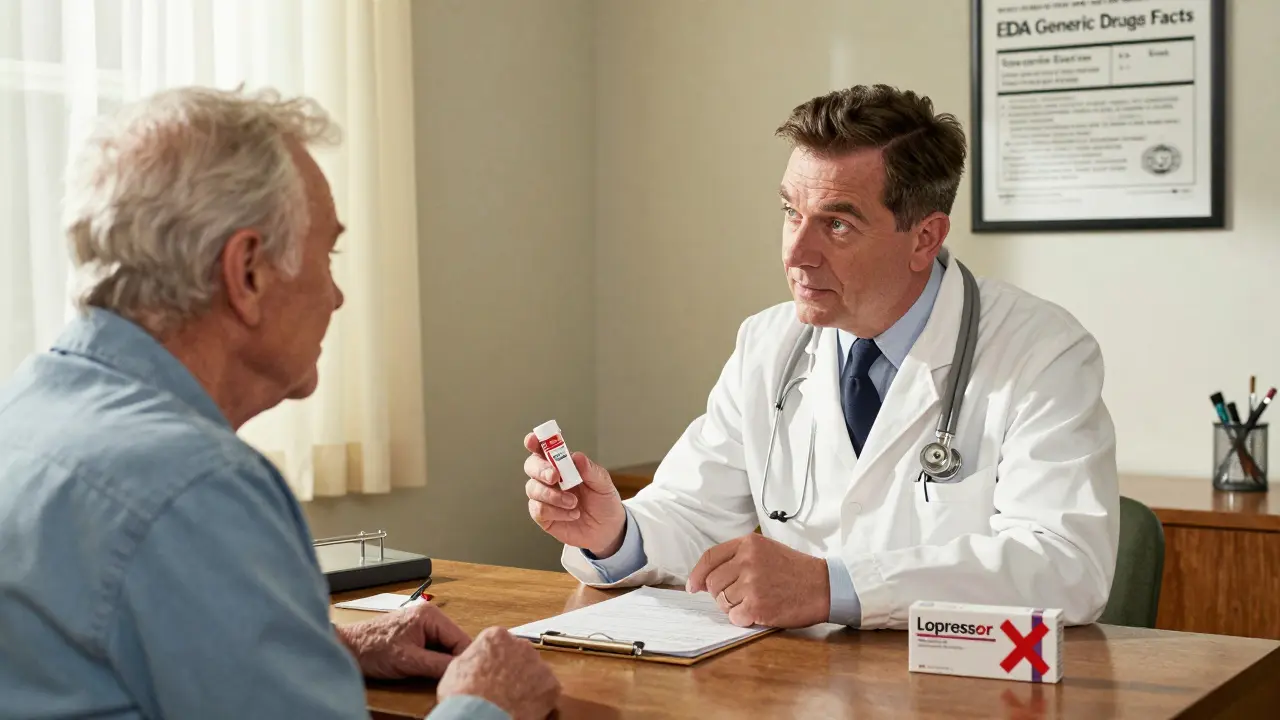
On the flip side, when providers use brand names in conversation - "Take your Lopressor" instead of "metoprolol" - they confuse residents, pharmacists, and patients. One third-year resident on Reddit shared how they nearly prescribed two doses of metoprolol because their attending said "Lopressor twice daily" without mentioning it was the same as the generic they’d ordered. That’s not a rare mistake. It’s systemic.
And the consequences add up. In psychiatry, where side effect fears are high, patients who believe generics are "weaker" are more likely to stop taking them. A 2022 study found 18% fewer reported side effects when providers explicitly endorsed generic equivalence. That’s not placebo. That’s the nocebo effect - harm caused by negative expectations. Education doesn’t just change prescribing. It changes outcomes.
What Clinicians Get Wrong About Generic Approval
Most clinicians know generics are approved by the FDA. Few know how rigorously.
The FDA’s Orange Book doesn’t just list generics - it rates them. An "A" rating means therapeutic equivalence. A "B" rating means it’s not equivalent. These aren’t opinions. They’re based on bioequivalence data submitted by manufacturers and reviewed by FDA scientists. Generic drugs must meet the same quality standards as brand-name drugs. The manufacturing facilities are inspected the same way. The same Good Manufacturing Practices apply.
But here’s where confusion creeps in: 45% of prescribers think generics must have the same inactive ingredients. They don’t. Inactive ingredients - fillers, dyes, preservatives - can differ. That’s okay. As long as they don’t affect absorption or safety. The FDA allows these differences precisely because they don’t change how the drug works. But many doctors still worry about dyes causing allergies or fillers affecting absorption. That’s a myth. If a generic caused a reaction due to an inactive ingredient, it would be flagged and pulled - just like a brand-name drug would be.
And then there’s the manufacturing myth. Some believe brand-name drugs are made in "better" factories. They’re not. The same plants often make both. The FDA doesn’t care if the pill says "Lipitor" or "atorvastatin." It cares that the active ingredient meets the same purity, dissolution, and stability standards. Period.

What Works: Real Education That Changes Behavior
Passive materials - PDF handouts, webinars, one-time lectures - don’t stick. A 2021 JAMA study compared two approaches: one group got a 20-page fact sheet. The other got four 90-minute interactive case sessions over six months. At six months, the case-based group retained 42% more knowledge. Why? Because they practiced. They talked through real patient scenarios: "Your patient with depression says they won’t take the generic because their cousin had a bad reaction." How do you respond? What data do you share?
Successful programs embed education into daily workflows. At UCSF, they added an EHR prompt: "This patient is on brand-name simvastatin. Would you consider switching to generic?" That simple nudge, paired with a one-click link to FDA equivalence data, led to a 37% drop in brand statin prescriptions. No grand seminar. No extra meeting. Just a smart system.
Some hospitals now use virtual reality. Trainees put on a headset and simulate a conversation with a skeptical patient. The AI patient pushes back: "I’ve heard generics don’t work as well." The trainee has to respond with evidence, tone, and empathy. Early results show a 41% boost in provider confidence. That’s not just knowledge. That’s skill.
Where Education Falls Short - And Why
Not all programs work. A Tennessee Medicaid initiative spent $1.2 million on physician education in 2020. Generic use only rose 8%. Why? The materials weren’t linked to the EHR. Doctors didn’t see them when prescribing. They were told to read a PDF during lunch. That’s not education. That’s paperwork.
Another failure point: complexity. Biosimilars aren’t generics. They’re different. They’re made from living cells, not chemicals. Only 31% of providers could correctly explain the difference in a 2023 FDA survey. That’s a problem. Oncologists, endocrinologists, and rheumatologists are prescribing more of these drugs - but without clear education, they’re either avoiding them or prescribing them incorrectly.
Time is the biggest barrier. Eighty-nine percent of physicians say they don’t have time to learn more. But here’s the truth: you don’t need hours. You need moments. Five minutes before a visit. One click in the EHR. A quick chat with a pharmacist. That’s enough - if it’s targeted.
Where Generics Shine - And Where Caution Still Matters
Generics are the gold standard for chronic conditions: hypertension, diabetes, depression, asthma, thyroid disease. For most patients, switching from brand to generic is seamless. Studies show no difference in hospitalizations, ER visits, or treatment failure.
But there are exceptions. Levothyroxine, used for hypothyroidism, has a narrow therapeutic window. Some studies suggest tiny variations in absorption might matter. The FDA disagrees - they say generics are equivalent. But some clinicians still prefer brand for this one drug. That’s not irrational. It’s cautious. The key isn’t to ban brand use - it’s to base the decision on evidence, not fear.
For drugs like seizure medications, where small changes in blood levels can trigger breakthrough seizures, some providers stick with brand. That’s fine - if it’s a shared decision with the patient, not a default. The goal isn’t to force generics everywhere. It’s to make sure the choice is informed.
Where to Start: Free, Proven Resources
You don’t need to build a curriculum from scratch. The FDA has free, ready-to-use tools:
- Generic Drug Facts Handout - A clear, one-page summary of how generics are approved.
- Orange Book - Searchable online database of therapeutic equivalence ratings.
- Generic Drugs and Health Equity Handout - Explains how generics reduce disparities in access.
These aren’t marketing brochures. They’re science-based, FDA-reviewed, and updated yearly. Yet only 22% of providers know they exist.
Other trusted sources: the Generic Pharmaceutical Association (GPhA) offers free CME modules. The Institute for Clinical and Economic Review (ICER) has detailed reports on cost-effectiveness. Use them. Bookmark them. Share them with residents and nurses.
The Future: AI, Incentives, and Better Systems
The next wave of education won’t be just about knowledge - it’ll be about behavior. UnitedHealthcare’s 2024 pilot uses AI to watch prescribing patterns. If a doctor rarely prescribes generics, the system automatically sends them a tailored 5-minute video - not a generic lecture, but one that addresses their specific patient population. Result? 28% more generic prescriptions.
In 2025, Medicare’s MIPS program will start measuring generic prescribing rates as a quality metric. That means your prescribing habits will affect your reimbursement. Not as punishment - as incentive. This isn’t about control. It’s about aligning financial incentives with patient outcomes.
And the savings? Over the next decade, better provider education could generate $156 billion in savings. That’s not a guess. It’s a Congressional Budget Office projection. That money doesn’t just go to insurers. It goes to patients who can afford their meds. To families who don’t have to choose between pills and groceries. To hospitals that don’t have to treat preventable readmissions.
Final Thought: It’s Not About Generics. It’s About Trust.
Doctors don’t resist generics because they’re stupid. They resist them because they’ve been left to guess. They’ve been handed a system that saves billions - but never taught how to explain it.
Education isn’t about making doctors feel guilty. It’s about giving them the tools to be better advocates. When you say, "This generic is identical to the brand, and here’s why," you’re not just saving money. You’re building trust. You’re reducing fear. You’re helping someone stick with their treatment.
That’s not just good prescribing. That’s good medicine.
Are generic drugs really as effective as brand-name drugs?
Yes. The FDA requires generics to have the same active ingredient, strength, dosage form, and route of administration as the brand-name drug. They must also prove bioequivalence - meaning they absorb into the bloodstream at the same rate and to the same extent. The 90% confidence interval for absorption must fall between 80% and 125%. This isn’t a guideline - it’s a legal requirement. Thousands of studies and decades of real-world use confirm that generics work just as well.
Why do some doctors still prefer brand-name drugs?
Many doctors were trained during a time when generics were less common, and brand-name marketing was dominant. Some hold outdated beliefs - like thinking generics are made in lower-quality facilities or have different inactive ingredients that affect safety. Others worry about patient reactions, especially with drugs like levothyroxine or seizure medications, where small changes in blood levels matter. But research shows these concerns are often based on misinformation, not evidence. Education that addresses these myths directly improves prescribing habits.
Can pharmacists substitute generics without the doctor’s approval?
It depends on the state. In 19 states, pharmacists can substitute a generic without telling the prescriber. In 16 states, the prescriber must write "dispense as written" to prevent substitution. In the rest, rules vary. But even in states where substitution is allowed, patients often don’t know they’re getting a generic - and if the doctor didn’t explain it, they may assume it’s a mistake. That’s why clear communication from the prescriber matters more than the law.
Do generics have different side effects than brand-name drugs?
The active ingredient - the part that causes the therapeutic effect - is identical. Side effects from that ingredient are the same. Inactive ingredients (like dyes or fillers) can differ, but they’re chosen to be safe and non-interfering. If a patient reports a new side effect after switching, it’s usually not because the drug changed - it’s because they’re now paying attention. A Harvard study found that when providers explicitly endorsed generic equivalence, patient-reported side effects dropped by 18%. That’s the nocebo effect in action.
How can I start educating myself on generics?
Start with the FDA’s free resources: the Generic Drug Facts Handout and the Orange Book online database. Both are updated regularly and written for clinicians. Then, try a 10-minute module from the Generic Pharmaceutical Association. If you’re in a hospital or clinic, ask if they have an EHR prompt or educational tool for generics. You don’t need a full course - just a few minutes a month to stay current. The goal isn’t to become an expert. It’s to be confident enough to explain it to your patients.
Bryan Coleman
February 1, 2026 AT 14:45Also, side note: typo in the post says 'Lopressor twice daily' but it should be 'Lopressor twice daily' - wait no, that's actually correct. My bad.
franklin hillary
February 3, 2026 AT 13:55Ishmael brown
February 3, 2026 AT 14:54Also my cousin took a generic thyroid med and his beard fell out. Coincidence? Maybe. But I still use brand.
Nancy Nino
February 4, 2026 AT 19:49June Richards
February 5, 2026 AT 22:13Lu Gao
February 6, 2026 AT 20:37Nidhi Rajpara
February 8, 2026 AT 15:19Chris & Kara Cutler
February 10, 2026 AT 10:14Jamie Allan Brown
February 11, 2026 AT 00:55